
 AU
AU
 UK
UK
 CA
CA
 NZ
NZ
 IND
IND

 US
US

 Share
Share
 X (Formerly Twitter)
 Whatsapp
 Facebook
 LinkedIn
 Telegram
 Email This Article
 Copy Link
 Summarize with AI
 Chat GPT
 Perplexity
Key Highlights
- WTI crude trades near $72.53 versus prior close of $67.28, a gain of over 7%.
• Largest single-session percentage advance since 2022.
• Brent-WTI spread widens as global risk premium expands.
• Oil volatility index spikes, reflecting elevated liquidity stress.
• Inflation expectations and rate path assumptions recalibrated.
Oil’s Return to Macro Centre Stage
Oil is often described as the lifeblood of the global economy—and recent market action reinforces why. From fuelling transportation networks and sustaining industrial production to shaping geopolitics and anchoring inflation expectations, crude oil remains deeply embedded in the architecture of global growth.
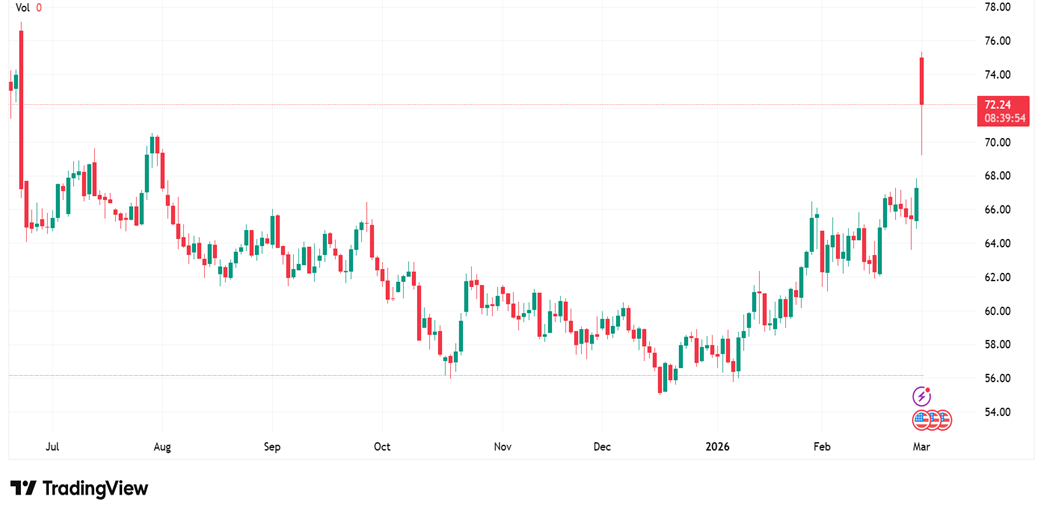
At the start of March 2026, that structural relevance was abruptly reaffirmed. West Texas Intermediate (WTI) crude oil surged to around $72.53, sharply higher from the prior close of $67.28. The move represents the most pronounced single-session percentage rise in roughly four years.
The catalyst was geopolitical escalation in the Middle East, including military strikes involving the United States, Israel and Iran. Markets reacted immediately, repricing supply-route vulnerability and embedding a higher geopolitical risk premium into futures curves.
This was not merely a technical breakout. It was a macro repricing event.
While supply-demand balances entering 2026 suggested relative equilibrium, heightened tensions around critical transit corridors reintroduced energy security as a dominant driver of price discovery. For investors and policymakers, the surge signals renewed fragility in the global energy system.
Source: tradingview.com
Market Mechanics: What Today’s Data Shows
The price move has been accompanied by broader market adjustments:
- The Brent-WTI spread has widened modestly, reflecting heightened international supply concerns.
• Front-month futures moved into steeper backwardation, indicating tighter near-term supply expectations.
• Implied volatility in oil options has climbed sharply, suggesting elevated hedging demand and thinner liquidity conditions.
• Energy equities outperformed broader indices intraday, while transport and airline stocks underperformed.
The structure of the move matters as much as the headline price. When volatility, futures spreads, and sector rotation move in tandem, it signals institutional repositioning rather than retail momentum.
Geopolitical Flashpoint: Strait of Hormuz and Supply Risk
The proximate driver remains developments around the Strait of Hormuz, through which roughly 20% of global seaborne crude transits.
Even without confirmed large-scale physical supply losses, shipping delays, insurance repricing, and precautionary rerouting have tightened perceived availability. Markets price probabilities, not just realised shortages.
The embedded “risk premium” reflects:
- Higher freight and insurance costs
• Potential inventory drawdowns
• Strategic reserve considerations
• Uncertainty over duration of tensions
Energy markets historically respond asymmetrically to geopolitical escalation. The upside reaction is swift; the normalization process is gradual.
Underlying Fundamentals: A Market That Was Balanced
What makes this episode analytically interesting is that it interrupts a period of relative balance.
Supply Conditions
The producer alliance OPEC+ had signalled incremental output increases earlier in the quarter. U.S. shale production remains resilient, with output holding near multi-year highs.
However, spare capacity—even when present—cannot instantly compensate for chokepoint disruption risk. Logistics, not just production, define effective supply.
Recent U.S. Energy Information Administration data showed inventories slightly below seasonal averages, which provided some underlying support before geopolitical developments accelerated the rally.
Demand Trends
Global demand growth entering 2026 had moderated compared with post-pandemic recovery peaks. Efficiency gains, electric vehicle adoption, and softer industrial growth in parts of Europe and Asia were expected to limit upside pressure.
Many institutional forecasts projected a balanced-to-slightly-oversupplied market for 2026. The current surge therefore reflects event risk overwhelming structural expectations.
Inflation Transmission
Energy prices feed directly into transport, freight, manufacturing inputs and consumer energy bills. A sustained move above the low-$70s could reintroduce upside risk to headline inflation metrics, particularly in the United States.
Breakeven inflation rates have already ticked higher in response to the oil rally, reflecting market-based adjustments to forward price expectations.
Monetary Policy Sensitivity
Central banks monitor energy price pass-through carefully. A persistent crude rally could complicate disinflation narratives and extend restrictive policy stances longer than markets previously assumed.
Energy-driven inflation shocks historically alter yield curve dynamics, particularly at the front end.
Capital Allocation and Risk Pricing
Commodity-linked funds, energy equities and real asset strategies tend to see inflows during oil volatility spikes. At the same time, higher input costs pressure margin-sensitive sectors.
WTI futures are heavily used for hedging and derivatives settlement. Movements in this benchmark influence risk modelling across institutional portfolios globally.
Liquidity, Volatility and Positioning
The magnitude of the move suggests a positioning adjustment rather than incremental buying.
- Short-covering in futures likely amplified the rally.
• Systematic strategies may have triggered momentum signals.
• Option markets show increased demand for upside protection.
When liquidity thins and volatility rises simultaneously, price swings expand beyond fundamental shifts.
Outlook: Two Diverging Paths
Containment Scenario
If tensions stabilise and shipping flows normalise, the geopolitical risk premium could gradually compress. Under this scenario, structural fundamentals—steady supply growth and moderate demand expansion—would likely reassert influence.
WTI could consolidate within a range consistent with underlying inventory levels and production capacity.
Escalation Scenario
If disruptions intensify or persist, price volatility could remain elevated. Sustained prices materially above current levels would increase inflation risk, pressure oil-importing economies, and potentially slow global growth momentum.
Institutional forecasts are currently split, reflecting this binary risk structure.
Conclusion: Energy Risk Is Structural, Not Episodic
WTI’s strongest surge in four years underscores a persistent market reality: oil remains central to macroeconomic stability.
Even amid energy transition narratives, crude continues to influence inflation trajectories, fiscal balances, trade flows, and capital allocation decisions. The current rally may moderate if geopolitical tensions ease. But the episode highlights how quickly energy risk can return to the forefront of financial markets.
For research-driven institutions, this environment demands integration of geopolitical intelligence, inventory trends, futures curve structure, and volatility metrics into forward-looking energy models.
Oil is no longer the only energy narrative. But it remains the most immediate macro signal.
Frequently Asked Questions (FAQs)
- Why has WTI crude oil risen the most in four years?
WTI crude has surged due to tightening global supply, OPEC+ production discipline, improving demand expectations, inventory drawdowns, and strong technical breakout momentum above key resistance levels.
- What does higher oil prices mean for the U.S. economy?
Rising oil prices can increase inflationary pressures, raise gasoline costs, impact consumer spending, and influence Federal Reserve monetary policy decisions.
- How does oil affect inflation?
Crude oil impacts inflation directly through fuel prices and indirectly through transportation and production costs, which can raise prices of goods and services across the economy.
- What is the key resistance level for WTI now?
After breaking above $70, the next major resistance levels are around $75–$78, with psychological resistance near $80 per barrel.
- Could oil prices continue rising in 2026?
If supply remains tight and global demand strengthens, WTI could maintain upward momentum. However, economic slowdowns or increased production could limit further gains.


 Jun 13, 2026




 Please wait processing your request...