
 AU
AU
 UK
UK
 CA
CA
 NZ
NZ
 IND
IND

 US
US

 Share
Share
 X (Formerly Twitter)
 Whatsapp
 Facebook
 LinkedIn
 Telegram
 Email This Article
 Copy Link
 Summarize with AI
 Chat GPT
 Perplexity
Palantir Technologies (NYSE: PLTR) reports earnings today, and for long-term investors this event is best viewed not as a quarterly scorecard but as a business-quality checkpoint. Over the past year, Palantir has steadily transitioned in market perception—from a niche government analytics vendor to an emerging global AI software platform with the potential to compound value over many years. The sustainability of this transition now depends on three interlinked variables: consistent commercial revenue growth, evidence of scalable AI monetisation, and disciplined capital allocation that supports expanding margins.
At elevated valuations, markets are no longer willing to pay for narratives alone. What matters is whether Palantir can demonstrate repeatable, cash-generative growth driven by deepening customer relationships and rising wallet share.
Commercial Engines Must Drive the Next Phase of Compounding
The most important driver of long-term value creation at Palantir is the strength of its commercial franchise, particularly in the U.S. market. High-quality software businesses compound when they embed themselves deeply into customer workflows, making switching difficult and expansion natural. Investors should therefore focus on customer additions, contract expansions, and the migration from pilot programs to enterprise-wide deployments.
Equally important is the trajectory of international commercial revenue. A geographically diversified revenue base reduces concentration risk and signals that the product solves universal enterprise problems rather than niche use cases. Sustained growth across geographies would strengthen the case that Palantir is building a global software franchise rather than a regionally concentrated business.
AIP Monetisation: From Product Excellence to Economic Excellence
Palantir’s Artificial Intelligence Platform (AIP) is central to its long-term moat. However, strong technology alone does not create shareholder wealth; monetisation does. The key question is whether AIP deployments consistently translate into higher annual recurring revenue, larger contract sizes, and longer customer lifetimes.
Investors should look for signs that AIP adoption is becoming repeatable and standardized, rather than bespoke or consulting led. When a software product scales well, incremental revenue should come with high gross margins and minimal incremental cost. Evidence of this dynamic would indicate that Palantir is moving closer to the economic profile of elite global software companies.
Margin Discipline Signals Management Quality
High-quality management teams balance growth with profitability. Palantir’s ability to grow commercial revenue while simultaneously expanding operating margins will be a strong indicator of management discipline.
Key metrics to monitor include operating margin, free cash flow generation, and stock-based compensation trends. A business that compounds shareholder wealth over long periods typically converts accounting profits into cash and reinvests that cash prudently. Continued margin expansion alongside growth would suggest Palantir is progressing toward this ideal.
Government Business: A Stable Cash-Generating Backbone
While commercial growth drives valuation, the government segment provides stability and predictability. Long-duration government contracts, particularly in defense and intelligence, generate dependable cash flows that can fund product development and expansion.
Investors should view this segment as the financial backbone of the company rather than the primary growth engine. Stability here is essential; deterioration would weaken the overall investment thesis.
Guidance as a Window into Long-Term Trajectory
Management’s forward commentary is arguably more important than the reported quarter. Upgraded guidance or strong confidence in pipeline growth would reinforce the view that Palantir is entering a multi-year compounding phase. Conservative commentary, even alongside decent quarterly numbers, could indicate slower-than-expected conversion of AI demand into revenue.
Technical Analysis (Daily Price Chart Analysis)
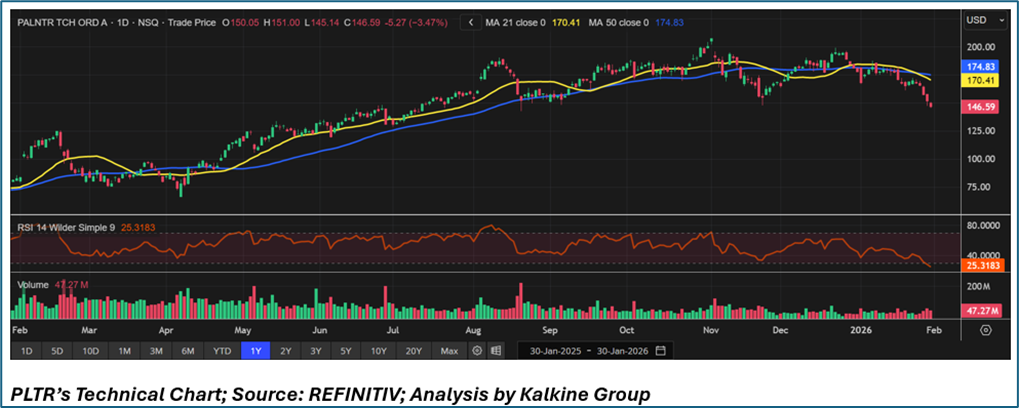
- Trend Breakdown Signals Corrective Regime: PLTR has shifted into a sharp corrective phase, with the latest close near USD 146.59, indicating a clear breakdown from its prior uptrend and increased near-term bearish pressure.
- Bearish Moving Average Structure Highlights Overhead Resistance: The stock is trading below the 21-DMA (USD ~170.41) and 50-DMA (USD ~174.83), confirming weak trend strength and establishing these averages as key overhead resistance levels.
- Oversold Momentum, but Reversal Still Unconfirmed: The RSI (~25.3) signals deep oversold conditions, suggesting potential for a technical rebound, but elevated volume (~47.27M) supports the strength of the sell-off and does not yet confirm a reversal.
Long-Term Perspective
Palantir’s investment case rests on its ability to build a high-quality, cash-generative AI software franchise with strong customer lock-in and disciplined execution. If commercial momentum, AIP monetisation, and margin expansion remain intact, the company has the potential to compound earnings and free cash flow over many years. Today’s earnings should therefore be assessed through the lens of long-term business quality rather than short-term volatility.


 Jun 13, 2026




 Please wait processing your request...