
 AU
AU
 UK
UK
 CA
CA
 NZ
NZ
 IND
IND

 US
US

 Share
Share
 X (Formerly Twitter)
 Whatsapp
 Facebook
 LinkedIn
 Telegram
 Email This Article
 Copy Link
 Summarize with AI
 Chat GPT
 Perplexity
Key Highlights
- Shares drop 8% post-earnings as weaker Q3 EPS guidance ($0.78–$0.80 vs ~$0.92 expected) overshadowed solid 15% revenue growth.
- FY2026 revenue outlook raised to ~$11.3B, reflecting resilient enterprise demand and continued platform consolidation momentum.
- Margin pressure from heavy AI and platform investments weighed on near-term profitability despite strong ARR expansion.
- Technical trend remains bearish, with the stock trading below key moving averages and momentum indicators signalling continued downside risk.
Palo Alto Networks shares declined approximately 8% in early trading after the cybersecurity group reported fiscal second-quarter results that combined solid revenue growth with a more cautious earnings outlook. The market reaction reflected a shift in investor focus from top-line expansion toward margin durability and profit trajectory. Although demand for network and cloud security remained firm, management’s guidance on near-term earnings introduced uncertainty around operating leverage.
The episode underscores a broader dynamic in the cybersecurity sector: strong sales momentum is increasingly expected, while profitability discipline is under closer scrutiny.
Palo Alto Networks Earnings Report: Revenue Growth Remains Robust in Fiscal Q2
For the fiscal second quarter, revenue increased approximately 15% year over year, supported by continued enterprise demand for integrated cybersecurity platforms. Growth was driven by network security, cloud security, and broader platform consolidation trends, as customers sought to streamline vendor relationships and centralize threat management.
Management noted that enterprises are increasingly consolidating security tools onto fewer platforms. This strategy has supported billings growth and strengthened backlog visibility. In an environment where IT budgets remain selective, consolidation can benefit larger vendors with broad product portfolios.
Looking ahead to fiscal third quarter, Palo Alto Networks guided revenue to around USD 2.94 billion well above market expectations near USD 2.6 billion. This revenue outlook suggests that customer engagement remains steady despite macroeconomic caution in enterprise technology spending.
For fiscal year 2026, the company raised its full-year revenue guidance to approximately USD 11.3 billion. This upward revision reinforces the resilience of demand for cybersecurity solutions amid rising digital transformation and persistent cyber threats.
Earnings Per Share Guidance and Margin Pressures Weigh on Stock Reaction
While revenue performance was solid, earnings guidance proved less reassuring. Palo Alto projected adjusted earnings per share for the fiscal third quarter in the range of USD 0.78 to USD 0.80, below analyst expectations near USD 0.92. The narrower and lower range raised questions about near-term margin stability.
Management attributed the softer earnings outlook to continued investments in platform expansion, product development, and go-to-market initiatives. These investments are aimed at strengthening competitive positioning in high-growth areas such as cloud-native security and AI-enabled threat detection. However, they also introduce incremental operating expenses.
For fiscal year 2026, adjusted earnings per share are projected between USD 3.65 and USD 3.70 broadly in line to slightly below consensus forecasts. Although not indicative of deterioration, the guidance suggests that revenue growth may not immediately translate into proportional margin expansion.
This combination of strong revenue and moderate earnings guidance highlights a structural trade-off: accelerating platform strategy versus short-term profitability metrics. Investors appear to be recalibrating expectations accordingly.
Cybersecurity Industry Trends: Platform Consolidation and AI-Driven Security
The cybersecurity industry continues to benefit from structural demand drivers. Increased cloud adoption, hybrid work environments, and escalating cyber threats have elevated security from a discretionary IT line item to a strategic priority.
Within this context, Palo Alto Networks has positioned itself as a platform-centric provider. Enterprises seeking operational efficiency often prefer integrated ecosystems that reduce complexity across firewalls, endpoint security, and cloud workloads. Platform consolidation can lead to larger contract sizes and longer customer retention cycles.
Artificial intelligence is also becoming central to threat detection and response. Security vendors are investing heavily in automation, analytics, and machine learning capabilities to manage growing data volumes and attack sophistication. Such investments, while supportive of long-term competitiveness, contribute to elevated near-term research and development expenditure.
The market’s reaction suggests that investors are distinguishing between structural demand strength and the timing of profitability realization.
Financial Position and Operating Strategy: Balancing Growth and Profitability
Palo Alto Networks’ raised revenue outlook for fiscal 2026 signals management confidence in sustained customer demand. The company continues to scale recurring revenue streams, particularly through subscription and software-based offerings. Recurring models generally enhance revenue visibility and predictability over time.
However, cost pressures remain relevant. Continued hiring, sales expansion, and product development investments may constrain operating margin improvement in the short term. In addition, competitive dynamics within cybersecurity where peers are also investing aggressively can influence pricing and sales efficiency.
The stock’s decline represents one of its more pronounced recent single-session moves. Such volatility often reflects recalibration rather than fundamental deterioration. Market participants appear to be assessing whether the current investment phase will ultimately translate into durable earnings expansion.
Risks Facing Palo Alto Networks and the Cybersecurity Sector
Despite resilient demand, several risks merit attention. Enterprise IT budgets remain sensitive to broader macroeconomic conditions. Although cybersecurity is generally considered essential, prolonged economic slowdown could influence deal timing or contract expansion.
Margin execution is another consideration. As companies scale cloud and AI capabilities, operating costs can rise ahead of revenue realization. Execution missteps in integration, product rollout, or sales efficiency could weigh on profitability metrics.
Competition within cybersecurity remains intense. Large diversified technology firms and specialized vendors continue to compete across network, cloud, and endpoint protection segments. Pricing discipline and technological differentiation will be central to sustaining growth.
Regulatory and geopolitical risks also affect the sector, as cybersecurity vendors operate globally and serve clients across critical infrastructure industries.
Palo Alto Networks Outlook: Revenue Strength Versus Profit Sensitivity
The recent share price decline illustrates a nuanced market response. Palo Alto Networks delivered robust revenue growth and lifted its annual sales outlook, signaling sustained demand for its cybersecurity platform. At the same time, earnings guidance suggested near-term margin moderation due to continued investment.
In a market environment where valuation sensitivity is heightened, strong revenue alone may not be sufficient to offset concerns around profit trajectory. The company’s strategy reflects a long-term emphasis on platform scale, recurring revenue, and technological depth. Whether these investments translate into improved operating leverage over time remains a central analytical question.
Technical Analysis (Daily Price Chart Analysis)
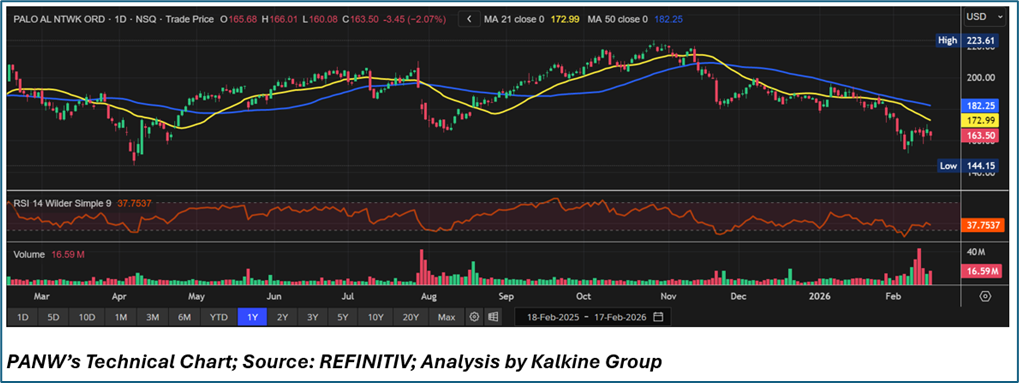
Trend Deterioration and Moving Average Configuration Signal Sustained Downtrend Bias: Palo Alto Networks (NASDAQ: PANW) continues to exhibit a structurally bearish technical profile on the daily timeframe. The stock is trading near USD 163.50, materially below both its 21-day moving average (USD 172.99) and 50-day moving average (USD 182.25). The downward slope and negative alignment of these moving averages reinforce a confirmed short- to intermediate-term downtrend, characterized by a sequence of lower highs and lower lows since late 2025. The inability of price to reclaim the 21-day moving average on recent rebounds suggests persistent distribution rather than constructive accumulation. Until PANW establishes sustained closes above these dynamic resistance levels, the prevailing technical structure remains corrective, with rallies likely to encounter supply pressure near declining moving averages.
Momentum Oscillators and Volume Profile Reflect Weak Internal Strength: The Relative Strength Index (RSI-14) is positioned near 37.8, below the neutral 50 threshold and approaching oversold territory. This reading reflects negative momentum conditions and confirms the dominance of sellers in recent sessions. Notably, RSI has failed to produce a sustained bullish divergence against price, implying that downside momentum has not yet structurally exhausted. Volume dynamics further validate the bearish bias, with elevated turnover accompanying recent declines—an indication of institutional distribution rather than light retail-driven selling. While oversold conditions may allow for tactical rebounds, the broader momentum structure remains fragile, with no confirmed reversal signals presently visible on the daily chart.
Critical Support and Resistance Zones Define Near-Term Inflection Risk: From a price structure perspective, immediate resistance is located near USD 172–173, corresponding to the 21-day moving average and recent consolidation breakdown level. A secondary and more consequential resistance zone resides near USD 182, aligned with the 50-day moving average and prior support-turned-resistance. On the downside, the recent low near USD 144.15 serves as primary structural support. A decisive breakdown below this level would likely confirm continuation of the broader corrective cycle, potentially extending the lower-high sequence. Overall, PANW’s technical framework reflects sustained distribution within a defined downtrend channel, with stabilization contingent upon reclaiming key moving averages and improving momentum breadth.
Final Perspective
Palo Alto Networks’ recent share price decline reflects a recalibration of investor expectations rather than a deterioration in core demand, as strong double-digit revenue growth and an upgraded full-year sales outlook were offset by more restrained earnings guidance and near-term margin pressure. The company continues to benefit from structural cybersecurity demand, platform consolidation trends, and recurring revenue expansion, yet the market response underscores heightened sensitivity to operating leverage and profit visibility.
In essence, Palo Alto Networks remains positioned within a structurally growing industry, but current valuation dynamics suggest that sustained earnings execution—alongside revenue momentum—will be central to restoring investor confidence.
FAQ Section:
Why did Palo Alto Networks stock decline despite strong revenue growth?
The stock decline reflected investor concern over lower near-term EPS guidance and margin moderation despite solid revenue and ARR growth.
What were the key growth drivers in Palo Alto Networks’ Q2 FY2026 results?
Growth was driven by 33% NGS ARR expansion to USD 6.33 billion, 40% SASE ARR growth past USD 1.5 billion, and continued momentum in XSIAM and Prisma AIRS.
How significant are the CyberArk and Chronosphere acquisitions to the company’s outlook?
The acquisitions add approximately USD 1.47 billion in Q3 NGS ARR contribution and expand the platform into identity security and observability.
How is AI adoption influencing Palo Alto Networks’ cybersecurity strategy?
AI adoption is increasing demand for platformized, real-time security across network, cloud, endpoint, browser, and identity layers, accelerating product integration and automation.
What does fiscal 2026 guidance indicate about growth and profitability trends?
Fiscal 2026 guidance projects USD 11.28–11.31 billion in revenue with 22%–23% growth and operating margins of 28.5%–29% amid continued investment and integration efforts.


 Jun 15, 2026




 Please wait processing your request...