
 AU
AU
 UK
UK
 CA
CA
 NZ
NZ
 IND
IND

 US
US

 Share
Share
 X (Formerly Twitter)
 Whatsapp
 Facebook
 LinkedIn
 Telegram
 Email This Article
 Copy Link
 Summarize with AI
 Chat GPT
 Perplexity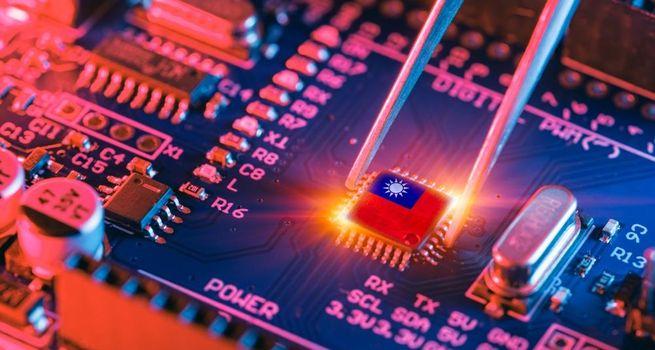
Taiwan Semiconductor Manufacturing Company : The Quiet Monopoly Powering the Loudest Theme on Wall Street
When the Numbers Start Doing the Talking
Every market cycle has its slogans. Few have numbers this loud. When a company expands foundry market share from dominance to near-total gravitational pull—while margins rise and capital intensity explodes—something structural is happening. Taiwan Semiconductor Manufacturing Company is not merely riding the AI wave; it is shaping the shoreline.
A 72% foundry market share is not a data point—it is a barrier. And when that barrier strengthens at the most advanced nodes, competitors are no longer chasing market share; they are chasing relevance.
Advanced Nodes: Where Competition Quietly Ends
The real story sits beneath the surface: nearly 80% of TSMC’s wafer revenue now comes from ≤7nm nodes. This is not diversification—it is deliberate concentration at the frontier of physics. At 2nm, yield is destiny. With rivals lagging by 20–30% in yields, customers face a binary choice: performance leadership with TSMC or strategic delay elsewhere.
This is why 2nm revenue is expected to surpass the combined revenues of 3nm and 5nm within months. Not because demand suddenly exploded—but because customers have already committed. Once silicon is designed in, it is not designed out.
AI Demand Is Different This Time
AI accelerators are not smartphones. They are infrastructure. Embedded into hyperscale data centres, sovereign compute projects, and enterprise workloads, they create long-duration demand with low elasticity. When management says AI revenue will compound at mid-to-high 50% rates through 2029, it reflects visibility, not optimism.
This is also why pricing discipline matters. By staying “strategic, not opportunistic,” TSMC preserves long-term trust while quietly expanding gross margin guidance. In monopolistic structures, restraint often signals strength.
Capital Allocation at the Edge of Risk
Spending $52–56 billion on capex is not bold—it is necessary. Advanced nodes are unforgiving, timelines stretch over years, and misallocation can permanently impair returns. Management’s repeated emphasis on nervousness is not weakness; it is stewardship.
Even after this spend, capacity remains tight until 2028–29. That admission alone explains why valuations remain grounded. This is not a speculative frenzy. It is a controlled expansion under constraint.
The Bottleneck Nobody Can Avoid
The most revealing phrase from management was simple: the bottleneck is wafer supply. When supply is capped and demand is structurally locked in, pricing power becomes durable. Those dynamic shifts value creation from customers to the ecosystem that enables production.
And this is where the second-order winners emerge.
Machinery & Equipment: The Hidden Supercycle
TSMC’s expansion is not an isolated event—it is a purchase order pipeline.
For Applied Materials, new fabs and yield optimisation drive sustained demand for deposition, CMP, and metrology tools. Each installed tool brings high-margin service revenue that compounds quietly.
For ASML, advanced-node expansion is existentially positive. EUV is not optional. Every additional layer deepens ASML’s moat and backlog visibility.
For Lam Research, higher fab intensity means recurring revenue from etch, deposition, and consumables as utilisation rises. Complexity breeds margin.
This is not a cyclical bounce. It is an ecosystem-wide capacity response to physics-driven scarcity.
Geopolitics, Energy, and Reality Checks
None of this eliminates risk. Taiwan’s power infrastructure, overseas fab margin dilution, customer concentration, and geopolitical uncertainty remain live variables. Markets are correct to price them in. But what has changed is that despite these risks, margins are rising and return on equity is near 40%.
That combination is rare—and historically durable.
Why the Market Isn’t Celebrating Yet
At ~$327, the stock reflects caution, not disbelief. Investors understand that dominance does not eliminate uncertainty. But markets often wait for clarity long after it has arrived in the numbers.
The inflection is not when demand appears—it is when supply fails to catch up. By management’s own admission, that moment is years away.
The Real Takeaway
This is not about inevitability. It is about structure. When an industry transitions from cyclical to strategic, capital flows differently, pricing behaves differently, and leadership compounds faster than models predict.
TSMC sits at the choke point of modern compute. Around it, the machinery ecosystem accelerates. Above it, AI demand hardens into infrastructure.
The loudest themes are often the most misunderstood. The quiet monopolies, meanwhile, keep doing the math.
And markets, eventually, always follow the math.


 Jun 13, 2026




 Please wait processing your request...