
 AU
AU
 UK
UK
 CA
CA
 NZ
NZ
 IND
IND

 US
US

 Share
Share
 X (Formerly Twitter)
 Whatsapp
 Facebook
 LinkedIn
 Telegram
 Email This Article
 Copy Link
 Summarize with AI
 Chat GPT
 Perplexity
- ETOR stock jumped after a Q4 earnings beat, showing resilient profitability despite weaker crypto trading.
- Diversified revenue helped offset crypto slowdown, with strong growth in equities, commodities, and interest income.
- FY2025 net income rose 12% YoY, while assets under administration increased 11% to USD 18.5 billion.
- AI-driven tools and platform innovation gained traction, enhancing user engagement and trading automation.
- Global expansion and share buybacks supported sentiment, with funded accounts rising and liquidity remaining strong.
eToro Stock Rises After Q4 Earnings Beat Despite Crypto Trading Slowdown
eToro Group Ltd. (NASDAQ: ETOR) shares gained following the company’s fourth-quarter and full-year 2025 earnings release, which highlighted resilient profitability, expanding global operations, and continued product innovation. The earnings report underscored the strength of eToro’s diversified multi-asset business model, even as cryptocurrency trading activity declined significantly during the period.
While cryptocurrency activity weakened, growth in equities, commodities, and interest-earning assets contributed to overall financial stability. This shift illustrates how diversified trading platforms can mitigate cyclical volatility in individual asset classes. eToro’s performance highlights broader structural changes in financial markets, where trading platforms increasingly rely on diversified revenue streams, technology innovation, and global expansion to sustain long-term growth.
eToro Earnings Analysis: Net Income Growth, Strong Contribution, and Balance Sheet Stability
For full-year 2025, eToro reported net contribution of USD 868 million, representing a 10% increase compared with the prior year. GAAP net income rose 12% year-over-year to USD 216 million, while adjusted EBITDA increased 4% to USD 317 million. These results reflect continued operational efficiency and stable user engagement across multiple asset classes.
In the fourth quarter specifically, GAAP net income increased 16% year-over-year to USD 69 million, and adjusted net income rose 6% to USD 70 million. Although adjusted EBITDA declined 19% year-over-year to USD 87 million, sequential improvement indicated stabilization following cryptocurrency market volatility. Assets under administration grew 11% year-over-year to USD 18.5 billion, supported by increased deposits and account growth.
The company’s balance sheet remained strong, with USD 1.3 billion in cash, cash equivalents, and short-term investments. This liquidity position provides financial flexibility for continued investment in product development, technology infrastructure, and global expansion initiatives.
Crypto Trading Decline Highlights Importance of eToro’s Diversified Multi-Asset Revenue Model
Cryptocurrency trading activity declined significantly during the quarter, reflecting broader market conditions. Net trading contribution from crypto fell 72% year-over-year to USD 26 million, driven by reduced trading volumes and lower invested amounts per transaction. January 2026 metrics also showed crypto trade volumes declining 50% year-over-year.
However, strong performance in other asset classes helped offset crypto weakness. Net trading contribution from equities, commodities, and currencies increased 43% year-over-year to USD 116 million, supported by increased engagement in traditional financial markets. Commodity trading activity, particularly in gold and other volatile assets, contributed to elevated trading volumes.
Interest-earning assets also increased, supporting net interest income growth of 18% year-over-year. This diversification demonstrates the platform’s ability to sustain revenue stability despite fluctuations in cryptocurrency markets, reflecting the benefits of operating across multiple asset categories.
AI-Driven Investing Tools and Platform Innovation Strengthen eToro’s Competitive Position
Artificial intelligence has become a central component of eToro’s technology strategy, influencing product development and user engagement. The company introduced AI-powered tools such as its “Tori” AI analyst, designed to provide users with personalized insights, portfolio analysis, and strategy development support.
eToro is also expanding its technology ecosystem through public APIs and the development of an app marketplace. This infrastructure allows users and third-party developers to create automated trading tools, analytical applications, and investment strategies integrated into the platform. Such initiatives reflect broader fintech industry trends toward automation, algorithmic trading, and AI-assisted investment decision-making.
Global Expansion Strategy and Multi-Region Market Access Support Long-Term Platform Growth
eToro’s global expansion strategy remains a key driver of user growth and platform scale. The company expanded access to equities listed on 25 global exchanges, including markets in Asia, the Middle East, and Europe. This expansion increases the platform’s appeal to international investors seeking diversified exposure across regions.
Funded accounts increased 9% year-over-year to 3.81 million, reflecting continued user acquisition and engagement. January 2026 metrics showed funded accounts rising further to 3.85 million. Growth in assets under administration and funded accounts indicates sustained platform adoption across geographic regions.
The company also strengthened its wealth management and neo-banking offerings, expanding retirement and savings products in markets such as the United Kingdom, France, and Australia.
Capital Allocation, Share Repurchase Program, and Financial Flexibility
eToro expanded its share repurchase authorization by USD 100 million, bringing total remaining authorization to USD 150 million. This capital allocation initiative reflects management’s emphasis on balancing investment in growth initiatives with shareholder returns.
Strong free cash flow generation and liquidity provide flexibility for continued technology investment, platform expansion, and potential strategic initiatives. Financial stability remains an important factor as fintech platforms compete for market share in a rapidly evolving digital investment environment.
Structural Trends in Retail Investing and Fintech Industry Support Platform Adoption
The fintech industry is experiencing structural shifts driven by digital adoption, demographic trends, and evolving investor preferences.
eToro’s platform integrates equities, cryptocurrencies, commodities, and savings products within a single digital interface. This multi-asset structure aligns with broader industry trends toward consolidated financial platforms capable of serving diverse investor needs.
The company’s expansion into always-on trading models, including extended trading hours and plans for broader 24-hour market access, reflects evolving market expectations shaped by cryptocurrency trading infrastructure.
Risks and Industry Uncertainties Facing eToro’s Growth Strategy
Despite strong financial performance, eToro operates within a highly competitive and cyclical industry. Cryptocurrency trading activity remains volatile and sensitive to market conditions, regulatory developments, and investor sentiment.
Increased competition from established brokers, fintech startups, and digital asset platforms may also affect market share and user growth. Additionally, regulatory changes across global jurisdictions could influence platform operations, product availability, and expansion strategies.
Dependence on trading activity as a primary revenue source introduces cyclicality, as revenue levels may fluctuate with market volatility and investor participation rates.
Technical Analysis (Daily Price Chart Analysis)
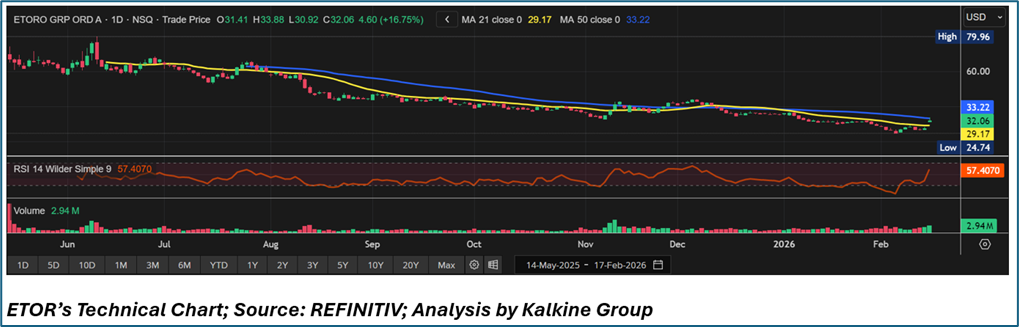
Trend Structure and Moving Average Alignment Indicate Early Reversal Attempt Within Broader Downtrend: eToro Group Ltd. (NASDAQ: ETOR) continues to trade within a broader medium-term corrective trend, characterized by a sequence of lower highs and lower lows since mid-2025. However, recent price action reflects an emerging stabilization phase, with the stock closing at USD 32.06 after a sharp single-session gain of approximately 16.75%. Notably, price has reclaimed its 21-day moving average (USD 29.17), signaling a shift in short-term momentum dynamics. Nevertheless, the stock remains below its 50-day moving average (USD 33.22), which continues to slope downward and serves as a critical dynamic resistance level. This configuration suggests the current move represents an early-stage recovery attempt rather than a confirmed trend reversal, with the broader trend remaining structurally neutral-to-bearish until sustained consolidation above the intermediate moving average is achieved.
Momentum Indicators Reflect Strengthening Buying Pressure With Scope for Continuation: The Relative Strength Index (RSI-14) has rebounded to approximately 57.4, rising decisively above the neutral 50 threshold and indicating strengthening positive momentum. This upward momentum shift reflects renewed accumulation activity following a prolonged period of weak sentiment and subdued price performance. Importantly, the RSI remains below overbought territory (70), suggesting the recent price advance has not yet reached levels typically associated with short-term exhaustion. This combination of improving momentum and volume expansion strengthens the technical credibility of the current recovery phase.
Key Resistance and Support Levels Define Critical Inflection Zone for Intermediate Trend Direction: From a structural standpoint, immediate resistance is positioned near USD 33.20, corresponding to the 50-day moving average and recent consolidation highs. A sustained breakout above this level would represent a meaningful technical inflection point, potentially signaling the transition from corrective consolidation toward a broader recovery phase. On the downside, initial support is now established near USD 29.00–29.50, aligned with the 21-day moving average and prior breakout zone, while stronger structural support remains near USD 24.70, representing the recent cyclical low. Overall, the technical structure reflects an early momentum recovery within a longer-term consolidation range, with confirmation of a durable trend shift dependent on sustained price strength above key intermediate resistance levels and continued improvement in momentum and volume profiles.
Final Perspective
eToro Group Ltd. (NASDAQ: ETOR) demonstrates improving operational resilience and strategic positioning following its fourth-quarter and full-year 2025 results, supported by net income growth, expanding assets under administration, and continued global user adoption despite cyclical weakness in cryptocurrency trading activity. The company’s diversified multi-asset platform encompassing equities, commodities, crypto, and interest-earning assets has helped stabilize revenue streams and mitigate volatility associated with individual asset classes. Concurrently, ongoing integration of artificial intelligence tools, expansion across global financial markets, and investment in platform infrastructure reinforce its technological and geographic scalability.
From a technical standpoint, recent price stabilization above short-term moving averages and improving momentum indicators suggest early recovery conditions, although confirmation of a sustained trend shift remains contingent on overcoming intermediate resistance levels.
FAQ Section:
What drove eToro’s Q4 earnings performance?
eToro’s Q4 performance reflected growth in funded accounts, higher interest income, and strong trading activity in equities and commodities. Diversified revenue streams helped offset weaker crypto trading activity during the quarter.
How much assets under administration does eToro manage?
eToro reported assets under administration of approximately USD 18.5 billion as of Q4 2025, representing an increase of 11% compared with the prior year period.
How is AI influencing eToro’s platform strategy?
eToro has integrated AI tools such as its AI Analyst and developer APIs to enhance trading insights, automate strategy development, and improve platform functionality. These initiatives are part of its broader effort to expand digital investing capabilities.
How many funded accounts does eToro have?
Funded accounts increased to approximately 3.81 million in Q4 2025, reflecting continued user growth and expansion across global markets.
Why did eToro stock rise despite weaker crypto trading activity?
The company’s diversified multi-asset model, including equities, commodities, and interest income, supported financial performance and reduced reliance on crypto-related revenue.

_06_19_2026_04_14_48_775022.jpg)
 Jun 18, 2026
_06_19_2026_04_15_58_896873.jpg)
_06_19_2026_04_16_38_970455.jpg)
_06_19_2026_04_17_25_556135.jpg)
_06_19_2026_04_18_05_865257.jpg)
_06_19_2026_04_19_00_614719.jpg)
 Please wait processing your request...