
 AU
AU
 UK
UK
 CA
CA
 NZ
NZ
 IND
IND

 US
US

 Share
Share
 X (Formerly Twitter)
 Whatsapp
 Facebook
 LinkedIn
 Telegram
 Email This Article
 Copy Link
 Summarize with AI
 Chat GPT
 Perplexity
Key Highlights
- Robinhood posted record 2025 revenue of USD 4.5 billion and net income of USD 1.9 billion, highlighting strong operational momentum.
- Crypto transaction revenue declined 38 percent year over year, keeping bitcoin price volatility a key overhang.
- Growth in equities, options, subscriptions, and interest income reduced reliance on crypto trading.
- HOOD remains in a downtrend, trading below key moving averages with weak momentum.
Robinhood Stock Faces Mixed Signals in 2026
Robinhood Markets Inc. (NASDAQ: HOOD) enters 2026 in a mixed position. The company has delivered record revenues, profits, and customer growth, reinforcing its transition into a broader financial services platform. At the same time, continued weakness in cryptocurrency markets, particularly lower bitcoin prices, has renewed scrutiny on the firm’s exposure to digital asset activity.
The contrast between strong headline financial performance and crypto-related softness highlights a key structural dynamic shaping Robinhood stock.
Record Revenue Growth Highlights Operational Momentum
Robinhood reported total net revenues of USD 4.5 billion in 2025, representing a 52 percent year over year increase and marking its second consecutive year of growth above 50 percent. Net income rose to USD 1.9 billion, while diluted earnings per share reached a record USD 2.05.
These results reflect improved monetization, operating leverage, and cost discipline across the platform. Adjusted EBITDA increased 76 percent year over year to USD 2.5 billion, underscoring profitability gains despite uneven market conditions.
However, the composition of revenue remains an important consideration, particularly in relation to cryptocurrency activity.
Bitcoin Price Weakness and the Crypto Winter Remain Key Variables
Cryptocurrency markets continue to influence Robinhood financial performance. In the fourth quarter of 2025, cryptocurrency transaction revenue declined 38 percent year over year to USD 221 million. Retail crypto trading volumes within the Robinhood app fell amid the ongoing crypto winter.
This decline occurred even as institutional crypto activity expanded following the Bitstamp acquisition. As a result, crypto remains a meaningful engagement driver but also a source of earnings volatility tied to bitcoin price movements.
Despite this weakness, overall transaction-based revenues still increased 15 percent year over year to USD 776 million.
Diversification Reduces Dependence on Crypto Trading
Robinhood diversification strategy continues to gain traction. Equities trading revenue increased 54 percent year over year, while options revenue rose 41 percent, reflecting strong participation in traditional capital markets products.
Subscription income has emerged as a more stable revenue stream. Robinhood Gold subscribers grew 58 percent year over year to 4.2 million, generating USD 50 million in subscription revenue during the fourth quarter.
Net interest revenue increased 39 percent year over year to USD 411 million, supported by growth in interest-earning assets and securities lending. These trends have helped offset crypto-related volatility and improve revenue stability.
Platform Assets and Customer Growth Strengthen the Balance Sheet
Total platform assets increased 68 percent year over year to USD 324 billion, driven by record net deposits of USD 68 billion and higher equity market valuations.
Robinhood added 1.8 million funded customers during the year, bringing the total to 27 million. Investment accounts reached 28.4 million, while average revenue per user increased 16 percent to USD 191.
More than 40 percent of customer assets are now held in ETFs, retirement accounts, advisory products, and cash management solutions, aligning the platform with long-term investing behavior.
Technology, AI Adoption, and Global Expansion
Robinhood continues to invest in technology to improve efficiency and scalability. More than 75 percent of customer support cases are now resolved using AI-driven systems, reducing operating costs.
International expansion remains a growth lever, with approximately 750,000 customers outside the United States. Expansion across Europe and Asia, along with the Bitstamp acquisition, supports both retail and institutional growth initiatives.
Technical Analysis (Daily Price Chart Analysis)
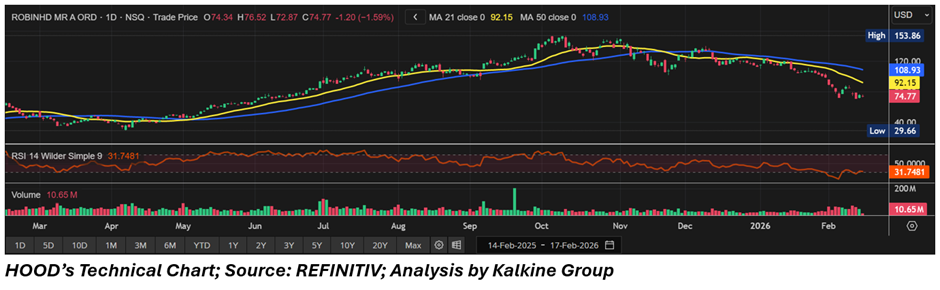
Prevailing Downtrend Confirmed by Moving Average Alignment and Structural Breakdown
Robinhood Markets Inc. (HOOD) is currently exhibiting a well-defined medium-term downtrend, characterized by a consistent sequence of lower highs and lower lows since peaking near USD 153.86 in late 2025. The stock is trading materially below its 21-day moving average (USD 92.15) and 50-day moving average (USD 108.93), with both moving averages trending downward, confirming persistent bearish momentum and trend deterioration. This negative moving average alignment reflects sustained institutional distribution and indicates that prior support zones have transitioned into overhead resistance, reinforcing the structural weakness in the prevailing price trend.
Momentum Indicators Reflect Weak Participation and Limited Near-Term Reversal Signals
The Relative Strength Index (RSI) is currently positioned at approximately 31.7, indicating weak momentum and proximity to oversold territory, though not yet at extreme capitulation levels. This suggests that while selling pressure remains dominant, the pace of decline may be stabilizing marginally. However, RSI’s prolonged positioning below the neutral 50 threshold confirms the absence of sustained bullish momentum and reflects subdued accumulation activity. Additionally, volume trends do not yet indicate decisive accumulation, implying that institutional investors have not meaningfully re-entered the stock at current levels.
Critical Support and Resistance Levels Define Near-Term Technical Risk-Reward Profile
From a structural standpoint, immediate support is located in the USD 70–75 range, which represents the current consolidation zone and a critical near-term demand area. A sustained breakdown below this level would likely expose downside risk toward the longer-term support near USD 50–60, corresponding to prior consolidation levels. On the upside, strong resistance is established near USD 92 and USD 109, aligned with the 21-day and 50-day moving averages, respectively. A decisive breakout above these levels would be required to signal trend stabilization and potential reversal. Until such confirmation occurs, the overall technical outlook remains cautiously bearish, with risk skewed toward continued consolidation or further downside pressure.
Final Perspective on Robinhood Stock Outlook 2026
Robinhood Markets Inc. demonstrated strong fundamental momentum in 2025, supported by record revenues, expanding customer assets, and rapid growth in subscriptions, interest income, and diversified financial services.
At the same time, persistent crypto market weakness and bitcoin price volatility continue to influence near-term sentiment around HOOD stock. While technical indicators suggest ongoing pressure, the company’s expanding product ecosystem and recurring revenue streams provide a foundation for longer-term financial stability as market conditions evolve.

_06_19_2026_04_14_48_775022.jpg)
 Jun 18, 2026
_06_19_2026_04_15_58_896873.jpg)
_06_19_2026_04_16_38_970455.jpg)
_06_19_2026_04_17_25_556135.jpg)
_06_19_2026_04_18_05_865257.jpg)
_06_19_2026_04_19_00_614719.jpg)
 Please wait processing your request...