
 AU
AU
 UK
UK
 CA
CA
 NZ
NZ
 IND
IND

 US
US

 Share
Share
 X (Formerly Twitter)
 Whatsapp
 Facebook
 LinkedIn
 Telegram
 Email This Article
 Copy Link
 Summarize with AI
 Chat GPT
 Perplexity
Highlights
- Xponential Fitness plunges 47.08% to $4.26 on 1.02 million shares, signalling institutional-led valuation reset.
- Franchise-driven revenue faces pressure as expansion slows while debt servicing, SG&A and marketing costs compress operating leverage.
- Breakdown below $6, RSI below 25; key supports $4.00 and $3.50 define near-term trend risk.
Xponential Fitness (NYSE:XPOF) plunged 47.08% to $4.26 on February 27, 206, wiping out nearly half its market capitalization in one session, with volume crossing 1.02 million shares and indicating aggressive institutional selling rather than retail-driven volatility.
Moves of this magnitude are rarely technical alone and typically reflect a combination of earnings miss or forward guidance revision, debt or liquidity concerns, governance or franchise health issues, structural slowdown in the growth narrative, and repricing of leverage risk. This was not a routine correction — it was a valuation reset event.
Understanding the Xponential Business Model
Xponential operates an asset-light franchise fitness platform controlling multiple boutique brands including Club Pilates, Pure Barre, CycleBar, StretchLab and Rumble. Revenue is generated through franchise royalties that provide recurring income, franchise development fees, equipment sales and merchandise.
While the franchise structure reduces capital intensity, it increases dependency on franchisee economics. If studio-level profitability weakens, royalty growth slows and leverage becomes a concern.
Financial Deep Dive: Where Is the Pressure Coming From?
Revenue Structure
XPOF generates revenue primarily from high-margin royalty fees, franchise expansion fees and lower-margin equipment sales, with pressure emerging when franchise expansion slows or same-store sales soften.
EBITDA & Margin Dynamics
The company has historically promoted strong adjusted EBITDA growth, but high SG&A expenses, debt servicing obligations, marketing costs and acquisition-driven growth can pressure net profitability. If revenue growth moderates while fixed costs remain elevated, operating leverage works in reverse.
Balance Sheet & Leverage Risk
One of the primary investor concerns appears to be leverage, with the company carrying material long-term debt, interest expense exposure and refinancing risk if rates remain elevated. In high-rate environments, leveraged consumer-facing companies are often repriced aggressively, and if franchise expansion slows while debt remains fixed, equity holders absorb disproportionate downside.
Cash Flow Considerations
Free cash flow stability depends on royalty collection strength, franchisee health and equipment inventory management, and any sign of franchisee stress can impact working capital cycles.
Technical Breakdown: What Does the Chart Say?
Multi-Timeframe Analysis
Short-Term (Daily Chart)
• Breakdown below key $6 support
• Oversold RSI (<25)
• Heavy distribution volume
Medium-Term (Weekly Chart)
• Multi-month downtrend continuation
• Lower highs and lower lows pattern
• No visible base formation
Key Technical Levels
- Immediate Support: $4.00
• Major Support: $3.50
• Resistance: $5.20–$5.50
• Breakdown Trigger Below: $3.50
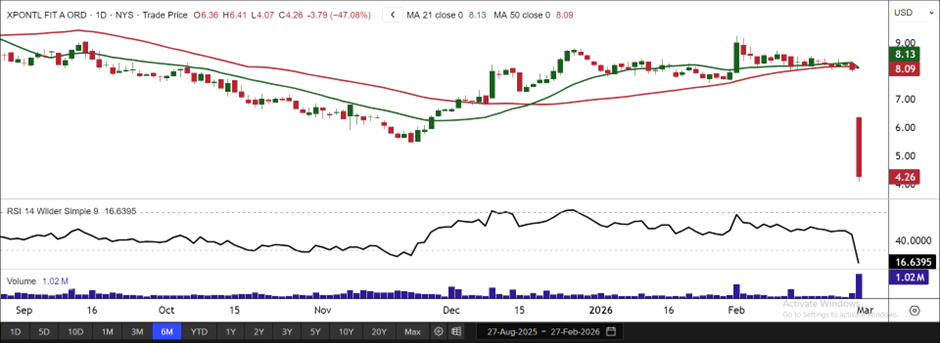
Data source: EODHD/Others as of February 27, 2026
The technical structure is damaged. Oversold conditions may produce a bounce, but trend reversal requires base formation.
Market Sentiment: Capitulation or Structural Repricing?
The scale of decline suggests institutional derisking rather than retail panic. When leveraged growth companies miss expectations, the market quickly transitions from “growth premium” to “survival discount,” and XPOF is currently trading as a balance sheet risk story rather than a growth narrative.
Scenario Analysis: What Happens Next?
Bullish Recovery Scenario
Stabilization above $4, debt refinancing clarity, franchise same-store sales resilience and a short-covering bounce could drive a potential rebound toward $6–$7.
Bearish Continuation Scenario
Further guidance downgrade, franchise contraction and debt covenant stress could push the stock toward a possible downside zone of $3.00.
Analyst Perspective: Is the Boutique Fitness Model Broken?
The boutique fitness model itself is not structurally obsolete, but it remains highly sensitive to discretionary income, dependent on franchise economics and vulnerable to over-expansion cycles. In high-rate environments, franchise growth slows as financing costs increase and the market demands profitability clarity rather than expansion promises.
XPOF must demonstrate stable royalty growth, improved cash flow conversion and a leverage reduction roadmap; until then, valuation recovery may remain constrained.
Key Risks Going Forward
Refinancing pressure, consumer demand softness, franchisee financial distress, a competitive fitness market and further earnings revision remain the primary risks.
Frequently Asked Questions (FAQ)
Why did XPOF stock fall 47%?
The drop likely reflects earnings disappointment, leverage concerns, or guidance revision triggering institutional selling.
Is Xponential Fitness going bankrupt?
There is no indication of insolvency, but leverage risk is now central to valuation.
Is the stock oversold?
Technically yes, but oversold does not guarantee reversal without fundamental stabilization.
What level must hold?
$4.00 is immediate support. Below $3.50 would signal further structural weakness.
Is this a buying opportunity?
Only for high-risk investors comfortable with volatility and leverage exposure.
Final Takeaway
Xponential Fitness is undergoing a rapid valuation reset, with the 47% collapse reflecting concerns around leverage, franchise health and growth sustainability. The next few quarters will determine whether this was capitulation — or the beginning of a longer structural downtrend.


 Jun 13, 2026




 Please wait processing your request...