
 AU
AU
 UK
UK
 CA
CA
 NZ
NZ
 IND
IND

 US
US

 Share
Share
 X (Formerly Twitter)
 Whatsapp
 Facebook
 LinkedIn
 Telegram
 Email This Article
 Copy Link
 Summarize with AI
 Chat GPT
 Perplexity
Key Highlights
- Following a Type A meeting, the FDA confirmed a single-arm study with an appropriate historical control can support BLA resubmission for tabelecleucel in EBV-positive post-transplant lymphoproliferative disease.
- Partner Pierre Fabre will submit updated Phase 3 ALLELE data incorporating additional patients and extended follow-up as the foundation of the resubmission package.
- The FDA's design agreement resolves the central regulatory uncertainty created by the earlier Complete Response Letter without requiring a new randomized controlled trial.
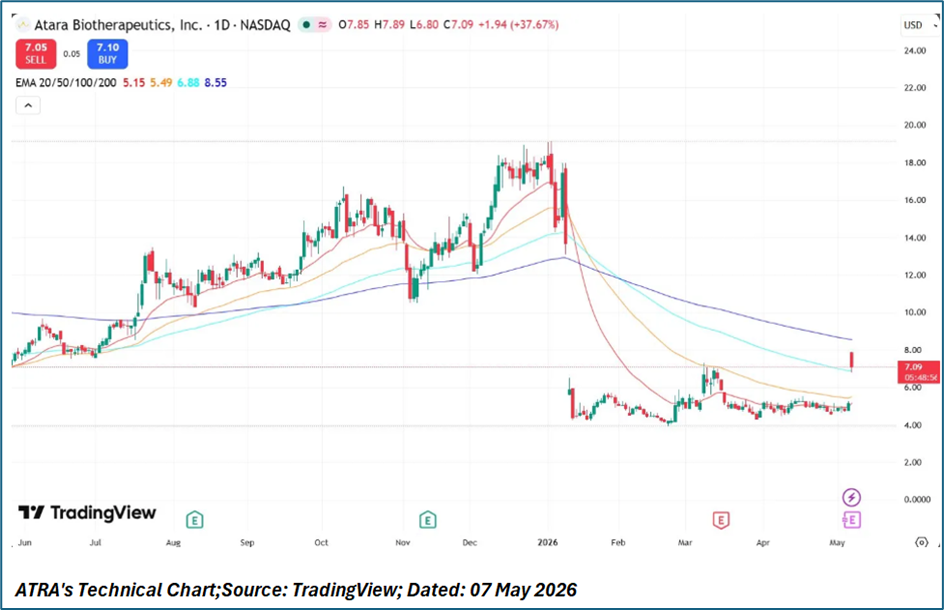
- ATRA shares surged 37.67% to $7.09, decisively reclaiming the 20-day, 50-day, and 100-day EMAs in a single session.
- The 200-day EMA at $8.55 is the next key resistance level, representing the threshold between a partial recovery and full trend rehabilitation.
Introduction: A Rare Disease Catalyst That Changes the Regulatory Narrative
Post-transplant lymphoproliferative disease driven by the Epstein-Barr virus is a rare and frequently fatal complication in immunocompromised transplant recipients. Standard Options including rituximab and chemotherapy carry limited efficacy in relapsed or refractory cases, and the clinical community has long recognized the need for a targeted cellular approach. Atara Biotherapeutics has developed tabelecleucel, an allogeneic EBV-specific T-cell therapy designed for precisely this population. Following an FDA Complete Response Letter that stalled the program, the Type A meeting outcome now provides a defined and achievable resubmission strategy, resetting investor expectations in a single session.
Industry and Macro Context: Regulatory Trends Favoring Rare Disease Cellular Therapies
The FDA has consistently demonstrated a pragmatic posture toward rare disease oncology programs, accepting single-arm trial designs supported by historical controls where randomization is ethically or logistically impractical. Allogeneic cell therapies, which use donor-derived rather than patient-derived cells, are particularly well suited to this regulatory framework given small patient populations and the urgency of clinical need. Pierre Fabre's established European commercial presence adds a credible ex-US commercialization dimension, strengthening the Partnership's overall value proposition for a program with global patient relevance.
Core Analysis: What the Type A Meeting Outcome Means for the Program
A Type A FDA meeting is the agency's highest-priority interaction category, convened to resolve stalled programs or urgent post-CRL disputes. The FDA's agreement on a single-arm design with historical control is the most operationally significant development since the CRL, removing the possibility of a lengthy new randomized trial requirement. The resubmission strategy rests on expanding the ALLELE dataset with more patients and extended follow-up, which will strengthen both the response rate profile and the durability evidence the FDA needs to complete its benefit-risk assessment. Execution risk now lies in the speed and quality of the data compilation process rather than in the fundamental regulatory pathway itself.
Financial and Market Implications: Repricing Risk and Capital Considerations
Prior to today's session, ATRA had been rangebound near $4 to $6, pricing in a meaningful probability of program termination or indefinite delay following the CRL. The move to $7.09 reflects a material reassessment of approval probability. The stock nevertheless remains well below its December 2025 to January 2026 peak of approximately $18 to $19, indicating significant residual upside is contingent on successful resubmission and approval. Cash runway management through the review period and any potential dilutive financing will be the principal financial risks investors must monitor over the coming quarters.
Technical Analysis: Price Action and Market Structure for ATRA Stock
The Daily Chart from June 2025 captures a full Market Cycle: a sustained institutional accumulation and rally from the $8 to $9 base to a peak near $18 to $19 in late December 2025 and early January 2026, followed by a sharp CRL-driven collapse to the $4 to $5 range, a multi-month base-building phase through February to April 2026, and now a decisive breakout on the regulatory catalyst. The May 7 session opened at $7.85, hit an intraday high of $7.89, briefly touched a low of $6.80, and closed at $7.09, reclaiming the 20-day, 50-day, and 100-day EMAs simultaneously.
|
Level |
Signal |
|
|
EMA 20 |
$5.15 |
Well below price |
|
EMA 50 |
$5.49 |
Well below price |
|
EMA 100 |
$6.88 |
Reclaimed on close |
|
EMA 200 |
$8.55 |
Next resistance ceiling |
The $4 to $6 base formed over February to April 2026 is now confirmed structural support. The 200-day EMA at $8.55 is the pivotal level separating a partial recovery from a full trend rehabilitation. Volume on the session almost certainly ran substantially above both the 10-day and 30-day averages, lending credibility to the move as institutional rather than purely speculative in nature. RSI will have shifted sharply higher from deeply oversold territory, though follow-through buying over the coming sessions will determine whether the breakout sustains or fades into resistance.
Strategic Outlook: Resubmission Timeline and Forward Catalysts
The critical near-term milestones are the actual BLA resubmission date and any update on the matured ALLELE dataset. A standard Class 2 resubmission review typically carries a six-month FDA review clock from acceptance, placing a potential decision within a twelve to eighteen month window from submission. European regulatory progress from Pierre Fabre and any commentary on commercial readiness would provide additional valuation support ahead of a US approval decision.
Conclusion
Atara Biotherapeutics has secured a rare and meaningful outcome following a CRL: an FDA-agreed, clearly defined resubmission pathway that avoids the need for an entirely new randomized trial. The Type A meeting result is a genuine regulatory achievement for a program addressing a high-unmet-need rare disease. At $7.09, the stock has reclaimed three of four major EMAs with volume confirming institutional participation, and the 200-day EMA at $8.55 is the next meaningful test. Whether this recovery becomes durable depends on the quality of the expanded ALLELE dataset and Atara's ability to sustain its operations through the FDA review period.


 Jun 05, 2026




 Please wait processing your request...