
 AU
AU
 UK
UK
 CA
CA
 NZ
NZ
 IND
IND

 US
US

 Share
Share
 X (Formerly Twitter)
 Whatsapp
 Facebook
 LinkedIn
 Telegram
 Email This Article
 Copy Link
 Summarize with AI
 Chat GPT
 Perplexity
Key Highlights
- enGene's Phase 2 LEGEND pivotal cohort confirmed a six-month complete response in BCG-unresponsive non-muscle invasive bladder cancer, with more than half of patients achieving a response at some point during the study.
- The safety profile across the LEGEND cohort remained manageable with limited disease progression, supporting the tolerability narrative ahead of regulatory review.
- An upcoming data presentation at the American Urological Association meeting provides the company a near-term credibility catalyst in front of a specialist clinical audience.
- Active discussions with the FDA are underway as enGene advances toward a potential Biologics License Application submission for detalimogene.
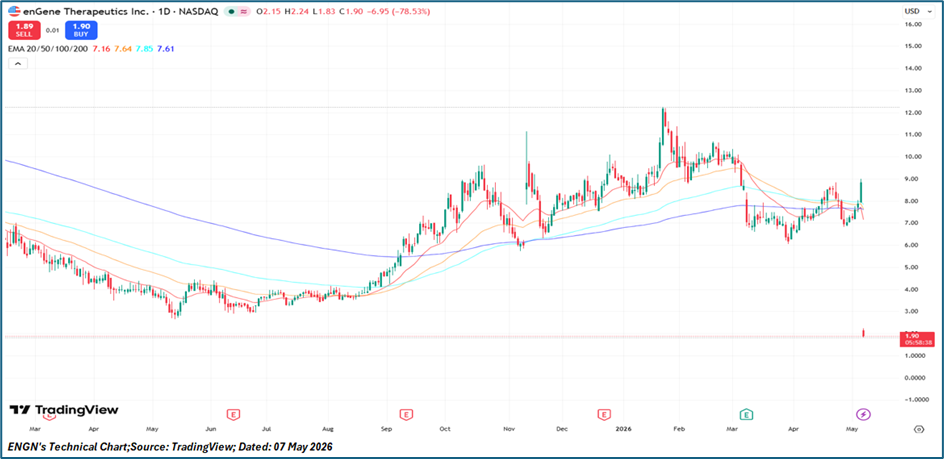
- ENGN shares trade at $1.90, more than 80% below their November 2025 peak, with the stock sitting far beneath all major moving averages and reflecting elevated investor uncertainty.
An Unmet Need That Commands Attention
Bladder cancer is one of the most common malignancies in the developed world, and the subset defined as high-risk, BCG-unresponsive non-muscle invasive bladder cancer represents a particularly difficult clinical problem. Bacillus Calmette-Guérin immunotherapy has long served as the backbone of treatment for NMIBC, yet a meaningful proportion of patients Fail to respond adequately or experience disease recurrence. For these individuals, the historical Options narrow quickly, often pointing toward radical cystectomy, a major surgical procedure carrying substantial morbidity and a lasting impact on quality of life.
Against this backdrop, enGene Therapeutics has been advancing detalimogene voraplasmid, an intravesical gene therapy candidate designed to express interferon-Alpha locally within the bladder to stimulate an anti-tumor immune response. The company's Phase 2 LEGEND pivotal cohort has now produced six-month complete response data, and the results carry direct relevance for the company's regulatory ambitions. The timing matters. FDA engagement is active, an AUA presentation is forthcoming, and the company is navigating this critical data disclosure period with its stock under significant financial stress.
Industry and Macro Context: Sector Trends in Bladder Cancer Treatment
The bladder cancer treatment landscape has undergone meaningful change in recent years. Recurring BCG shortages, driven by Manufacturing constraints among the small number of global suppliers, have accelerated Demand for effective alternative therapies. Regulatory agencies including the FDA have signaled a genuine interest in supporting the development of BCG-sparing or BCG-unresponsive treatment options, having previously granted Accelerated Approval to several competing agents based on complete response rates as a primary endpoint in this disease setting.
The competitive field for BCG-unresponsive NMIBC includes agents such as pembrolizumab, nadofaragene firadenovec, and newer entrants exploring different mechanisms. The acceptance of single-arm trials using complete response rate as the primary endpoint has created a regulatory pathway accessible to smaller biotechnology companies with focused clinical programs. enGene is pursuing precisely this route with detalimogene, leveraging a gene therapy mechanism that differentiates the asset from checkpoint inhibitors and viral vectors already on the market.
Broader investor sentiment in the clinical-stage biotechnology sector remains selective. Capital has concentrated toward programs with clear near-term data readouts, strong safety profiles, and a plausible regulatory pathway. enGene sits squarely within this category, though its sub-two-dollar stock price tells a story about current investor skepticism that the clinical data alone has not yet resolved.
Core Analysis: Interpreting the LEGEND Phase 2 Complete Response Data
The six-month complete response rate is the operationally critical endpoint for NMIBC trials following the FDA's guidance on this disease setting. In the context of BCG-unresponsive disease, a complete response at six months is the primary measure regulators use to evaluate whether a drug provides meaningful clinical benefit. Prior approvals in this space have been based on complete response rates in the range of 35% to 55% at the six-month mark, with response durability at twelve months being an important secondary consideration.
enGene's LEGEND cohort reporting that more than half of patients achieved a response at some point during the study is an encouraging signal, though investors should distinguish between any-time response and the durable six-month complete response figure, which is the number the FDA will scrutinize most closely. Limited disease progression across the cohort is a secondary finding that strengthens the overall benefit-risk profile. The manageable safety profile aligns with prior observations from the program and avoids the systemic toxicity concerns that have limited uptake of some competing agents.
The upcoming American Urological Association meeting presentation will likely provide the full dataset with granular patient-level data, response durability curves, and potentially updated subgroup analyses. For investors, this event represents the most important near-term information disclosure since the top-line data release. Active FDA discussions ahead of a BLA filing suggest the company believes its data package is sufficiently robust to support a regulatory submission, which is itself a meaningful strategic signal.
Financial and Market Implications: Valuation, Cash, and Investor Sentiment
The disconnect between the clinical narrative and the Market Price is the central tension in the ENGN Investment case. A stock trading at $1.90 with all major moving averages clustered between $7 and $8 reflects a market that has aggressively re-rated the company's probability of success, likely driven by concerns about the cash runway, potential dilution risk from future capital raises, and uncertainty around the sufficiency of the LEGEND data for a BLA submission.
For a pre-Revenue clinical-stage biotechnology company, the path from Phase 2 data to BLA filing to potential approval involves a multi-year timeline and substantial ongoing expenditure. The market's pricing of ENGN at current levels implies meaningful skepticism about either the regulatory outcome, the financing environment, or both. Favorable AUA data and constructive FDA feedback could serve as catalysts to narrow this valuation gap, but investors are pricing in significant execution and financing risk at these levels.
Any positive signal from FDA discussions or a BLA acceptance letter could catalyze a sharp upward repricing. Conversely, a rejection, a clinical hold, or an Equity raise at deeply discounted levels would likely accelerate downside pressure from already depressed prices.
Technical Analysis: Price Action and Market Structure for ENGN Stock
The Daily Chart for enGene Therapeutics tells a story of a stock in profound structural distress. From a base near $2.50 in early 2025, the stock staged an impressive rally through the summer and into autumn, driven by clinical trial momentum and improving sector sentiment. ENGN reached an intraday peak of approximately $12 in November 2025, representing a near five-fold appreciation from its mid-year lows. That peak, however, proved to be a climactic high rather than the beginning of a sustained uptrend.
The subsequent price action has been a systematic erosion of value across every timeframe. The stock has broken below its 20-day EMA at $7.16, its 50-day EMA at $7.64, its 100-day EMA at $7.85, and its 200-day EMA at $7.61. The compression of all four moving averages in a tight band between $7.16 and $7.85 suggests that the broader trend over the past year has been essentially flat or slightly declining at the macro Moving Average level, while the stock itself has collapsed far beneath this range. A stock trading at $1.90 against a 200-day EMA of $7.61 is signaling either extreme distress or significant undervaluation depending on which lens an investor applies.
|
Indicator |
Value |
Signal |
|
EMA 20 |
$7.16 |
Price far below |
|
EMA 50 |
$7.64 |
Price far below |
|
EMA 100 |
$7.85 |
Price far below |
|
EMA 200 |
$7.61 |
Price far below |
|
Session Range |
$1.83 – $2.24 |
High intraday Volatility |
|
Price vs Peak |
~$12 to $1.90 |
Approx. 84% drawdown |
Momentum indicators would likely show a deeply oversold RSI reading, though in situations of fundamental uncertainty, RSI signals alone carry limited predictive value. The MACD would be in a sustained negative configuration with little near-term evidence of a crossover. Volume patterns on the recent move from the $6-7 range down to the $1.90-$2.00 area suggest persistent selling without the kind of climactic Capitulation volume that often precedes durable lows. Immediate resistance sits in the $2.50 to $3.00 zone, where prior support levels have now converted to overhead Supply. Meaningful technical recovery would require a sustained close above $3.00 followed by a test of the $5.00 region before any larger trend Reversal could be considered.
Strategic Outlook: Catalysts, Risks, and the Regulatory Timeline
The AUA meeting presentation is the most proximate catalyst on the horizon. A compelling full dataset with durable response rates and clean safety data could restore a degree of clinical credibility and draw renewed attention from specialist investors in the oncology space. Following the AUA, the quality and pace of FDA feedback in the pre-BLA discussions will determine whether a regulatory submission is achievable within the near-to-medium term.
If the FDA indicates alignment with the company's data package and endpoint strategy, a BLA filing could represent a transformative value inflection point for ENGN. The conditional approval pathway used in prior NMIBC approvals could accelerate the timeline, though the bar for demonstrating meaningful clinical benefit and managing any manufacturing or chemistry, manufacturing, and controls questions remains high. Beyond regulatory considerations, the company's ability to manage its cash position and access Capital Markets on terms that do not severely dilute existing shareholders will be critical to sustaining the development program through the regulatory review period.
A Binary Setup for a Distressed Biotech with a Real Clinical Asset
enGene Therapeutics occupies a position that many investors find uncomfortable but that specialist biotech analysts understand well: a company with clinically meaningful data, an active regulatory dialogue, and a stock price that reflects maximum uncertainty rather than maximum pessimism about the science. The LEGEND trial has produced a signal that is broadly consistent with what the FDA has historically required for approval in BCG-unresponsive NMIBC. The near-term clinical and regulatory milestones are real, and the addressable market for an approved detalimogene product is commercially significant. Yet the stock's position relative to its moving averages, and the severity of its drawdown from peak levels, demands that investors approach ENGN with careful attention to position sizing, financing risk, and the binary nature of the regulatory outcome that ultimately determines its value.


 Jun 05, 2026




 Please wait processing your request...