
 AU
AU
 UK
UK
 CA
CA
 NZ
NZ
 IND
IND

 US
US

 Share
Share
 X (Formerly Twitter)
 Whatsapp
 Facebook
 LinkedIn
 Telegram
 Email This Article
 Copy Link
 Summarize with AI
 Chat GPT
 Perplexity
Key Highlights
- ERNA-101 combined with PD-1 blockade achieved complete tumor elimination and 100% long-term survival in syngeneic ovarian cancer models, representing a compelling preclinical proof-of-concept signal.
- The use of syngeneic models, which preserve an intact immune system, strengthens the translational relevance of the combination effect observed in the study.
- The data positions ERNA-101 as a potential synergistic partner for checkpoint inhibitors, a commercially significant attribute given the dominance of PD-1 therapies across oncology.
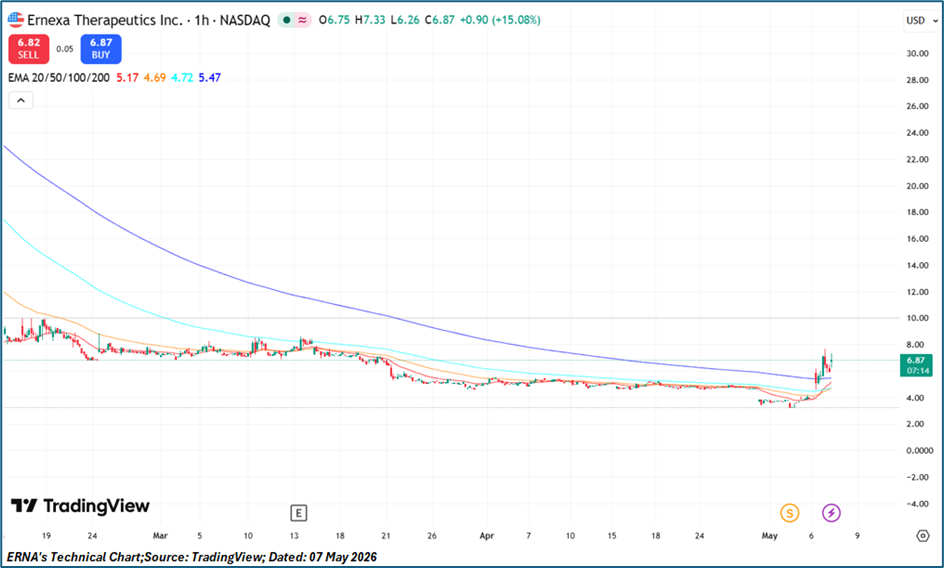
- ERNA shares rose 15.08% to $6.87, recovering from multi-month lows and breaking above all four hourly exponential moving averages on the catalyst.
- The stock remains well below its late February 2026 levels near $9 to $10, underscoring that significant valuation recovery depends on advancing ERNA-101 into clinical development.
Ovarian Cancer and the Search for Effective Cellular Combinations
Ovarian cancer remains one of the most lethal gynecologic malignancies, largely because the majority of patients are diagnosed at an advanced stage when surgical and chemotherapeutic Options offer limited long-term benefit. The field has increasingly turned toward immunotherapy, particularly checkpoint inhibitors, to address the unmet need in recurrent and platinum-resistant disease. Cell therapy approaches have lagged behind their hematologic cancer counterparts in solid tumor settings, but preclinical evidence of durable efficacy in combination with PD-1 blockade is precisely the type of signal that attracts scientific and investor attention. Ernexa Therapeutics has now produced that signal with ERNA-101, and the market has responded with a meaningful single-session gain from deeply depressed price levels.
Industry and Macro Context: Cell Therapy in Solid Tumors and Checkpoint Combination Strategies
The oncology Investment landscape has long grappled with the challenge of translating cell therapy success from blood cancers into solid tumor settings, where the immunosuppressive tumor microenvironment limits T-cell infiltration and persistence. Combination strategies pairing cell therapies with PD-1 or PD-L1 inhibitors have emerged as a scientifically rational approach to overcome this barrier. PD-1 blockade reduces immune exhaustion and can sustain effector cell activity within the tumor, potentially amplifying the cytotoxic response delivered by an adoptive cell therapy. For Ernexa, demonstrating this synergy in a preclinical ovarian cancer model is a foundational step toward building a clinical development rationale and attracting potential Partnership interest from established oncology developers.
Core Analysis: Interpreting the ERNA-101 Preclinical Dataset
Three elements of the preclinical results deserve careful investor attention. First, complete tumor elimination in a syngeneic model is a high bar. Syngeneic models use immunocompetent animals where the full immune landscape is preserved, making them a more rigorous test of combination immunotherapy than immunodeficient xenograft models. Second, 100% long-term survival is the strongest possible efficacy endpoint in a preclinical setting and provides a clean translational hypothesis for clinical trial design. Third, the dependence on PD-1 co-administration introduces both opportunity and complexity: it confirms mechanistic synergy but means the clinical program will likely require a combination trial design, which adds regulatory and operational layers to the development pathway. Investors should frame this data as a well-constructed preclinical foundation rather than near-term clinical evidence, and monitor the timeline for an Investigational New Drug application or equivalent regulatory filing as the next material milestone.
Financial and Market Implications: A Modest Repricing With More to Prove
The 15.08% session gain is measured relative to the magnitude of the preclinical result, which is appropriate. Unlike a Phase 2 or regulatory catalyst that directly de-risks a BLA pathway, preclinical data represents an early and uncertain step toward clinical validation. The stock had declined from approximately $9 to $10 in late February 2026 to lows near $3.50 immediately before this session, erasing the majority of its prior market Capitalization. The recovery to $6.87 restores some of that lost ground but leaves the company's valuation highly dependent on its ability to fund a clinical program, secure partnership support, and generate human proof-of-concept data. Cash runway and the timeline to IND submission are the two financial variables most critical to monitor.
Technical Analysis: Price Action and Momentum for ERNA Stock
The one-hour chart covering late February through early May 2026 documents an extended and essentially uninterrupted downtrend followed by a sharp Reversal on the preclinical catalyst. From the late February base near $9 to $10, the stock ground lower across each week of March and April, with brief consolidation attempts failing to hold as selling pressure persisted. A final leg lower in late April and early May compressed the stock to approximately $3.50 to $4.00 before the May 6 to 7 surge reclaimed the $6.87 level on the current session.
|
Hourly EMA |
Level |
Signal |
|
EMA 20 (20-hour) |
$5.17 |
Price well above |
|
EMA 50 (50-hour) |
$4.69 |
Price well above |
|
EMA 100 (100-hour) |
$4.72 |
Price well above |
|
EMA 200 (200-hour) |
$5.47 |
Price well above |
|
Feb 2026 Prior High |
~$9.00 – $10.00 |
Longer-term resistance |
On the one-hour timeframe, all four EMAs currently sit well below the price at levels ranging from $4.69 to $5.47, reflecting the depth of the prior downtrend and confirming that the near-term momentum has shifted upward. The session high of $7.33 represents the immediate resistance level, and a sustained hold above $6.50 would reinforce the credibility of the reversal. The 200-hour EMA was in a steep and prolonged decline throughout the February to April period, and it will take several weeks of sideways-to-higher price action before it flattens and begins to provide upward support. The February 2026 highs near $9 to $10 represent the significant overhead resistance on a broader timeframe, and reclaiming that zone would require substantial additional positive clinical or partnership-related catalysts.
Strategic Outlook: Path to Clinical Development and Partnership Potential
The immediate priorities for Ernexa are to translate the preclinical signal into a clinical development plan, identify a PD-1 combination partner for potential co-development, and preserve sufficient Capital to fund an IND-enabling program. Ovarian cancer has a well-established regulatory pathway with multiple validated endpoints, and prior FDA approvals in the space provide a useful clinical trial design template. A partnership with an established checkpoint inhibitor developer could accelerate timelines and reduce capital requirements, making Business development activity a key variable for investors to monitor alongside the science.
Conclusion
Ernexa Therapeutics has produced a striking preclinical signal: complete tumor elimination and perfect survival in a rigorous syngeneic ovarian cancer model is a result that justifies serious scientific attention. The 15.08% session gain reflects a market repricing from deeply oversold levels, but the stock's distance from its February 2026 highs near $9 to $10 makes clear that the investment case is still in its early stages. ERNA-101 now has a compelling preclinical foundation; the next test is whether the company can translate that foundation into a funded, well-designed clinical program that validates the combination strategy in human patients.


 Jun 05, 2026




 Please wait processing your request...