
 CA
 NZ
 UK
 AU
 IND

 US

 Share
 X (Formerly Twitter)
 Whatsapp
 Facebook
 LinkedIn
 Telegram
 Email This Article
 Copy Link
 Summarize with AI
 Chat GPT
 Perplexity
Key Highlights
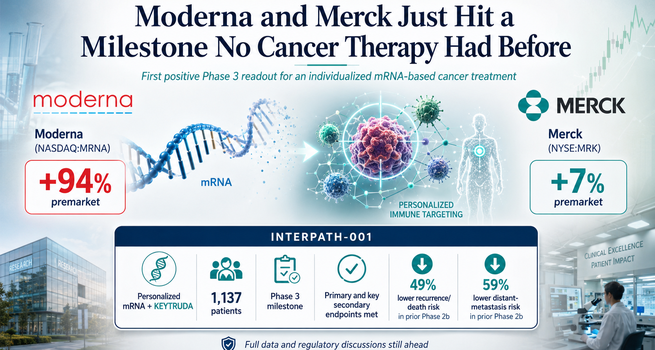
- Moderna shares surged roughly 94% in premarket trading, while Merck rose close to 7%, after the companies reported positive Phase 3 results for their individualized cancer therapy in melanoma.
- The INTerpath-001 trial met both its primary endpoint of recurrence-free survival and a key secondary endpoint of distant metastasis-free survival for intismeran autogene combined with KEYTRUDA, versus KEYTRUDA alone.
- This marks the first positive Phase 3 readout for an individualized neoantigen therapy and for an mRNA-based cancer treatment, validating Moderna's oncology pipeline beyond its declining Vaccine franchise.
- Both companies plan to present full data at an international medical meeting and engage regulators on potential filing submissions, with timelines still undisclosed.
A Reaction Rooted in a Pipeline Gap
Moderna (NASDAQ:MRNA) shares jumped roughly 94% in premarket trading, while Merck (NYSE:MRK) shares rose close to 7%.
For Merck, the result reinforces an already large immuno-oncology Franchise built around KEYTRUDA, now studied in more than 2,800 trials across cancer types.
For Moderna, it addresses a more pressing concern. Its commercial base has leaned heavily on the COVID-19 vaccine Spikevax and RSV vaccine mRESVIA, a franchise facing shrinking margins and continued losses as post-pandemic Demand cooled. Some analysts have also noted that Moderna's valuation already reflects expectations that the therapy could eventually extend beyond melanoma into other cancer types, meaning the stock's reaction may partly reflect confidence in that broader thesis rather than the melanoma result alone.
What the Trial Showed
INTerpath-001 evaluated intismeran autogene, an individualized mRNA-based neoantigen therapy built from each patient's own tumor mutation profile, combined with KEYTRUDA, against KEYTRUDA alone, in patients with completely resected stage IIB through IV melanoma. The trial enrolled 1,137 patients randomized 2:1 toward the combination arm.
At a pre-specified interim analysis, the combination showed statistically significant, clinically meaningful improvement in recurrence-free survival, the primary endpoint, and distant metastasis-free survival, a key secondary endpoint, versus KEYTRUDA alone. The trial continues to evaluate other endpoints, including overall survival, so current data confirms delayed recurrence and spread, not yet extended survival.
Safety data was consistent with prior studies of the combination, with no new safety signals, and reported side effects were broadly comparable to those seen with other vaccines. This builds on Phase 2b data from KEYNOTE-942, presented at the 2026 ASCO Annual Meeting, which showed a 49% reduction in risk of recurrence or death and a 59% reduction in risk of distant metastasis for the same combination versus KEYTRUDA alone.
The therapy itself works by targeting the unique set of mutations found in each patient's individual tumor, rather than applying a single standard treatment across all patients. This personalized profile is used to train the immune system to recognize and attack those specific cancer markers, with the response then paired with KEYTRUDA to strengthen the overall anti-cancer effect. Melanoma accounts for only around 1% of all skin cancers but is responsible for the large majority of skin cancer deaths, and most recurrences occur within the first two to three years following initial surgical treatment, underscoring why a therapy aimed at delaying or preventing recurrence carries outsized clinical relevance for this specific cancer type.
Why Phase 3 Changes the Risk Picture
Clinical development risk narrows sharply at each trial phase. Phase 2 results, however promising, carry meaningfully higher odds of not replicating at Phase 3 scale, given smaller samples and less rigorous controls. INTerpath-001 is described as the first positive Phase 3 readout for individualized neoantigen therapies and for mRNA-based cancer treatment as a category, a bar most oncology candidates never clear.
A positive Phase 3 result does not equal approval. Both companies say they will engage regulators on filing submissions, without a stated timeline. The path from trial data to a marketed, reimbursed product still involves regulatory review, Manufacturing scale-up given the therapy's personalized nature, and payer negotiations, each carrying its own execution risk.
The Pipeline Beyond Melanoma
The INTerpath programme spans nine Phase 2 and Phase 3 trials across non-small cell lung cancer, bladder cancer, and renal cell carcinoma, alongside earlier-stage studies in pancreatic and gastric cancers. A positive result in melanoma does not guarantee replication elsewhere, given differences in mutational burden across tumor types, but it is the first randomized, controlled validation that the underlying platform can succeed at Phase 3.
For Merck, the timing is relevant given ongoing questions about KEYTRUDA's growth trajectory as the drug approaches patent-related considerations later this decade. A differentiated, personalized combination franchise offers a potential path to extending its clinical relevance beyond existing approved indications.
What Investors Should Watch Next
The premarket move reflects genuine clinical validation, but Moderna's sharper reaction also reflects how much the stock had been priced for a struggling vaccine Business with few alternative growth drivers. Durability will depend on the full dataset at the upcoming medical meeting, how the recurrence-free survival benefit holds up with longer follow-up, eventual overall survival data, and the regulatory path that follows. Melanoma is one indication in a broader multi-tumor programme, and subsequent trial readouts will determine whether this becomes a durable oncology franchise or remains a single strong data point.


 Nov 15, 2026





 Please wait processing your request...