
 AU
AU
 UK
UK
 CA
CA
 NZ
NZ
 IND
IND

 US
US

 Share
Share
 X (Formerly Twitter)
 Whatsapp
 Facebook
 LinkedIn
 Telegram
 Email This Article
 Copy Link
 Summarize with AI
 Chat GPT
 Perplexity
Key Highlights
- CNSide Diagnostics received Medicare enrollment and a Provider Transaction Access Number from CMS, enabling the Subsidiary to submit reimbursement claims for the CNSide CSF Assay Platform.
- The enrollment expands access to approximately half of the U.S. Medicare population, representing a foundational step toward meaningful commercial Revenue generation for the platform.
- Medicare reimbursement infrastructure is expected to accelerate broader private payer coverage negotiations, as commercial insurers frequently benchmark their own coverage policies against CMS determinations.
- The milestone advances the CNSide platform from a purely clinical tool toward a reimbursed diagnostic service, materially changing the revenue potential of the subsidiary.
- PSTV shares gained 4.17% to $6.25, a measured market response consistent with the incremental but foundational nature of a reimbursement infrastructure milestone.
Why Reimbursement Infrastructure Is a Critical Commercial Inflection
In the diagnostics industry, clinical Utility alone does not generate revenue. A laboratory test or assay platform becomes commercially viable only when it can be billed to payers, and Medicare enrollment is the essential first step in that process. For Plus Therapeutics' CNSide Diagnostics subsidiary, the receipt of Medicare enrollment and a PTAN from CMS transforms the CNSide CSF Assay Platform from a clinically available but commercially constrained product into a billable service accessible to the largest single payer in the United States. The milestone is procedural in nature but strategically meaningful, and the path from enrollment to actual claims Volume will determine how quickly this development translates into measurable revenue.
Industry and Macro Context: Diagnostics Reimbursement and the CNS Testing Landscape
The central nervous system diagnostics market has expanded significantly as biomarker science for neurological diseases has matured. Cerebrospinal fluid assays occupy a high-value segment within CNS diagnostics, providing direct access to neurological biomarkers that peripheral blood tests cannot match in sensitivity or specificity. CMS reimbursement is a gating Factor for broad clinical adoption, as hospital systems, neurology practices, and laboratory networks are generally unwilling to implement testing protocols that lack an established billing pathway. The CMS policy of using Local Coverage Determinations and national coverage frameworks increasingly incorporates molecular and proteomic CSF assays as the evidence base for their clinical utility strengthens, creating a favorable regulatory environment for platforms like CNSide.
Core Analysis: What the PTAN and Medicare Enrollment Mean Operationally
A Provider Transaction Access Number is the operational credential that allows a laboratory or diagnostic provider to submit claims to Medicare contractors. Without it, no billing can occur regardless of clinical adoption. The receipt of this number means CNSide can now process claims for patients covered under Medicare fee-for-service programs, which account for a substantial share of older patients most likely to require CNS diagnostic workups. The reference to approximately half of the Medicare population reflects the geographic and contractor coverage scope of the initial enrollment, with the expectation that broader national coverage follows as administrative processes are completed. Importantly, Medicare enrollment also functions as a credibility signal in negotiations with commercial payers, which frequently look to CMS coverage decisions as proxies for clinical validity when establishing their own reimbursement policies.
Financial and Market Implications: Revenue Pathway and Investor Expectations
Plus Therapeutics operates across two primary areas: its radiopharmaceutical therapeutic pipeline and the CNSide diagnostics subsidiary. The Medicare enrollment milestone is specific to CNSide and represents the first concrete step toward revenue generation from that Business unit. The 4.17% session gain reflects a market that correctly interprets this as an enabling milestone rather than a revenue event in itself. Actual claims volume, average reimbursement rates per assay, and the conversion of clinical interest into ordering patterns are the variables that will determine the financial impact over the coming quarters. Investors should monitor initial claims data, any announcements of commercial payer coverage agreements, and the pace of laboratory network adoption as leading indicators of CNSide's commercial trajectory.
Technical Analysis: Price Action and Market Structure for PSTV Stock
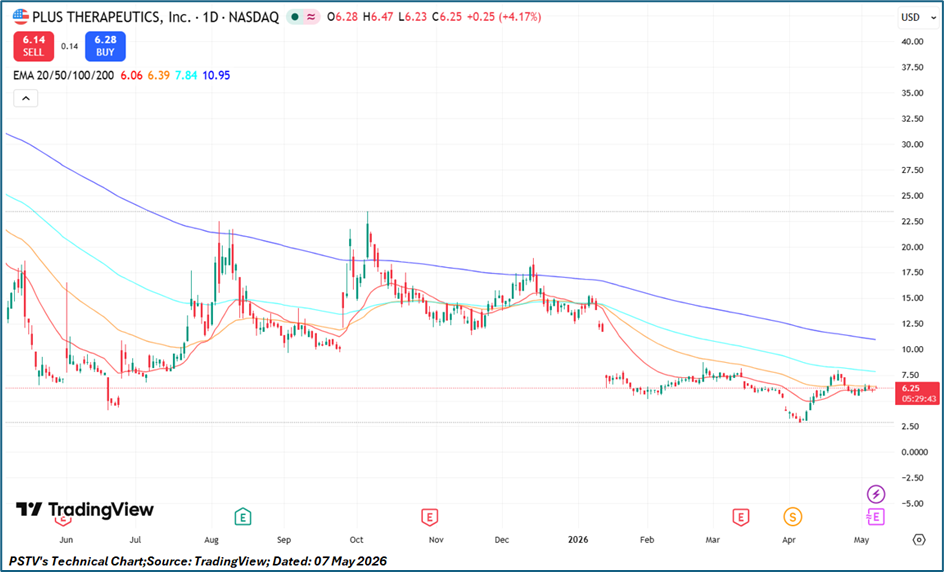
The Daily Chart from June 2025 through May 2026 documents a stock that experienced dramatic Volatility driven by catalysts before settling into a prolonged downtrend. Sharp spikes to approximately $22 to $24 in August and again in October 2025 represent the kind of event-driven price action typical of small-cap biotech and diagnostics stocks responding to clinical or regulatory news. Both spikes failed to sustain, with sellers quickly reasserting control and driving the stock back toward its trading range. From the October 2025 high, the stock entered a sustained decline through the first quarter of 2026, reaching a low near $3.00 in early March before recovering to the current $6.25 level.
|
Daily EMA |
Level |
Signal |
|
EMA 20 |
$6.06 |
Price just above |
|
EMA 50 |
$6.39 |
Price just below |
|
EMA 100 |
$7.84 |
Significant resistance |
|
EMA 200 |
$10.95 |
Major overhead resistance |
|
March 2026 Low |
~$3.00 |
Base support established |
The current EMA structure remains bearish overall. Price at $6.25 sits just above the 20-day EMA at $6.06 but has not yet reclaimed the 50-day EMA at $6.39, which will be the immediate test in the sessions ahead. The 100-day EMA at $7.84 and the 200-day EMA at $10.95 represent substantial overhead resistance that reflects the severity of the prior downtrend. The March 2026 low near $3.00 establishes a base reference from which the stock has recovered approximately 108%, but the broader trend rehabilitation requires a sustained series of higher lows and eventual reclaim of the 50-day and 100-day EMAs to shift the technical narrative from recovery to trend Reversal.
Strategic Outlook: From Enrollment to Revenue and the Broader PSTV Pipeline
The near-term commercial priorities for CNSide are converting the Medicare enrollment into active claims submissions, securing additional geographic coverage, and using the CMS credential to accelerate commercial payer negotiations. In parallel, Plus Therapeutics' radiopharmaceutical pipeline remains the larger long-term value driver for the company, and investors should assess how the CNSide commercialization progress interacts with the funding requirements and strategic focus of the broader organization. Any announcement of the first commercial payer coverage agreement or material claims volume data would represent the next meaningful catalyst beyond today's enrollment milestone.
Conclusion
Medicare enrollment and PTAN receipt are foundational commercialization milestones that are easy to undervalue but essential to understand. Without them, no diagnostic platform generates billable revenue regardless of its clinical merits. CNSide has now cleared this hurdle, and the access to approximately half the Medicare population provides a real and immediate addressable market for claims submission. The 4.17% market response correctly frames this as an enabling event rather than a revenue inflection, and the genuine test of this milestone's value will be visible in the claims volume and commercial payer adoption data that follows over the coming quarters. Technically, PSTV remains in recovery mode with the 50-day EMA at $6.39 as the immediate proving ground.


 Jun 05, 2026




 Please wait processing your request...