
 CA
 NZ
 UK
 AU
 IND

 US

 Share
 X (Formerly Twitter)
 Whatsapp
 Facebook
 LinkedIn
 Telegram
 Email This Article
 Copy Link
 Summarize with AI
 Chat GPT
 Perplexity
Key Highlights
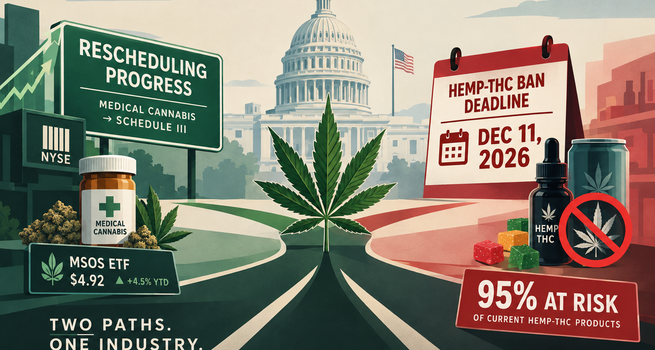
- The U.S. cannabis sector in mid-September 2026 is defined by two parallel federal tracks: progress on marijuana rescheduling and a looming crackdown on most hemp-derived THC products.
- The AdvisorShares Pure US Cannabis ETF (MSOS) trades around $4.92 to $4.96, up roughly 4% to 5.5% year-to-date but still down more than 80% from its 2021 highs.
- Trulieve (NYSE: TRLV), trading around $11.62, became the first major plant-touching operator to list on the NYSE after isolating its medical operations.
- A short-term spending bill delayed most of the hemp-derived THC ban to December 11, though industry estimates warn it could eliminate roughly 95% of current intoxicating hemp products.
The U.S. cannabis sector in mid-September 2026 is defined by two parallel federal tracks: progress on marijuana rescheduling and a looming crackdown on most hemp-derived THC products. State markets keep growing, but operators still face oversupply, thin margins, and uneven access to capital.
Federal Rescheduling: Medical Moves Forward, Adult-Use Remains Unfinished
In December 2025, President Trump directed the Justice Department to move quickly on transferring marijuana from Schedule I to Schedule III. In April 2026, the DOJ immediately placed state-licensed medical cannabis and FDA-approved cannabis drugs into Schedule III, a change that eases the punitive 280E tax treatment for medical operators and opened a path for some companies to list on major U.S. exchanges.
A separate, broader rulemaking covering adult-use marijuana went through DEA administrative hearings in late June through mid-July 2026. On September 9, the D.C. Circuit rejected a request by opponents, including a drug-testing trade group, to pause the process, so the effort continues. Full rescheduling of recreational cannabis has not been finalized. It would not legalize interstate commerce or federal adult-use sales, but it would further reduce tax and banking friction.
Trulieve listed on the NYSE in June 2026 after isolating its medical operations, and Glass House Brands followed. Other multi-state operators are watching whether they can do the same, since a Nasdaq or NYSE listing remains limited to companies that can carve out Schedule III medical operations from their broader adult-use business.
Hemp-Derived THC Products Face a December Deadline
Congress changed the federal definition of hemp in late 2025. The new standard uses total THC, not just delta-9, and caps finished products at 0.4 mg of total THC per container. Industry estimates say this would make roughly 95% of current intoxicating hemp products, including delta-8, many gummies, and most THC drinks, federally unlawful.
The original effective date was November 12, 2026. A short-term spending bill delayed most of the ban to December 11, though synthetic and converted cannabinoids still face the earlier deadline. THC beverages had been a bright spot, with NielsenIQ reporting $239 million in measured retail sales in the year through April, up 135%, but distributors have already pulled back and some producers have cut staff. Hemp-cannabinoid retail sales were estimated at $38.7 billion, and the Whitney Economics 2026 report warned that the new rules could wipe out tens of billions in Revenue and hundreds of thousands of jobs if they take effect as written.
State Markets Keep Growing Even as Federal Reform Lags
Recreational sales are legal in 25 states and medical in about 40, with public support remaining high. States have collected more than $15.8 billion in cannabis tax revenue over five years, including $3.5 billion in the most recent year, and Massachusetts recently passed $10 billion in cumulative recreational sales. Operators remain optimistic about 2026 revenue, but many still report excess supply, price compression, and only modest Margin improvement. Banking access is still constrained, though a recent GAO report found no evidence that banks have been penalized solely for serving licensed cannabis businesses.
How Cannabis Stocks and the MSOS ETF Are Performing
U.S. cannabis equities rallied earlier in 2026 on rescheduling news, with the AdvisorShares Pure US Cannabis ETF (MSOS) more than doubling over a 12-month stretch as of mid-year. Performance has since been mixed. As of mid-September, MSOS trades around $4.92 to $4.96, up roughly 4% to 5.5% year-to-date and about 17% to 19% over the past 12 months, with a 1-month gain of roughly 6% but a roughly flat to slightly negative 3-month return. Its 52-week range spans about $2.96 to $7.25, and Assets under management sit around $970 million to $990 million. MSOS remains down more than 80% from its 2021 highs, and its moves are tightly tied to Washington headlines on rescheduling progress or hemp-THC rules more than quarterly earnings.
Among individual operators, prices have diverged following Trulieve's NYSE listing and various medical-only carve-outs. Trulieve (NYSE: TRLV) trades around $11.62, the first major plant-touching operator on the NYSE and among the stronger names in the group. Curaleaf (OTC: CURLF) trades around $10.09, supported by the largest store footprint among U.S. operators and a recent bounce. Green Thumb (OTC: GTBIF) trades around $7.31 and is often cited as one of the more profitable operators in the sector. Glass House (CSE: GLAS / OTC: GLASF) trades in the mid-$7s range, having also listed after separating its medical operations. Verano (OTC: VRNOF) and Cresco (OTC: CRLBF) show more mixed recent performance, trading in the weaker, lower single-digit range. Some aggregator sites still show stale OTC prices, since live quotes for the larger names are higher following the 2026 rally and exchange listings.
More broadly, the U.S. multi-state operator basket was modestly higher in recent sessions, with one sector snapshot showing the MSO index up 2% with mixed breadth, more names up than down at the September 15 open, but no strong directional conviction. Analyst tone remains net bullish, with more Buy ratings than Sell ratings, though coverage is described as cautious. Cannabis-focused REITs such as Innovative Industrial Properties (NYSE: IIPR) and NewLake Capital Partners (OTCQX: NLCP) have generally traded more steadily than the operators themselves, since they collect rent rather than sell product directly. Canadian licensed producers, including Tilray (NASDAQ: TLRY), Canopy Growth (NASDAQ: CGC), and Cronos Group (NASDAQ: CRON), are less directly tied to U.S. rescheduling and have traded mixed to soft.
What's Driving Prices, and What Comes Next
On the positive side, medical rescheduling has delivered concrete 280E tax relief for medical operators, the first NYSE listings have opened a path to broader capital access, and there remains hope that broader Schedule III treatment for adult-use cannabis could eventually follow. On the negative or uncertain side, adult-use cannabis remains Schedule I, hemp-derived THC products face a hard December 11 deadline, oversupply and price compression persist in many state markets, and most operators still trade at low multiples relative to their cash flow.
The bottom line: medical cannabis has taken a concrete regulatory step forward, and adult-use rescheduling is advancing but unfinished. At the same time, the much larger hemp-THC market faces an existential deadline in December unless Congress creates a new regulatory framework. State legal markets continue to expand and generate tax revenue, yet the industry as a whole is still navigating oversupply, high taxes in many states, and incomplete federal reform. Investors should expect the sector to keep trading in large swings tied to court rulings, DEA updates, or hemp-bill headlines, rather than settling into a smooth, earnings-driven uptrend in the near term.


 Nov 12, 2026





 Please wait processing your request...