
 AU
AU
 UK
UK
 CA
CA
 NZ
NZ
 IND
IND

 US
US

 Share
Share
 X (Formerly Twitter)
 Whatsapp
 Facebook
 LinkedIn
 Telegram
 Email This Article
 Copy Link
 Summarize with AI
 Chat GPT
 Perplexity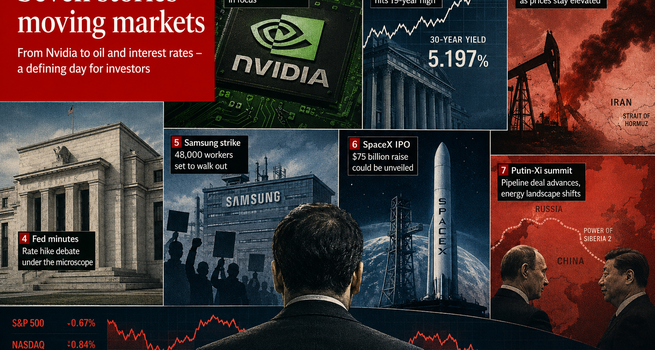
- Earnings: All Eyes on Nvidia as a $350 Billion Swing Looms; Target and Lowe's Add to the Consumer Read
Nvidia (Nasdaq:NVDA) reports Q1 fiscal 2027 results after the close tonight, the single most watched corporate event of the year. Consensus calls for Revenue of $79.2 billion and EPS of $1.78, implying 79.5% year-over-year growth. The stock is down 6% from its all-time high reached last week but has gained 17.4% over the past three months and 19% year to date. Options are implying a move of approximately 6.5% in either direction, translating to a roughly $350 billion swing in Market Capitalisation, larger than the individual Market Value of approximately 90% of S&Amp;P 500 constituents. Options skew has shifted toward calls, with bets on rising tech prices moving from a five-year low in March to a five-year high by mid-May.
The key watchpoints are not the headline number which is effectively priced in at a 97% beat probability but forward guidance on the Vera Rubin architecture transition, China H200 delivery commentary, gross Margin trajectory, and hyperscaler spending signals. The four major hyperscalers have guided combined 2026 Capital Expenditure above $700 billion.
Before the open, Target (NYSE:TGT) reports Q1 with consensus EPS of $1.46 on revenue of $24.64 billion, the most closely watched turnaround story in U.S. retail under new CEO Michael Fiddelke; Lowe's (NYSE:LOW) also reports before the bell, down 25% from its February high and 21.5% over the past three months, providing the second housing sector read after Home Depot's (NYSE:HD) Tuesday results of $3.43 adjusted EPS on $41.77 billion in revenue, which beat consensus but saw same-store sales grow just 0.6% against a 0.9% estimate, with CFO Richard McPhail noting homeowners continue to defer larger projects.
- Nvidia's earnings conference call begins at 5:00 PM ET; results typically arrive between 4:20 and 4:30 PM ET. Analyst noted that investors have become complacent about AI capex while the market is no longer simply paying up for downside protection it is increasingly paying for upside participation.
- Walmart (NASDAQ:WMT) stock hit a new all-time high on Tuesday and has gained 7.5% in the past three months, setting a high bar for its Thursday report; Target is down 4.4% from its April high but up 10% over the past three months and named former Walmart executive Jeff England as chief Supply chain officer on Tuesday.
- Risk note: Nvidia has beaten estimates in 21 of 23 quarters since the AI boom began but declined on the day of release in three of its last four reports despite those beats; the stock's reaction will depend disproportionately on Q2 guidance and China commentary rather than the Q1 headline.
- Fixed Income: U.S. 30-Year Treasury Hits 19-Year High at 5.197%; Strategists Say Bonds Are Firmly in the Danger Zone as Third Straight Equity Decline Deepens
The U.S. 30-year Yield/">Treasury Yield hit 5.197% on Tuesday, its highest level since July 2007, the year the first iPhone launched. It closed at 5.183%. The 10-year rose to 4.667%, the 20-year hit 5.189%, and the 2-year stands at 4.12% all at 52-week highs. The S&P 500 fell 0.67% to 7,353.61 for its third consecutive daily decline, the Nasdaq fell 0.84% to 25,870.71, and the Dow lost 322.24 points to 49,363.88. Over 63% of U.S. issues declined. The Russell 2000 was the worst performer at minus 1.01%. The dollar index rose 0.34% to 99.33 and the dollar strengthened to 159.05 against the yen. Gold fell 1% to $4,511.20. The German 10-year bund is at 2011 highs, the British 10-year gilt at 5.126%, and the Japanese 10-year at highs not seen since the 1990s. European Inflation data from Germany, the UK, and the EU are due Wednesday and will be closely watched for confirmation that the Iran war energy shock is feeding into consumer prices across G7 economies.
- The Vanguard FTSE Europe ETF has lost 3% in the past month; the iShares MSCI Brazil ETF is down approximately 13% in the past month and 6% in the past week, reflecting global emerging market pressure from higher U.S. yields and dollar strength.
- Rising yields push up borrowing costs and raise the discount rate for future earnings, directly challenging equity valuations at a moment when the S&P 500 is trading at elevated multiples and the Fed rate hike probability stands at 51% for December.
- Risk note: the combination of a 30-year yield at 19-year highs, a Fed rate hike becoming the base case, and Nvidia earnings tonight creates an asymmetric setup where a disappointing print or hawkish FOMC minutes could trigger a fourth consecutive daily decline.
- Geopolitics and Energy: Trump Says He Was an Hour Away from Striking Iran; Senate Votes to End Military Action in Rebuke; Brent Holds at $111
Trump said Tuesday the U.S. may need to strike Iran again and that he had been an hour away from ordering an attack before postponing it, adding "there seems to be a very good chance they can work something out." Vice President JD Vance said the U.S. and Iran have made "a lot of progress" in talks and that neither side wants to see a resumption of the military campaign.
Separately, the Senate voted to advance a measure to end U.S. military action in Iran, a direct rebuke of Trump's prosecution of the war. Brent Crude settled at $111.28 and WTI at $107.77 on Tuesday, with both benchmarks holding near multi-month highs as the Strait of Hormuz remains largely closed despite partial shipping resumption. Analysts noted that China's role in brokering progress during the Trump-Xi summit "failed to materialise" and that the oil market continues to price persistent supply disruptions. The AAA national average for regular gasoline stands at $4.52 per gallon. The IEA projects global oil inventories will approach all-time lows of 7.6 billion barrels by end-May.
- The Senate vote to end military action does not carry force of law without House passage and presidential signature, but it signals growing Congressional resistance to an open-ended military engagement and adds political pressure on the White House to reach a negotiated settlement.
- Vance said at a White House briefing that the Iran war "won't be forever," the most explicit public signal yet from the administration that it is actively seeking an exit path.
- Risk note: Trump's disclosure that he was an hour from ordering strikes introduces a new variable future escalation could come with minimal warning, making oil's current $111 level a floor rather than a ceiling if talks collapse.
- Monetary Policy: FOMC Minutes Released Today at 2:00 PM ET; Last Powell-Era Record Expected to Show Escalating Rate Hike Debate as Inflation Reaccelerated
The Federal Reserve releases minutes from its April 28-29 meeting at 2:00 PM ET today, the final set of FOMC minutes under Jerome Powell's chairmanship. The release arrives on the same day as Nvidia earnings, making Wednesday the most data-dense single session of the year. The minutes will be read as a historical baseline for Warsh's incoming regime and as a signal of how far the internal rate hike debate had progressed by late April. The March minutes showed the number of FOMC officials willing to consider a rate hike rose from "several" in January to "some" in March. Markets will focus on whether that language escalated further in April, and whether any officials explicitly advocated for a hike given that headline CPI stood at 3.8% and monthly PPI surged 1.4% both materially above the Fed's 2% target. The federal funds target currently sits at 3.5% to 3.75%; futures markets price a 51% probability of a rate hike by December 2026.
- The minutes cover the period immediately before Trump's Truth Social attack on Powell intensified, before the Beijing summit, and before the UAE nuclear plant drone strike making them a snapshot of Fed thinking at a moment when the inflation and geopolitical picture was already deteriorating but had not yet reached current levels.
- Warsh's first FOMC meeting as chair is June 16 to 17; any language in today's minutes suggesting the committee was moving toward a hike will sharpen focus on June as a live meeting.
- Risk note: the minutes release at 2:00 PM ET and Nvidia results at approximately 4:20 PM ET compress two of the most market-moving events of the week into a single three-hour window.
- Supply Chain: Samsung Strike Confirmed for Thursday After Talks Collapse; 48,000 Workers Set to Walk Out as Emergency Arbitration Option Walked Back
Samsung Electronics faces an 18-day strike beginning Thursday May 21 after a final round of government-mediated talks broke down Wednesday morning. Union leader Choi Seung-ho told reporters the union had accepted the government mediator's final proposal but Samsung management rejected it, with Samsung stating the union's demands including bonuses for loss-making units "would undermine the fundamental principles of company management." More than 48,000 workers are set to participate. Samsung shares fell approximately 3% on the news. South Korea's labour commissioner Park Soo-keun said the government remains open to restarting mediation "anytime," while a government official walked back the earlier threat of emergency arbitration, saying it was "premature." A rally on April 23 that drew 40,000 workers caused a 58% drop in foundry production and an 18% decline in memory production on that day alone; an 18-day full strike would have materially larger implications. Samsung accounts for 22.8% of South Korea's exports and 12.5% of GDP.
- The union demanded Samsung abolish its 50% of annual salary cap on bonuses, allocate 15% of annual operating profit to bonuses, and formalise these changes beyond one year; management offered 10% of operating profit plus a one-time special payment.
- Samsung is the world's largest memory chip maker; any sustained production disruption would tighten global DRAM supply at a moment when AI infrastructure Demand is structurally elevated and Seagate has already flagged capacity constraints.
- Risk note: the government walking back emergency arbitration removes the most direct mechanism for preventing the strike, making a Thursday walkout the base case unless Samsung materially revises its position before midnight.
- Capital Markets: SpaceX IPO Prospectus Expected Today as Goldman Sachs Confirmed as Lead Left Underwriter; $75 Billion Raise at $1.75 Trillion Valuation Targets June 12 Listing
Goldman Sachs has been confirmed as lead left underwriter for SpaceX's initial public offering, with Morgan Stanley also serving as a lead banker. The IPO prospectus could be released as soon as today, Wednesday May 20. SpaceX is targeting a raise of approximately $75 billion at a valuation of roughly $1.75 trillion, which would make it the largest stock market flotation in history, surpassing Saudi Aramco's $25.6 billion raise in 2019. The company has selected Nasdaq as its trading venue and is targeting a listing as early as June 12. Bank of America, Citigroup, and JPMorgan are among 19 additional banks involved in smaller roles spanning institutional, retail, and international channels. The $1.75 trillion valuation represents a significant step up from the $1.25 trillion combined valuation of SpaceX and xAI when they merged in February. The IPO arrives at a pivotal moment following the Musk v. Altman verdict that cleared Musk's legal overhang, and as the broader AI IPO pipeline including OpenAI and Anthropic prepares for the most consequential year of technology listings since 2019.
- Goldman was also lead left underwriter when Tesla went public in 2010 alongside Morgan Stanley, the same pairing now assembled for SpaceX a symmetry that underscores both firms' long-standing relationship with Musk.
- A $75 billion raise at $1.75 trillion implies SpaceX selling approximately 4.3% of its equity at IPO; the float will be deliberately thin, creating mechanical demand dynamics that could produce significant first-day Volatility.
- Risk note: the IPO arrives as the 30-year Treasury yield hits 19-year highs and equity markets are in a three-day losing streak the market conditions for a $75 billion raise are materially less favourable than they were when SpaceX's June 12 target was set.
- Geopolitics: Putin-Xi Summit Closes with Power of Siberia 2 Pipeline Advancing and Putin Inviting Xi to Russia; Energy Deal Reshapes Global Supply Dynamics
The two-day Putin-Xi summit in Beijing concluded Tuesday with Russian President Vladimir Putin confirming that talks on the Power of Siberia 2 Natural Gas pipeline had advanced materially, stating "practically all the key issues have been agreed upon." Putin invited Xi to visit Russia and said bilateral ties are at "an unprecedented level." Approximately 40 agreements were signed across energy, banking, and industrial sectors. The pipeline, which would supply Russian natural gas to China via Mongolia, has been under negotiation for years and stalled repeatedly over pricing. The Hormuz closure has given Beijing fresh strategic incentive to lock in alternative energy supply, and Moscow needs the export revenue to sustain its war economy amid a growth forecast slashed to 0.4% for 2026. The back-to-back Trump and Putin summits in Beijing within a single week have positioned Xi as the central figure in global diplomacy, with Chinese state media describing the sequencing as evidence Beijing is "fast emerging as the focal point of global diplomacy."
- Putin travelled with Russia's top oil, gas, banking, and chemical sector executives; the delegation's composition signals the summit was designed to produce concrete commercial outcomes rather than diplomatic optics alone.
- Washington will closely monitor the energy deal's final terms; any arrangement that materially strengthens Russia's war financing capacity will draw U.S. sanctions pressure on Chinese entities involved in the transaction.
- Risk note: a concluded Power of Siberia 2 deal deepens Moscow's economic insulation from Western sanctions, extends the Ukraine war timeline, and adds a structural geopolitical risk premium to European energy markets already strained by the Hormuz closure.


 Jun 05, 2026




 Please wait processing your request...