
 AU
AU
 UK
UK
 CA
CA
 NZ
NZ
 IND
IND

 US
US

 Share
Share
 X (Formerly Twitter)
 Whatsapp
 Facebook
 LinkedIn
 Telegram
 Email This Article
 Copy Link
 Summarize with AI
 Chat GPT
 Perplexity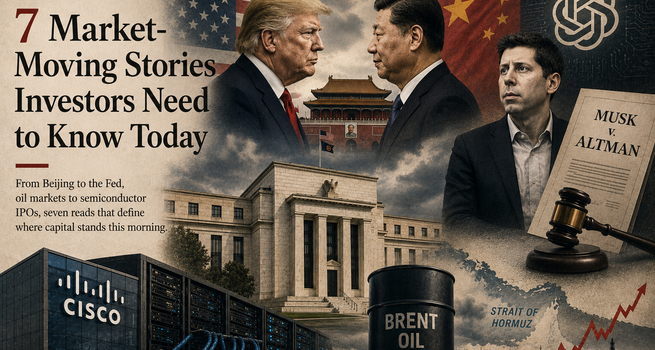
From Beijing to the Fed, oil markets to semiconductor IPOs, seven reads that define where Capital stands this morning.
- Geopolitics: Trump and Xi Open Beijing Summit; Taiwan and Trade Dominate the Strategic Agenda
President Donald Trump and Chinese President Xi Jinping held their first formal session at the Great Hall of the People in Beijing on Thursday, the first U.S. presidential state visit to China since 2017. Xi framed the relationship in stabilising terms, stating the two nations "should be partners, not rivals." Trade remained the central economic variable. Xi told Trump that trade wars produce no winner and that bilateral economic ties are mutually beneficial. A Chinese foreign ministry statement described working-group outcomes as "generally balanced and positive." A bilateral Board of Trade structured around managed trade mechanisms including quotas and voluntary export restraints is being discussed. Global equities hovered near record highs as markets awaited fresh catalysts from the summit.
- Xi warned that mishandling Taiwan would risk "clashes and even conflicts," calling it the "most important" bilateral issue.
- Nvidia CEO Jensen Huang, Tesla CEO Elon Musk, and Apple CEO Tim Cook all travelled with the U.S. Business delegation.
- Mainland China equities dropped approximately 1% Thursday despite broadly positive summit framing.
- Monetary Policy: Warsh Confirmed as Fed Chair; Rate Trajectory Remains Contested Amid Persistent Inflation
The Senate voted 54 to 45 to confirm Kevin Warsh as the next chair of the Federal Reserve, the closest such confirmation in the institution's modern history. Warsh assumes Leadership at a structurally difficult moment: headline inflation has reaccelerated, energy prices remain elevated due to the Iran conflict, and futures markets assign only a 3% probability to a rate cut at any point in 2026. Jerome Powell, whose term as chair expires Friday, is expected to remain on the board as a governor through 2028. Warsh has previously called for "regime change" at the Fed, signalling tighter coordination with the Treasury and a smaller Balance Sheet.
- Only Pennsylvania Democrat John Fetterman crossed party lines to support the confirmation.
- Markets currently price a 36% probability of a rate increase by December 2026; the federal funds target sits at 3.5% to 3.75%.
- Warsh's first FOMC meeting as chair is scheduled for June 16 to 17.
- Earnings: Cisco Posts Record Revenue as AI Infrastructure Demand Reshapes Networking Capital Allocation
Cisco reported fiscal third-quarter revenue of $15.84 billion, a 12% increase year over year and a record for the company. Adjusted EPS of $1.06 exceeded the consensus estimate of $1.04. Networking revenue grew 25%. Forward guidance of $16.7 billion to $16.9 billion for Q4 also surpassed expectations. Shares rose approximately 17% in extended trading. CEO Chuck Robbins attributed results to "very strong, broad-based demand" linked to AI infrastructure buildout. The company separately announced a workforce reduction of fewer than 4,000 employees, representing less than 5% of total headcount, with cuts commencing Thursday.
- CSCO shares have gained approximately 33% year to date, outpacing the Nasdaq's 14% advance.
- Applied Materials also reports earnings Thursday, adding further disclosure density to semiconductor-adjacent Capital Markets.
- Risk note: elevated sector valuations relative to near-term earnings visibility remain a material consideration for institutional investors.
- Legal and AI Governance: Altman Testifies in Musk v. Altman Trial; OpenAI IPO and Microsoft Exposure in Focus
OpenAI CEO Sam Altman concluded approximately four hours of testimony in Oakland, California on Tuesday, rejecting Musk's central claim that OpenAI and Microsoft had "stolen a charity" by converting to a for-profit structure. Altman argued the conversion was the only viable path to raising the capital required to develop safe AI at scale, while framing Musk as a leader who sought 90% control of OpenAI and "demotivated key researchers." Musk's lawyer cross-examined Altman on his trustworthiness, surfacing criticism from former OpenAI figures including Mira Murati and board members involved in his 2023 ouster. Closing arguments are scheduled for Thursday, with a Jury verdict possible as early as next week. Separately, testimony revealed Microsoft CEO Satya Nadella feared OpenAI could supplant his company in the technology hierarchy as far back as 2022, with Microsoft's total OpenAI commitment projected to exceed $100 billion by June 2026.
- Musk is seeking up to $150 billion redistributed to the OpenAI nonprofit, plus removal of Altman and Brockman and dissolution of the for-profit entity.
- OpenAI's valuation has reached $850 billion; it has since forged cloud partnerships with Microsoft rivals Google, Oracle, and Amazon, straining the preferential access Microsoft assumed in its early Investment.
- Risk note: any verdict short of a full OpenAI win risks delaying the company's anticipated IPO and widening the discount on OpenAI Secondary Market positions.
- Energy Markets: IEA Projects Structural Oil Supply Deficit Through 2026; Brent Holds Above $107 as Hormuz Risk Persists
The International Energy Agency's May 2026 Oil Market Report projects a global supply deficit of 1.78 million barrels per day for the year, with approximately 12.8 million barrels per day of supply lost since February due to the Iran conflict. Global oil supply is projected to fall 3.9 million barrels per day across 2026. Brent Crude was trading at approximately above $105 per barrel on Wednesday, with the IEA projecting steepest inventory draws in May and June. The release of 400 million barrels by 32 IEA member nations is expected to provide a temporary buffer but will not close the structural gap. The conflict has pushed annual energy prices up nearly 18% in the U.S., a primary driver of the reacceleration in headline CPI to 3.8%.
- WTI crude traded at approximately $101.67 per barrel on Wednesday, with both benchmarks mildly softer on the session.
- Wolfe Research has cautioned that the near-term bull case for equities rests partly on oil prices falling rapidly following an Iran conflict resolution.
- Risk note: a sustained Hormuz blockade through the second quarter materially extends the inflation timeline and constrains the Fed's policy Options.
- Labour and Supply Chain: Samsung Faces 18-Day Strike Threat from 41,000 Workers; South Korea Warns of Growth and Export Risk
Samsung's labour union has threatened an 18-day walkout beginning May 21 if its demands are not met, potentially involving more than 41,000 workers. South Korea's finance minister warned Thursday that a strike of this scale could pose a material threat to the country's economic growth, exports, and financial markets. Samsung shares recovered as much as 5.46% on Thursday after briefly losing approximately $66 billion in Market Capitalisation on Wednesday following news of the labour dispute. Samsung is the world's largest memory chip producer, and any sustained disruption to its Manufacturing operations carries direct implications for global semiconductor supply chains at a moment when AI-driven demand is structurally elevated.
- The strike threat was first announced at a union rally on April 23; negotiations have not yet produced a resolution.
- The DRAM memory ETF fell 7% on Tuesday before partially recovering, reflecting investor sensitivity to memory supply risk.
- Risk note: a sustained Samsung production disruption would tighten memory supply at a moment of peak AI infrastructure demand.
- Capital Markets: Cerebras Systems Prices IPO at $185 as AI Chip Sector Tests Public Market Valuation Limits
AI chip startup Cerebras Systems priced its initial public offering at $185 per share, above its marketed range of $150 to $160, raising $5.55 billion in the largest technology listing of 2026. The company develops wafer-scale processors designed for large-scale AI Training workloads and begins trading on Nasdaq today under the ticker CBRS. The IPO arrives as the Philadelphia Semiconductor index has risen 64% since the end of March, reflecting sustained institutional demand for AI-linked infrastructure exposure. Whether public market valuations can absorb the forward earnings assumptions embedded in semiconductor listings at current multiples remains a structurally open question for capital allocators.
- The offering was oversubscribed more than 20 times, prompting Cerebras to upsize both price and share count ahead of pricing.
- Cerebras has positioned itself as a direct architectural alternative to Nvidia's GPU-dominant training stack; in January it signed a $20 billion-plus compute commitment from OpenAI.
- Risk note: elevated semiconductor valuations relative to near-term earnings visibility represent a material downside consideration for institutional investors.


 Jun 05, 2026




 Please wait processing your request...