
 AU
AU
 UK
UK
 CA
CA
 NZ
NZ
 IND
IND

 US
US

 Share
Share
 X (Formerly Twitter)
 Whatsapp
 Facebook
 LinkedIn
 Telegram
 Email This Article
 Copy Link
 Summarize with AI
 Chat GPT
 Perplexity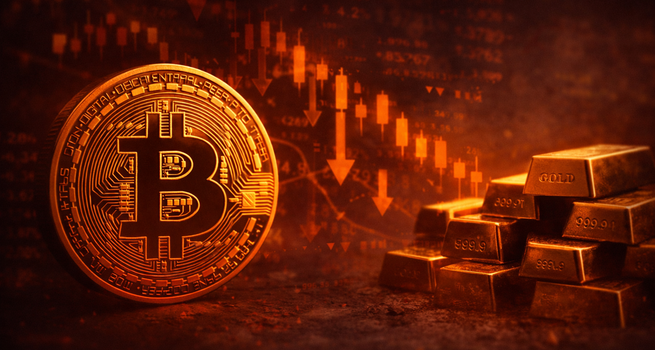
Key Highlights
- Bitcoin rose 4.4% after geopolitical tensions eased, not intensified
- Ethereum outperformed, reinforcing crypto’s high-beta profile
- Crypto continues to trade in line with equities during risk cycles
- Oil-driven inflation and rates remain dominant macro drivers
- The “digital gold” thesis faces renewed scrutiny
A Narrative Meets Reality
Bitcoin’s claim to be “digital gold” has long rested on a simple proposition. In times of geopolitical stress and monetary disorder, it should act as a store of value independent of traditional financial systems.
Events on March 23 offered a clear test. The results were less flattering.
When President Donald Trump announced a five-day pause on planned US strikes against Iranian energy infrastructure, bitcoin rose sharply. Prices climbed from roughly $68,500 to above $71,000, a gain of 4.4% within hours. Ethereum rose even more, advancing over 7%.
The direction of the move is instructive. Bitcoin rallied as risk receded, not as it intensified.
Crypto Market Analysis: Price Action Mirrors Risk Assets
The broader crypto complex followed a familiar pattern. During the preceding period of heightened geopolitical tension, digital assets weakened alongside global equities. When the immediate risk appeared to diminish, both rebounded.
This symmetry is difficult to reconcile with the idea of bitcoin as a hedge. Safe-haven assets are expected to rise when uncertainty increases. Bitcoin did the opposite.
Instead, its behaviour aligns with that of high-beta assets. It falls when liquidity tightens and rises when conditions ease.
Ethereum’s sharper move reinforces this interpretation. Its 7.2% rally underscores the speculative nature of the broader crypto ecosystem, where gains are often amplified in risk-on environments.
Macro Context: Oil, Inflation, and the Return of Rate Risk
The backdrop to these moves is critical.
Oil prices had surged in the days leading up to the announcement, driven by fears of disruption in the Strait of Hormuz. That surge fed directly into inflation expectations, forcing markets to reassess the trajectory of interest rates.
Bond yields rose. The dollar strengthened. Equities declined.
In such an environment, assets dependent on abundant liquidity tend to struggle. Bitcoin was no exception.
When the prospect of immediate conflict eased, oil prices fell sharply. Inflation fears moderated. Yields stabilised. Risk appetite returned. Bitcoin rose alongside equities.
The sequence highlights a key point. Crypto is not insulated from macro forces. It is embedded within them.
Bitcoin vs Gold: Diverging Safe Haven Credentials
The comparison with gold remains central to bitcoin’s identity.
Gold, too, declined during the recent bout of market stress. However, the drivers were different. Rising real yields increased the opportunity cost of holding non-yielding assets, weighing on gold prices.
Bitcoin’s decline, by contrast, tracked equity markets more closely. Its recovery mirrored the rebound in risk assets rather than reflecting a distinct monetary dynamic.
This distinction matters.
Gold’s behaviour can be explained within a well-established macro framework. Bitcoin’s behaviour suggests it is still governed primarily by liquidity conditions and investor sentiment.
Market Correlation: Integration with Financial Cycles
The correlation between crypto and traditional risk assets has become increasingly evident.
During periods of stress:
- Equities fall
- Liquidity tightens
- Bitcoin declines
During periods of relief:
- Equities rise
- Liquidity improves
- Bitcoin rallies
This pattern indicates that crypto markets are not operating independently of the broader financial system. Rather, they are highly sensitive to the same drivers that influence equities and other risk assets.
For institutional investors, this raises important questions about diversification and portfolio construction.
Investor Perspective: Reassessing the Digital Gold Thesis
The “digital gold” narrative has proven resilient, in part because it is difficult to falsify in benign conditions. When markets are stable, bitcoin’s upward drift can be attributed to scarcity and adoption.
Periods of stress are more revealing.
Recent market behaviour suggests that bitcoin functions less as a hedge against systemic risk and more as a leveraged expression of it. When conditions deteriorate, investors reduce exposure. When conditions improve, they return.
This is not the behaviour of a traditional safe haven.
Strategic Outlook: Volatility Likely to Persist
The immediate outlook for bitcoin will depend largely on macro developments.
If geopolitical tensions ease further:
- Oil prices may stabilise
- Inflation expectations could moderate
- Bitcoin may continue to recover alongside equities
If tensions re-escalate:
- Energy prices could rise again
- Central banks may face renewed pressure to tighten
- Bitcoin is likely to come under pressure
In either scenario, the asset’s sensitivity to external conditions remains clear.
Conclusion: A Story Under Strain
Bitcoin’s performance following the recent geopolitical developments offers a useful reality check.
The asset did not behave as a hedge against uncertainty. It behaved as a participant in the broader risk cycle.
This does not invalidate the long-term case for bitcoin as a store of value. But it does suggest that, at present, its role in portfolios is closer to that of a risk asset than a defensive one.
The label of digital gold may endure. The market evidence, for now, points elsewhere.
FAQ Section
- Why did bitcoin rise after tensions eased?
Bitcoin rose because markets shifted into a risk-on environment. Reduced geopolitical risk improved investor sentiment, leading to gains in both equities and crypto assets.
- Does bitcoin behave like gold during crises?
Recent evidence suggests it does not. Unlike gold, bitcoin tends to move with equities and broader risk assets during periods of market stress.
- What drives bitcoin prices today?
Bitcoin prices are largely influenced by macro factors such as interest rates, liquidity conditions, and overall market sentiment rather than purely geopolitical events.
- Is bitcoin still a hedge against inflation?
Bitcoin’s effectiveness as an inflation hedge remains debated. In practice, its price movements have been more closely tied to liquidity and risk appetite than to inflation itself.
- How should investors view bitcoin in portfolios?
Investors may consider bitcoin as a high-risk, high-reward asset rather than a traditional hedge, given its strong correlation with equities and sensitivity to macroeconomic conditions.


 Jun 05, 2026




 Please wait processing your request...