
 AU
AU
 UK
UK
 CA
CA
 NZ
NZ
 IND
IND

 US
US

 Share
Share
 X (Formerly Twitter)
 Whatsapp
 Facebook
 LinkedIn
 Telegram
 Email This Article
 Copy Link
 Summarize with AI
 Chat GPT
 Perplexity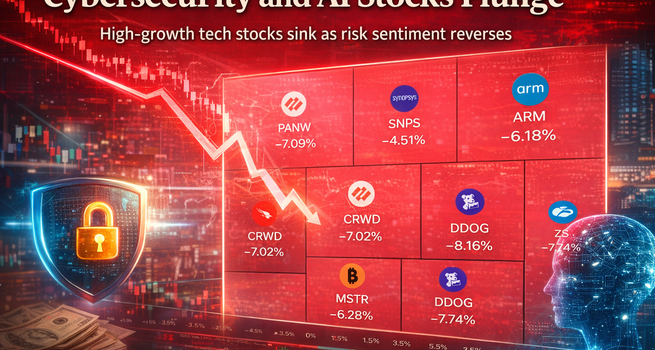
Key Highlights
- High growth technology stocks declined sharply across cybersecurity and AI segments
- CrowdStrike (NASDAQ: CRWD) and Palo Alto Networks (NASDAQ: PANW) led losses among security names
- Arm Holdings (NASDAQ: ARM) and Synopsys (NASDAQ: SNPS) weakened amid semiconductor pressure
- Datadog (NASDAQ: DDOG) and Zscaler (NASDAQ: ZS) extended declines on growth stock repricing
- MicroStrategy (NASDAQ: MSTR) fell alongside broader risk-off sentiment in crypto-linked equities
Introduction: Growth Stocks Face Renewed Selling Pressure
A broad-based sell-off across high growth technology stocks unfolded in the latest trading session, with cybersecurity, software infrastructure, and semiconductor-linked names leading declines. The move reflects a recalibration in investor sentiment as elevated valuations and macro uncertainty weigh on risk appetite.
Market participants have increasingly rotated away from premium growth assets toward more defensive sectors, following a period of strong outperformance driven by artificial intelligence optimism and digital transformation themes. The latest pullback suggests that investors are reassessing earnings visibility and valuation sustainability across some of the most crowded trades in global equities.
Technology Sector Analysis: Cybersecurity and AI Stocks Under Pressure
The decline was particularly pronounced within the cybersecurity segment, where multiple industry leaders recorded steep losses. CrowdStrike (NASDAQ: CRWD) fell over 7 percent, while Palo Alto Networks (NASDAQ: PANW) declined by a similar magnitude. Fortinet (NASDAQ: FTNT) also came under pressure, losing more than 5 percent.
These moves highlight a broader shift in sentiment within a sector that has historically commanded premium multiples due to strong recurring revenue models and robust demand for digital security solutions. While the structural demand for cybersecurity remains intact, recent price action indicates that investors are becoming more sensitive to valuation levels and growth sustainability.
Software infrastructure names also weakened. Datadog (NASDAQ: DDOG), a key player in observability and cloud monitoring, declined more than 8 percent, marking one of the sharpest moves within the group. Zscaler (NASDAQ: ZS), another high growth security platform, dropped nearly 8 percent, extending recent volatility in cloud security valuations.
The semiconductor and AI ecosystem did not escape the sell-off. Arm Holdings (NASDAQ: ARM), which has been closely tied to AI-driven demand for chip architecture, fell more than 6 percent. Synopsys (NASDAQ: SNPS), a critical supplier of electronic design automation tools, declined over 4 percent.
The weakness across these names suggests that investors are reassessing the pace and durability of AI-related revenue expansion, particularly after a period of aggressive multiple expansion.
Market Trends: Rotation and Valuation Reset in Growth Equities
The current decline reflects a broader market trend in which investors are rotating out of high multiple growth stocks and into areas perceived as offering greater earnings stability. This shift is occurring against a backdrop of persistent macro uncertainty, including interest rate expectations, geopolitical developments, and evolving liquidity conditions.
Growth stocks, particularly those in technology, have been highly sensitive to changes in discount rates. As expectations around monetary policy remain fluid, valuation frameworks for long-duration assets have come under renewed scrutiny.
The magnitude of declines across multiple segments indicates that this is not an isolated company-specific event but rather a coordinated repricing across the growth spectrum. The simultaneous weakness in cybersecurity, software, and semiconductor names underscores the interconnected nature of modern technology ecosystems.
Core Analysis: Drivers Behind the Sell-Off
Several factors appear to be driving the current sell-off across technology equities.
First, valuation compression remains a central theme. Many of the affected companies have traded at elevated revenue multiples, supported by strong growth narratives and recurring revenue models. As investors reassess risk, these valuations are increasingly being challenged.
Second, positioning and crowding have amplified the move. Cybersecurity and AI stocks have been among the most widely owned segments within institutional portfolios. As sentiment shifts, the unwinding of crowded positions can accelerate downside momentum.
Third, earnings expectations are being recalibrated. While demand for cybersecurity and cloud services remains robust, there is growing scrutiny around the pace of enterprise spending. Any signs of moderation in IT budgets could have a disproportionate impact on companies priced for sustained high growth.
Fourth, broader market dynamics are influencing risk appetite. The decline in MicroStrategy (NASDAQ: MSTR), which fell more than 6 percent, reflects weakness in crypto-linked equities and signals a broader reduction in speculative positioning.
Financial and Market Implications: Impact on Valuation and Investor Sentiment
The recent sell-off has meaningful implications for valuation, sentiment, and capital allocation across the technology sector.
From a valuation perspective, the decline suggests a potential normalization of multiples after a period of expansion. Investors are increasingly demanding clearer earnings visibility and stronger cash flow generation to justify premium pricing.
Investor sentiment has also shifted. The sharp and simultaneous declines across multiple high profile names indicate a move toward caution, particularly in segments that have benefited from strong narrative-driven inflows. This shift may lead to increased volatility in the near term as markets search for a new equilibrium.
Sector positioning is likely to evolve as a result. Portfolio managers may rebalance exposure toward companies with more stable earnings profiles or those trading at more moderate valuations. This could lead to a divergence within the technology sector, with some segments outperforming while others continue to face pressure.
Capital allocation trends may also adjust. Companies that have relied on aggressive growth strategies may face greater scrutiny regarding profitability and return on investment. This could influence strategic decisions around expansion, hiring, and product development.
Conclusion: A Broad Repricing Across High Growth Technology
The latest decline in cybersecurity, software, and semiconductor stocks reflects a broader repricing across high growth technology equities. While the structural drivers of demand remain intact, including digital transformation and AI adoption, the market is increasingly focused on valuation discipline and earnings sustainability.
The coordinated nature of the sell-off suggests that this is less about company-specific weakness and more about a shift in how investors are assessing risk and return in the current environment. As markets adjust, the balance between growth potential and valuation support will remain a central theme for investors navigating the technology sector.


 Jun 05, 2026




 Please wait processing your request...