
 AU
AU
 UK
UK
 CA
CA
 NZ
NZ
 IND
IND

 US
US

 Share
Share
 X (Formerly Twitter)
 Whatsapp
 Facebook
 LinkedIn
 Telegram
 Email This Article
 Copy Link
 Summarize with AI
 Chat GPT
 Perplexity
From the Beijing summit's final day to SpaceX's imminent IPO filing, seven stories defining Capital Markets at the open.
1. Geopolitics: Trump-Xi Summit Enters Final Day; Oil Sales, Boeing Jets and AI Guardrails Emerge as Headline Deliverables
President Donald Trump and Chinese President Xi Jinping are meeting Friday for a tea session and working lunch at Zhongnanhai to close their two-day Beijing summit, the first U.S. presidential visit to China since 2017. Day one produced a framework to build a "constructive, strategic and stable" bilateral relationship for the next three years and beyond. Trump told Fox News that China agreed to purchase 200 Boeing jets and that Chinese ships would begin sailing to Texas, Louisiana, and Alaska to buy American oil, though China has not officially confirmed the energy purchase. U.S. Trade Representative Jamieson Greer said China would buy double-digit billions of dollars in U.S. agricultural products annually for three years. Treasury Secretary Scott Bessent said the two nations would begin discussing AI guardrails. Xi told assembled U.S. CEOs that China's door "will only open wider."
- Boeing shares fell 4.1% on Thursday as the 200-jet figure came in well below the roughly 500 aircraft analysts had expected, with no contract details, delivery timeline, or operator names disclosed.
- Analysts cautioned the Commodity-heavy nature of the deals, covering oil, soybeans, and beef, risks positioning the U.S. more as a raw material supplier than a strategic technology partner.
- Day one produced a framework but no binding deliverables; analysts note all summit outcomes remain reversible and several provisions expire or require reinstatement by late 2026.
2. Technology and Trade: U.S. Clears H200 Chip Sales to Ten Chinese Firms; Zero Deliveries Made as Nvidia's China Revenue Remains in Limbo
The U.S. Commerce Department has approved approximately ten Chinese companies, including Alibaba, Tencent, ByteDance, JD.com, Lenovo, and Foxconn, to purchase Nvidia's H200 processors, the company's second-most powerful AI chip. Despite approvals being in place since December 2025, not a single delivery has been made. Chinese firms have pulled back from completing purchases following guidance from Beijing, and pressure within China is reportedly mounting to block or tightly vet the orders. Commerce Secretary Howard Lutnick told a Senate hearing last month that the Chinese central government has not allowed purchases "because they're trying to keep their Investment focused" on domestic alternatives. Nvidia CEO Jensen Huang joined Trump's Beijing delegation after a direct presidential invitation, raising hopes the summit could unlock the stalled trade. Nvidia shares hit an all-time high of USD 230 on Thursday, up more than 40% from their March low. China once accounted for 13% of Nvidia's revenue; Huang has estimated the country's AI market alone is worth USD 50 billion in 2026.
- The H200 significantly outperforms the downgraded H20 previously cleared for the Chinese market; the B200, Nvidia's most powerful chip, remains blocked.
- Nvidia reports Earnings on May 20; the China revenue trajectory is the single most watched variable in the print.
- Risk note: the deal remaining undelivered despite formal U.S. approval illustrates the structural complexity of the technology rivalry, as approved trade can still be blocked by the other side.
3. Legal and Corporate: OpenAI Explores Legal Action Against Apple Over Strained iPhone AI Partnership; AAPL Dips 1%
OpenAI is exploring legal action against Apple over what it characterises as a failure to invest sufficiently in their 2024 partnership integrating ChatGPT into the iPhone, according to people familiar with the matter. OpenAI lawyers are working with an outside legal firm on Options including sending Apple a notice alleging breach of contract without necessarily filing a full lawsuit initially. OpenAI described a "pattern of behaviour from Apple showing no interest in investing required resources to deliver on the promise of the partnership," adding that Apple is "focused solely on extracting a tax for their market position." The startup had anticipated the collaboration would drive material subscriber growth and expected deeper integration across Apple apps and prime Placement within Siri. Apple's use of OpenAI technology across its operating systems remains limited and features can be hard to find. Apple shares fell 1% on the report.
- Apple earlier this year partnered with Google to use Gemini models to power Apple Intelligence, widely viewed as a rebuke of OpenAI, which was Apple's first AI partner.
- OpenAI has separately hired Apple's former design chief Jony Ive to work on a new consumer device that could compete directly with the iPhone, sharpening the commercial rivalry.
- Risk note: the legal threat arrives as OpenAI simultaneously faces a Jury verdict in the Musk v. Altman trial and prepares for a public offering, with governance and legal overhang on multiple fronts a material consideration for its IPO valuation.
4. Capital Markets: Cerebras Soars 68% on Nasdaq Debut; SpaceX Prospectus Expected Next Week in What Could Be the Largest IPO in History
Cerebras Systems opened at USD 350 on Thursday, 89% above its USD 185 IPO price, and closed at USD 311.07, giving the AI chipmaker a Market Capitalisation of approximately USD 95 billion. The company raised USD 5.55 billion across 30 million shares, the largest U.S. tech IPO since Uber's 2019 debut, and could raise USD 6.38 billion if underwriters exercise the full overallotment option. Revenue jumped 76% in 2025 to USD 510 million and the company swung to a net profit of USD 88 million from a loss of USD 481.6 million the prior year. Applied Materials also beat expectations after the close, reporting adjusted EPS of USD 2.86 on revenues of USD 7.91 billion against estimates of USD 2.66 and USD 7.65 billion respectively. SpaceX is planning to disclose its IPO prospectus as soon as next week, targeting a roadshow beginning June 8, with a possible valuation near USD 1.75 trillion and a USD 75 billion raise that would be the largest IPO in history, surpassing Saudi Aramco's USD 25.6 billion in 2019.
- OpenAI and Anthropic are both pursuing public offerings as soon as later in 2026 with potential valuations above USD 1 trillion, pointing to a historically dense AI IPO pipeline.
- Cerebras has a USD 20 billion-plus compute deal with OpenAI and a USD 24.6 billion revenue Backlog as of end-2025; 62% of 2025 revenue came from a single UAE university, a customer concentration risk that remains material.
- Risk note: elevated first-day valuations and thin floats in AI IPOs create mechanical Demand dynamics that can diverge sharply from fundamental value once lockup periods expire.
5. Digital Assets: CLARITY Act Clears Senate Banking Committee 15 to 9; Crypto Equities Rally Then Fade as Floor Vote Risk Repriced
The Senate Banking Committee voted 15 to 9 on Thursday to advance the Digital Asset Market Clarity Act, formally known as H.R. 3633, the most significant legislative step forward for U.S. crypto market regulation to date. The bill splits digital asset oversight between the SEC and the CFTC, resolving a years-long jurisdictional dispute that has left the industry in a regulatory grey zone. Democratic Senators Ruben Gallego and Angela Alsobrooks joined all 13 Republicans in the bipartisan vote. Crypto-linked equities rallied sharply on the news before fading as committee vote euphoria gave way to traders repricing the bill's difficult path to a full Senate floor vote and the unresolved ethics provision addressing elected officials profiting from digital assets. Coinbase ended up 5.06%, Strategy up 5.02%, and MARA Holdings up 4.24%, all closing well off their intraday highs. Bitcoin closed higher on the session after briefly touching a multi-week high intraday before pulling back as broader risk sentiment softened into the close. The bill must still clear a full Senate floor vote requiring 60 votes to overcome a filibuster before moving to House reconciliation and presidential signature.
- Senator Elizabeth Warren described the bill as "legislation written by the crypto industry for the crypto industry"; Democratic Senator Alsobrooks stated her committee vote would not translate to a floor vote unless outstanding issues were addressed.
- Trump and his family have reportedly accumulated at least USD 1.4 billion in crypto-related gains since taking office, making the ethics language politically contentious on both sides.
- Risk note: the bipartisan committee Margin does not guarantee the 60 votes needed on the Senate floor; the bill faces a materially higher bar before it can be considered law
6. Monetary Policy: Powell's Final Day as Fed Chair; Warsh Assumes Leadership as Inflation, Energy Risk and Fed Independence Concerns Define the Mandate
Jerome Powell's term as Federal Reserve chair expires Friday, ending a tenure that navigated Pandemic-era inflation, the most aggressive rate hiking cycle since the 1980s, and the inflationary consequences of the Iran war. Kevin Warsh, confirmed by the Senate 54 to 45 on Wednesday in the closest such vote in the institution's modern history, formally assumes the chairmanship today. Warsh inherits a structurally difficult mandate: headline CPI stands at 3.8%, its highest since 2023; monthly PPI surged 1.4% in April, the largest monthly increase since March 2022; the 10-year Treasury Yield touched 4.48% this week; and futures markets assign only a 3% probability to a rate cut at any point in 2026. Powell is expected to remain on the Fed board as a governor through January 2028.
- Warsh has called for "regime change" at the Fed, signalling tighter coordination with the Treasury, a smaller Balance Sheet, and a reassessment of the communications framework.
- Warsh's first FOMC meeting as chair is June 16 to 17; markets will closely scrutinise his opening statement for policy path signals.
- Risk note: Warsh's close alignment with the Trump administration raises Fed independence concerns that institutional investors and foreign central banks will monitor carefully.
7. Energy Markets: Brent on Track for a 6% Weekly Gain as Hormuz Remains Closed; Trump Says He Does Not Need the Strait Open
Brent Crude is headed for a weekly gain of approximately 6%, trading near USD 107 per barrel Friday morning, as the Strait of Hormuz remains effectively closed with no resolution to the U.S.-Iran conflict in sight. West Texas Intermediate is above USD 102. In a Fox News interview following his Thursday session with Xi, Trump said he "doesn't need Hormuz open," adding that Xi wants to see the war end and is interested in purchasing more American oil. The IEA's May 2026 Oil Market Report projects a global Supply Deficit of 1.78 million barrels per day for the year, with total supply losses of 12.8 million barrels per day since February. The conflict has pushed annual U.S. energy prices up nearly 18%, the primary structural driver of headline CPI reaching 3.8% in April. The AAA national average for a gallon of regular gas stands at USD 4.53 as of Thursday.
- Trump's statement that he does not need Hormuz open reduces the perceived urgency of a near-term resolution, materially extending the inflation risk horizon.
- China is Iran's largest oil customer, importing approximately 1.4 million bpd of Iranian crude in 2025, approximately 90% of Iran's total exports; Xi's willingness to pressure Tehran on Hormuz is therefore a key variable.
- Risk note: a sustained Hormuz blockade through Q2 structurally constrains Warsh's policy options at the Fed and extends the timeline before any rate reduction is possible.


 Jun 05, 2026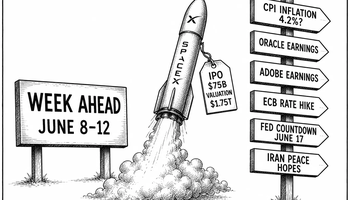




 Please wait processing your request...