
 AU
AU
 UK
UK
 CA
CA
 NZ
NZ
 IND
IND

 US
US

 Share
Share
 X (Formerly Twitter)
 Whatsapp
 Facebook
 LinkedIn
 Telegram
 Email This Article
 Copy Link
 Summarize with AI
 Chat GPT
 Perplexity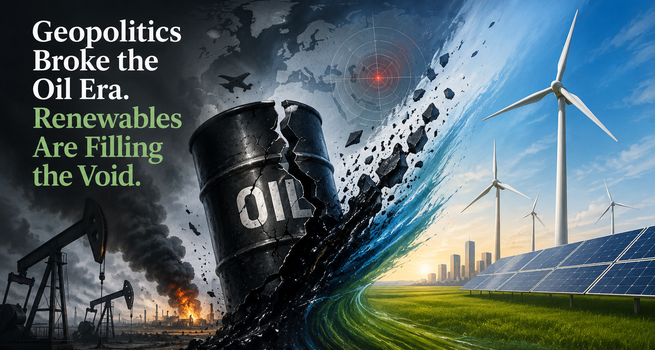
Key Highlights
- The Iran conflict has exposed the structural fragility of fossil fuel Supply concentration, compressing the timeline on energy security decisions governments were already making slowly.
- Renewable energy is being repositioned from climate policy to sovereign infrastructure, with Capital allocation at the state level reflecting that shift.
- Oil Demand is approaching a structural peak, and the UAE's OPEC exit is the clearest signal yet that even the most efficient producers are running a harvest strategy against a closing window.
- Coal, the presumed bridge fuel, is losing economic ground to renewables before it can Fill the gap left by oil disruption.
- Capital Markets face simultaneous oversupply risk and geopolitical Volatility, with the structural direction of Investment flows becoming increasingly legible despite short-term noise.
Introduction
Energy transitions do not follow clean timelines. They are accelerated by crises, complicated by Economics, and shaped as much by geopolitical necessity as by technological progress. The Iran conflict, which erased an estimated several million barrels per day of OPEC production in recent months, is the latest demonstration of this pattern.
The instinctive reading of a Gulf supply shock is that it reinforces fossil fuel dependence. Prices spike, energy security anxieties resurface, and the world is reminded of its reliance on a geography it cannot control. But beneath that immediate reaction, a more consequential process is unfolding. The shock is not restoring faith in fossil fuels. It is accelerating the structural argument against them.
What the Iran disruption has done is compress the timeline on decisions that governments and capital allocators were already making slowly. The case for renewables, once constructed around emissions targets and climate commitments, is being rebuilt on harder ground: energy independence, supply resilience, and the now-irreversible economics of solar and wind deployment.
Oil set up the problem. Coal, once treated as the default bridge fuel, is being displaced before it can credibly serve that role again. Renewables are not waiting for the transition to be managed neatly. They are gradually absorbing the strategic and economic space that fossil fuels are increasingly failing to hold.
The global energy system is entering a phase where geopolitical shocks accelerate the structural case for renewables, even as fossil fuel producers race to monetise reserves before the demand cycle closes permanently.
Geopolitics and the Repricing of Energy Security
The Strait of Hormuz carries approximately 20 percent of global oil supply through a corridor that can be shut by a single regional conflict. The Iran war has made that vulnerability not theoretical but operational. A significant monthly decline in OPEC output surpassed every comparable supply shock in modern history, exceeding the Covid-19 disruption of 2020, the 1970s oil crisis, and the 1991 Gulf War in terms of immediate Volume loss.
Governments and institutional investors watching this unfold are not concluding that they need to secure more Gulf oil. They are concluding that they need structurally less exposure to it.
Energy security is being repriced. The framework that once measured security through access alone, asking only whether sufficient supply existed somewhere in the world at acceptable cost, is giving way to a more demanding standard: resilience and decentralisation. The relevant question is no longer whether oil can be sourced. It is whether the supply architecture can absorb a political or military shock in a concentrated geography without cascading economic damage to systems that depend on it.
Renewable energy, distributed in generation, domestically deployable, and structurally immune to foreign interdiction, addresses that question directly. It cannot be sanctioned. It cannot be blockaded. A solar installation in Gujarat or a wind farm in the North Sea does not depend on safe passage through a contested maritime chokepoint. Its fuel cost is zero and its supply chain, once built, is domestic.
This is the repricing that the Iran shock has accelerated. Renewables are no longer being evaluated solely on emissions reduction potential. They are being assessed as strategic infrastructure, carrying a Risk-adjusted-return/">Risk-Adjusted Return profile that includes the avoided cost of geopolitical vulnerability. That is a fundamentally different and considerably stronger investment thesis than the one that underpinned renewable deployment a decade ago.
Renewables as Strategic Infrastructure, Not Climate Policy
For the better part of two decades, the political case for renewable energy rested on climate commitments: Paris Agreement targets, net-zero pledges, and the moral weight of decarbonisation. That framing, while substantively correct, created a dependency on political continuity that proved fragile. When administrations changed or fiscal pressures mounted, renewable mandates were among the first casualties.
The reframing now underway is more durable because it does not require political consensus on climate. Renewable energy is being evaluated alongside defence spending, critical mineral stockpiles, and strategic food reserves as a component of national security infrastructure. The logic is not environmental. It is sovereign.
For net-importer nations, a category that includes most of Europe, Japan, South Korea, India, and significant parts of Southeast Asia, every unit of domestically generated renewable electricity is a unit of energy that does not require foreign currency, diplomatic Goodwill, or safe maritime passage to procure. The Iran shock has given this calculation immediate and visible economic consequences. Energy Import bills, currency pressures, and supply disruption costs are tangible. Carbon targets are not.
Governments are responding with commensurate urgency. European energy independence investment has accelerated under the explicit framing of reducing exposure to politically unstable supply regions. India's renewable capacity expansion, already among the most ambitious globally, is being driven as much by energy sovereignty as by emissions commitments. China's dominance in solar Manufacturing and deployment, accounting for 45 to 60 percent of global renewable capacity additions, reflects a long-standing strategic judgment that energy self-sufficiency is a geopolitical asset worth subsidising heavily.
The electrification of transport, industrial processes, and heating multiplies the strategic value of each unit of renewable capacity. Every sector that converts from fossil fuel dependence to domestic electricity generation reduces the economy's exposure to external supply shocks. Grid expansion becomes not merely infrastructure investment but systematic geopolitical de-risking.
Renewable energy is displacing fossil fuels not only because it is cleaner but because it is more controllable, more predictable, and now cheaper at the Margin than new fossil fuel generation in most major markets. That convergence of economics and strategy is producing a quality of political commitment that climate policy alone never generated.
The Peak Oil Demand Shift and the UAE's Harvest Strategy
Beneath the noise of current supply disruptions lies a structural transformation in oil markets that is more consequential than any single geopolitical event. Global oil demand is approaching its peak. The debate is increasingly less about whether this occurs and more about when, and how the transition from growth to plateau to decline reshapes the economics of an industry built on long-duration asset valuations.
The International Energy Agency's Stated Policies Scenario projects a flattening of oil demand around 2030, driven by EV adoption, vehicle efficiency improvements, and electrification of transport. In China, over half of new vehicle sales are now electric. The on-road fleet remains predominantly internal combustion engine, but the displacement curve is visible and the trajectory is not reversing. Europe and North America are compressing that timeline through regulatory mandates. The aggregate effect is a systematic erosion of transport fuel demand, historically the single largest driver of oil consumption growth.
For producers and capital allocators, this changes the fundamental asset classification of petroleum reserves. Oil is transitioning from a long-duration asset, one where the terminal value of reserves stretches confidently into the future, to a declining cash-flow asset, where the present value of future production is being compressed by a shortening demand horizon. That compression has profound implications for reserve valuation, capital allocation, and, critically, producer strategy.
The UAE's departure from OPEC on May 1, 2026 is the most strategically significant oil market development of the year, and it illustrates the shift precisely. The UAE had spent approximately 150 billion dollars expanding its production capacity to nearly 4.85 million barrels per day. Under OPEC Quota constraints, it was producing roughly 30 percent below that capacity. The question Abu Dhabi was effectively asking was straightforward: why invest to produce oil you are not permitted to sell, particularly when the demand window is closing?
The UAE's competitive position makes that question urgent in a way it is not for most other producers. Its breakeven oil price sits below 50 dollars per barrel, compared to Saudi Arabia's requirement of approximately 90 dollars to balance its national budget. That structural cost advantage transforms the incentive calculus entirely. The UAE does not need high oil prices to generate positive returns. It needs volume, and it needs that volume monetised before the demand curve bends definitively downward.
This is a textbook harvest strategy applied to a depreciating Asset Class. When demand is expected to peak and then decline, the economically rational response for a low-cost producer is not to restrict output in support of prices that benefit higher-cost competitors equally. It is to maximise volume throughput while demand exists, capture Market Share from producers with less favourable cost structures, and generate returns that remain acceptable even in a structurally lower price environment. The UAE is targeting 5 million barrels per day by 2027. That is not an optimistic production target. It is a strategic Liquidation timetable.
This diverges sharply from OPEC's traditional price-control model, which depends on coordinated supply restriction to sustain price floors that serve the fiscal needs of high-breakeven members. The UAE's exit signals a judgment that this model is increasingly misaligned with the structural realities of a peaking demand environment. It is a bet on volume over price, and it is the rational bet when the demand curve is bending and the window for monetisation is finite.
The broader implication is a fracturing of producer cohesion with long-term consequences for price ceilings. If the UAE's strategy proves economically superior to OPEC's approach, it creates visible incentives for other low-cost producers to follow. Saudi Arabia retains the largest spare capacity among remaining members, but its high breakeven makes it the member with the most to lose from sustained lower prices. The structural tension between maintaining price floors and liquidating reserves before demand declines will define producer politics for the remainder of this decade, and it will exert persistent downward pressure on the long-term oil price outlook.
Coal: The Bridge Fuel That Is Running Out of Road
Coal occupies an uncomfortable position in the energy transition narrative. It was the first fossil fuel the world systematically targeted for displacement, and in developed markets that displacement is well advanced. European coal consumption has fallen sharply over the past decade. US coal-fired power generation has been in structural decline since 2008. The economics of new coal capacity in OECD markets are broadly non-viable against the levelised cost of renewables at current build rates.
But the global picture is considerably more complex, and honest analysis requires engaging with it. Coal demand in emerging markets, particularly across South and Southeast Asia, has continued to grow. India's coal consumption has expanded in line with its economy. Indonesia, Vietnam, and Bangladesh have added coal-fired capacity in recent years, driven by the immediate need for reliable baseload power in rapidly industrialising economies where the grid infrastructure required to integrate variable renewable generation does not yet exist at sufficient scale.
The Iran-driven oil disruption has not revived coal as a credible alternative. Oil and coal serve structurally different end markets. Oil is concentrated in transport and Petrochemicals. Coal is concentrated in power generation and industrial heat. The supply shock has not redirected meaningful demand toward coal, and the energy security argument for coal is weak precisely because it remains a traded Commodity subject to its own supply concentration and price volatility.
What the current moment illustrates is that coal's displacement is sequential and uneven rather than simultaneous and global. It is being pushed out by renewables in markets where the economics and grid infrastructure support the transition. In markets where those conditions do not yet hold, it persists by default rather than by preference. The IEA projects coal demand beginning to fall before the end of this decade even under current policies, driven primarily by the pace of solar and wind deployment in China. China accounts for the majority of new global renewable capacity additions and is simultaneously the world's largest coal consumer.
The coal story is ultimately a story about the speed of the renewable buildout in emerging markets. Where solar generation and grid-scale storage become cost-competitive and deployable at scale, coal loses its economic rationale entirely. That process is underway in most markets that matter. The sequencing varies. The direction, in most major markets, is becoming harder to dispute.
Capital Allocation and the Structural Redirect
Energy markets are entering a regime without a clean historical precedent. Short-term geopolitical supply disruption and long-term structural demand compression are operating simultaneously, creating a pricing environment characterised by volatility spikes against a backdrop of softening structural ceilings. For capital allocators, this is not a sector rotation question. It is a fundamental reassessment of how energy Assets are priced across multi-decade horizons.
The bifurcation within fossil fuels matters here. Short-cycle, low-cost oil production retains near-term cash-flow viability. Long-cycle, capital-intensive fossil fuel projects such as deepwater, oil sands, and frontier exploration face compressing terminal valuations as demand ceilings approach and the risk premium on stranded assets rises. The risk-adjusted case for committing capital to infrastructure with a 20 to 30 year payback period in fossil fuels is deteriorating even as short-term commodity prices remain elevated by supply disruption.
The redirect in aggregate capital flows is already observable. Low-carbon technologies now attract over 900 billion dollars annually in global investment, compared to approximately 735 billion for oil and gas. That gap is projected to widen materially through 2030. Notably, oil revenues themselves are being recycled into the transition. The UAE's strategy is the clearest expression of this logic: monetise oil output aggressively at volume, redeploy the proceeds into sovereign Wealth funds, renewable infrastructure, technology, and diversified financial assets. This is not contradiction. It is rational sequencing. Harvest the depreciating asset while cash flows remain strongly positive. Reinvest in the appreciating one before the valuation gap widens further.
Renewable energy infrastructure offers a return profile that is increasingly distinct and attractive in this environment. Long-duration, predictable cash flows. Improving cost structures driven by manufacturing scale and technology maturation. Growing policy support reframed as critical national infrastructure rather than discretionary climate spending. The risk premium that once attached to renewable projects, reflecting technology uncertainty and policy reversibility, is compressing as both dimensions resolve. Solar and wind are now the cheapest source of new electricity generation in most major markets. The policy case has been strengthened, not weakened, by geopolitical disruption.
The structural direction of capital is becoming legible. It is moving away from long-cycle fossil fuel development and toward the electrification infrastructure, grid capacity, storage, and renewable generation that defines the energy system of the next several decades.
Structural Tension: The Disorderly Displacement
The central analytical challenge of the current energy transition is that it is not a managed handover. It is a disorderly displacement, where short-term forces and long-term structural trajectories pull simultaneously in different directions, and where the gap between them creates both risk and opportunity for investors and policymakers navigating it in real time.

Source: Kalkine
Oil markets are entering a regime where cyclical shocks occur within a structurally weakening demand backdrop. Each successive price spike will occur against an improving renewable economics base, an expanding electrification infrastructure, and a growing sovereign consensus that energy independence is a strategic necessity rather than a policy preference. The ceiling for each fossil fuel cycle is lower than the last. That asymmetry is the defining feature of this decade's energy market.
Renewables face the mirror image. Near-term challenges remain material: capital intensity, grid integration complexity, intermittency management at scale, and critical mineral supply chain constraints that have not yet been fully resolved. But the structural tailwinds are durable and compounding. Declining generation costs. Sovereign-level demand for the strategic attributes only renewables provide. The accelerating installed base that reduces the marginal cost of further deployment. The displacement is not smooth. It will not be linear. But the direction is becoming increasingly difficult to ignore, and the pace is faster than most transition models projected even five years ago.
The structural tailwinds are durable, but the counterweights are real and should not be dismissed. Renewable intermittency remains an unresolved operational constraint in grids that lack sufficient storage capacity. Battery economics, while improving, have not yet scaled to the point where they eliminate baseload dependency at the system level. Oil demand in aviation, petrochemicals, and heavy industry carries a stickiness that EV adoption does not address. These sectors face longer and more technically complex decarbonisation pathways. And in many emerging markets, energy poverty and development imperatives make the speed of fossil fuel displacement a political constraint as much as an economic one. The transition is directional. It is not frictionless.
Conclusion
The energy system is not transitioning smoothly. There is no clean handover from fossil fuels to renewables, no graceful exit, no managed timeline agreed by all participants. What is occurring is a disorderly displacement, accelerated by geopolitical shocks, shaped by cost economics that have moved faster than policy anticipated, and complicated by the uneven readiness of different markets to absorb the change.
Oil set up the problem by concentrating the world's energy supply in geographies that cannot be relied upon for stability. Coal, the presumed fallback, is losing its economic rationale before it can play that role in a new disruption. Renewables are absorbing the strategic and economic space that fossil fuels are vacating, not because policy mandated it at the required pace, but because the economics and the security calculus have converged in a way that makes the transition increasingly self-reinforcing.
Producers are recalibrating around the reality of peak demand. Investors are repricing the duration and terminal value of fossil fuel assets. Governments are reframing renewable infrastructure as a sovereign necessity rather than a climate preference. These recalibrations are individually rational. Together, they are compressing the transition timeline in ways that will surprise markets still anchored to gradualist assumptions.
The defining feature of the next decade will not be the orderly rise of renewables or the graceful decline of fossil fuels. It will be the strategic tension between the two, playing out across commodity markets, sovereign balance sheets, and the infrastructure investment decisions being made today under conditions of considerable uncertainty. That tension will shape pricing, determine which producers survive the transition with balance sheets intact, and redirect trillions in capital toward the infrastructure of the energy system that follows. Understanding its dynamics, clearly and without ideological bias in either direction, is the essential analytical task for investors, strategists, and policymakers operating in this environment.


 Jun 05, 2026




 Please wait processing your request...