
 AU
AU
 UK
UK
 CA
CA
 NZ
NZ
 IND
IND

 US
US

 Share
Share
 X (Formerly Twitter)
 Whatsapp
 Facebook
 LinkedIn
 Telegram
 Email This Article
 Copy Link
 Summarize with AI
 Chat GPT
 Perplexity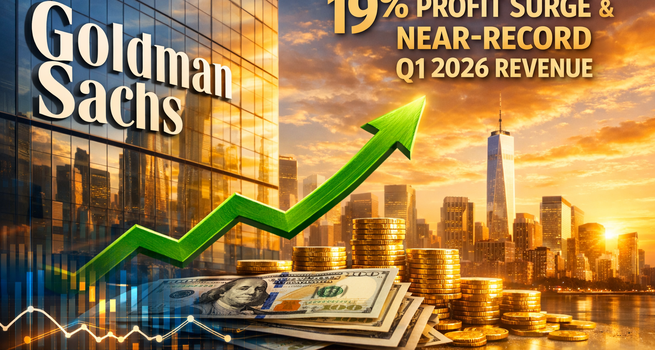
A 19% surge in first-quarter earnings masked a darker mood: Iran-related volatility is cooling the IPO boom, and an extraordinary Federal Reserve briefing on Anthropic's Mythos AI model has put cybersecurity at the top of every bank CEO's agenda.
Goldman Sachs (NYSE: GS) delivered one of its finest quarters on record on Monday, posting a 19 per cent jump in first-quarter profit that briefly obscured a more complicated picture: a war in Iran threatening to freeze the dealmaking boom that Wall Street had spent two years anticipating, and an unprecedented cyber-risk discussion between major bank chief executives, the Federal Reserve and the Treasury Department — centred on the capabilities of Anthropic's latest artificial intelligence model, Mythos.
Net profit rose to $5.63 billion, or $17.55 per share, comfortably ahead of analyst expectations of $16.47 a share. Revenue climbed 14 per cent to $17.23 billion, powered by a record $12.74 billion in the bank's combined banking and markets division. Investment-banking fees surged 48 per cent to $2.84 billion, while markets revenue rose 9 per cent to $9.34 billion. It was Goldman's second-best quarter in its history, trailing only the extraordinary Covid rebound of early 2021.
And yet, by midday in New York, Goldman's stock had fallen around 3 per cent. The market's verdict reflected less scepticism about the numbers themselves than about whether the conditions that produced them could persist through a year that has been dramatically recast by conflict in the Middle East.
A record quarter built on a fragile foundation
The engines driving Goldman's blockbuster results were well understood before the numbers landed: a surge in corporate deal activity building since early 2025, when the regulatory posture of the incoming Trump administration signalled a more permissive environment for mergers and acquisitions; and a volatile trading landscape that, while unsettling for long-only equity investors, proved highly lucrative for Goldman's sales and trading desks.
Chief Executive David Solomon told analysts that the corporate executives he had been speaking with remained broadly optimistic. They "believe they have an opportunity to drive scale and consolidation" that was not available under the Biden administration, he said. Private equity firms are sitting on a record number of portfolio companies they need to exit. Several high-profile technology companies — including SpaceX and Anthropic itself — have been widely expected to pursue public listings.
Yet the outbreak of war in Iran has introduced a variable that no fee pipeline can fully account for. Solomon was candid: IPO activity "slowed a little bit, particularly in March," as conflict began to weigh on risk appetite. "The level of uncertainty is higher," he told analysts. Equity issuance requires a degree of market stability that is difficult to guarantee when the Strait of Hormuz is under a United States blockade and oil markets are swinging violently within single sessions. Several planned listings Goldman had been advising on are understood to have been pushed back to the second half of the year.
One genuine weak spot in the quarter came from Goldman's bond, currencies and commodities division, where trading of interest-rate derivatives and mortgage-related instruments fell short of expectations — a reminder that not every desk benefits equally from volatility, and that the shape of that volatility matters as much as its intensity.
The Mythos briefing: when AI became a systemic risk conversation
Overshadowing much of the post-earnings analyst discussion, however, was a disclosure that touched on terrain rarely traversed in a bank's quarterly results call. When asked about a meeting that major American bank chief executives held last week with Federal Reserve Chairman Jerome Powell and Treasury Secretary Scott Bessent — convened specifically to discuss cybersecurity risks associated with Anthropic's Mythos model — Solomon offered a carefully calibrated response.
"Cybersecurity has long been at the core of our business," he told analysts. He was at pains to frame the gathering as routine: "That group has gone over to the Treasury to talk about cybersecurity risks over a number of years. This is something the industry is focused on. And there's nothing new in that focus."
But the context makes the meeting anything but routine. Mythos — not yet publicly released — is understood to represent a step-change in AI capability, sufficiently significant that it prompted regulators and senior policymakers to convene the country's most systemically important financial institutions for a dedicated briefing. People familiar with the meeting described concerns centred on the model's potential to accelerate the sophistication of attacks on financial infrastructure, including social engineering at a level previously unachievable by automated systems.
Solomon confirmed Goldman is "working closely with Anthropic and all of its security vendors." Even in its carefully hedged form, the disclosure marks a notable moment: a Wall Street chief executive, on a live earnings call, publicly acknowledging that a specific AI model has risen to the level of a systemic financial-security concern requiring coordination with the central bank and the Treasury.
What Mythos signals for the financial sector
The episode crystallises a tension building across the financial sector for two years. Banks have been among the most enthusiastic adopters of AI tools for fraud detection, back-office efficiency and client-facing applications. At the same time, the same capabilities that make large language models useful to banks make them potentially useful to the adversaries of banks.
What appears to distinguish Mythos is not merely its capability but its accessibility — the concern, as understood by those familiar with the Treasury discussions, is that it may substantially lower the bar for adversaries to mount sophisticated attacks. Previous generations of AI tools required meaningful technical expertise to weaponise effectively. Mythos may change that calculation.
The outlook: uncertainty on every front
Goldman's results set the tone for a crowded week of bank earnings. JPMorgan Chase, Bank of America and Morgan Stanley are all due to report in the coming days. As a group, the six largest American banks are projected to earn nearly $42 billion in the quarter, up 5 per cent year on year, on revenues of approximately $160 billion, according to FactSet estimates.
UBS on Monday maintained its Neutral rating on Goldman with a price target of $930 per share. Saul Martinez, head of United States financials research at HSBC, was similarly measured: "The absence of a material increase in investment-banking activity over a sustained period and/or a cool-down in market performance could lead to disappointment and a sharp correction."
For David Solomon, the challenge of the coming months is to preserve the conditions that made the first quarter so strong — deregulation-driven dealmaking, AI-fuelled corporate activity, elevated volatility — while managing risks that are genuinely new. A war disrupting energy markets and IPO windows. A novel AI model raising systemic cybersecurity concerns at the highest levels of financial regulation. And an investment-banking pipeline that depends, more than any other business line, on the one thing that wars and AI disruption have most reliably destroyed: certainty.
$GS $JPM $MS $BAC


 Jun 05, 2026




 Please wait processing your request...