
 AU
AU
 UK
UK
 CA
CA
 NZ
NZ
 IND
IND

 US
US

 Share
Share
 X (Formerly Twitter)
 Whatsapp
 Facebook
 LinkedIn
 Telegram
 Email This Article
 Copy Link
 Summarize with AI
 Chat GPT
 Perplexity
Key Highlights
- Ceasefire Hopes: Stocks rose as President Trump paused planned strikes on Iranian energy sites for five days to allow for peace talks.
- Oil Prices Crash: Crude oil plunged over 10% on the news, easing global inflation fears and lowering costs for travel sectors.
- Yields Retreat: The 10-year Treasury yield fell to 4.33%, pulling back from an eight-month high as the "war premium" faded.
- Strait of Hormuz: Markets initially fell overnight after a 48-hour ultimatum to reopen the waterway, but recovered on the diplomatic shift.
- Tech and Travel Gains: Airlines, cruise lines, and the "Magnificent Seven" tech stocks led the rally, with Tesla and Palantir seeing significant jumps.
Equities rally and yields retreat as five-day pause in hostilities offers respite from energy-driven inflation fears, though Tehran’s ‘total compensation’ demands temper late-session gains.
Global financial markets experienced a violent shift in sentiment on Monday, as investors pivoted from preparing for a scorched-earth escalation in the Persian Gulf to pricing in a fragile diplomatic opening.
US stocks settled sharply higher after President Donald Trump announced a five-day postponement of planned strikes against Iranian energy infrastructure and power plants. The decision followed the commencement of high-level talks aimed at resolving a conflict that has brought the global energy trade to its knees and pushed sovereign bond yields to multi-year highs.
The benchmark S&P 500 index closed up 1.15%, while the blue-chip Dow Jones Industrial Average added 1.38%. The tech-heavy Nasdaq 100 rose 1.22%, buoyed by a retreat in Treasury yields that provided relief to high-growth valuations.
A reprieve for crude
The primary engine behind Monday’s rally was a dramatic collapse in oil prices. Crude futures plunged more than 10% on news of the diplomatic window, offering the first sign of cooling in a market that Goldman Sachs warned could otherwise breach the $150-a-barrel record set in 2008.
For weeks, the "Hormuz Risk Premium" has dominated boardrooms. The International Energy Agency (IEA) confirmed the scale of the crisis on Monday, noting that more than 40 energy sites across nine Middle Eastern countries have been "severely or very severely" damaged. With 7.5% of global supply disrupted and 8 million barrels per day (bpd) set to be cut this month, the White House’s decision to pause kinetic operations was viewed by many as a necessary circuit breaker.
"The market was staring into an abyss of structural energy undersupply," said one senior macro strategist at a London hedge fund. "The five-day pause doesn't end the war, but it halts the immediate threat of the 'obliteration' of Iran’s power grid, which would have surely invited a permanent closure of the Strait."
High-stakes ultimatums
The calm in the cash markets belied a weekend of extreme volatility. In overnight electronic trading, stock futures initially cratered after President Trump issued a 48-hour ultimatum for Tehran to "fully open" the Strait of Hormuz—the world’s most vital oil artery—or face the destruction of its domestic power infrastructure.
Tehran’s response was characteristically defiant. Senior officials, including Mohsen Rezaee, a military adviser to the Supreme Leader, warned that any strike on Iranian soil would render the assets of financial entities that purchase US Treasury bonds "legitimate targets." The threat to mine the "entire Persian Gulf" remains the ultimate "black swan" for global shipping, as the UAE reported fresh drone and missile strikes over the weekend.
The rally lost some of its midday momentum after Mr. Rezaee released a statement insisting that hostilities would only cease once all damages to Iran were compensated, sanctions were lifted, and "legal international guarantees" against US interference were secured—terms that many in Washington view as non-starters.
Bonds breathe a sigh of relief
The cooling of the geopolitical temperature allowed the battered sovereign bond market to recover. Before the news of the talks broke, the 10-year US Treasury yield had touched an eight-month high of 4.44%. It finished the day down 5 basis points at 4.33%.
The relief was even more palpable in Europe, where the energy crisis has stoked fears of a return to 1970s-style stagflation. The 10-year German Bund yield retreated from a 14.75-year high of 3.08%, while the UK 10-year Gilt yield pulled back from a nearly 18-year peak.
Despite the softening yields, central bankers remain on high alert. ECB Governing Council member Peter Kazimir signaled on Monday that while the bank can do little about immediate energy-driven spikes, it will act with "appropriate forcefulness" if inflation expectations become unanchored. Swaps are currently discounting a 68% chance of a 25-basis-point hike from the ECB in late April.
Corporate Winners and Losers
The "de-escalation trade" produced clear winners across the equity spectrum:
- Travel and Leisure: The 10% drop in oil prices sent fuel-sensitive stocks soaring. Norwegian Cruise Line Holdings jumped 6%, while major carriers United Airlines and Alaska Air Group each gained more than 4%.
- Big Tech and AI: The "Magnificent Seven" all finished in positive territory. Tesla led the pack, gaining 3%, while Palantir Technologies rose 6% after its "Maven" AI system was designated a program of record for the Pentagon.
- Housing: Lower yields boosted homebuilders, with DR Horton and Toll Brothers gaining more than 4% on hopes of a reprieve for mortgage rates.
However, the session was not without its casualties. Estée Lauder slumped 7% amid reports of a pending acquisition of Puig Brands, while Fair Isaac Corp (FICO) fell 5% following news of a congressional query into its mortgage credit scoring practices.
The Week Ahead
As the five-day "peace window" begins, the focus shifts to the diplomatic theater. Investors are now forced to weigh the optimistic rhetoric from the White House against the hardline demands coming out of Tehran.
The IEA’s release of 400 million barrels from emergency stockpiles has provided a temporary cushion, but with 20 vessels already attacked in the Gulf since the conflict began, the physical infrastructure of the global energy trade remains incredibly fragile.
For now, Wall Street is betting on the "comprehensive resolution" mentioned by Mr. Trump. But as the 7:44 p.m. Eastern deadline passes and the five-day clock starts ticking, the market remains one headline away from a return to the highs of the "war premium."


 Jun 05, 2026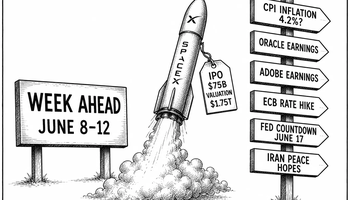




 Please wait processing your request...