
 AU
AU
 UK
UK
 CA
CA
 NZ
NZ
 IND
IND

 US
US

 Share
Share
 X (Formerly Twitter)
 Whatsapp
 Facebook
 LinkedIn
 Telegram
 Email This Article
 Copy Link
 Summarize with AI
 Chat GPT
 Perplexity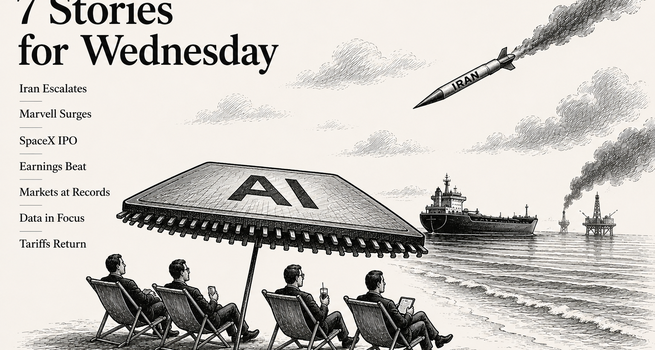
Geopolitics and Energy: Iran Fires Missiles at Bahrain for First Time Since Ceasefire; CENTCOM Strikes Qeshm Island; Oil at $95
CENTCOM struck targets on Qeshm Island in the Strait of Hormuz over the weekend. Iran fired missiles at Kuwait and Bahrain, which America "successfully defeated." It is the first time Bahrain, which hosts a major U.S. navy base, has come under attack since the temporary ceasefire was agreed. Trump claims peace talks are still "going on." Iran has not communicated with Washington for several days. WTI at $95.56, up 1.92%. Brent at $97.80, up 1.88%, on the third straight day of escalation. Gold at $4,490.90, down 0.64%.
- The Bahrain attack is a material escalation, it is the first strike on a country hosting a permanent U.S. naval base since the ceasefire, directly threatening the U.S. Fifth Fleet headquarters.
- Gulf hostilities flared anew with Iranian missile attacks on Bahrain, Kuwait and other regional targets either thwarted or failed, as diplomacy between Washington and Tehran showed little progress.
- Risk note: oil at $95.56 is approaching war-era highs; if Brent crosses $100 before a deal is signed, PCE Inflation will accelerate further in June data and rate hike probability will move materially higher.
- Semiconductors: Marvell Surges 33% After Jensen Huang Calls It "The Next Trillion-Dollar Company"; Coherent and Corning Rally
Marvell Technology (Nasdaq:MRVL) closed up 32.52% to $290.79 on Tuesday after Nvidia (NASDAQ:NVDA) CEO Jensen Huang appeared onstage with Marvell CEO Matthew Murphy at Computex Week in Taipei and said: "The next trillion-dollar company, ladies and gentlemen... Let's do it together." Volume hit 102 million shares, roughly 257% above its three-month average. Marvell's market cap hit just over $250 billion. Marvell's Teralynx T100 switch silicon at 102.4 Tbps and custom chip Revenue expected to exceed $10 billion by fiscal 2029 underpin the thesis. Nvidia invested $2 billion in Marvell.
The iShares Semiconductor ETF (NASDAQ:SOXX) climbed nearly 6%. Coherent (NYSE:COHR) surged 17.63% to $426.89 on optical connectivity Demand. Corning (NYSE:GLW) surged 13.41% to $200.40 on its Nvidia AI data centre Manufacturing Partnership. Micron (NASDAQ:MU) surpassed $1.19 trillion market cap on 89% gain past month and 503% year to date, with Q2 guidance of $18.7 billion. Kioxia briefly became Japan's second most valuable company, pushing Toyota to third.
- The move added over $40 billion in Marvell market cap, rendering many put options worthless; it is Marvell's biggest one-day gain ever, narrowly topping its previous best set in May 2023.
- Micron and SK Hynix had market caps of barely $100 billion a year ago and both now top $1 trillion, providing a template for how rapidly AI-driven demand can reprice semiconductor valuations.
- Risk note: Huang's trillion-dollar endorsement is a market comment, not a financial projection; reaching $1 trillion requires a 4x increase from current levels, implying sustained AI infrastructure spending over multiple years.
- Tuesday Earnings Results: Palo Alto Networks +10% After Hours; HPE Posts Biggest Beat Since 2018; Deere Tightens Guidance
After-Hours: Palo Alto Networks (NASDAQ:PANW) reported Q3 fiscal 2026 EPS of $0.85 beating the $0.81 estimate, with revenue at $3.002 billion essentially in line. Stock jumped 9.96% after hours. Q4 guidance of $3.35 billion to $3.36 billion beat the $3.28 billion estimate. Full-year guidance lifted to $11.42 billion to $11.43 billion. CEO Nikesh Arora said: "The latest advancements at the AI frontier have increased the level of urgency around Cybersecurity, and redefined the shape of the industry for the coming years." Next-Generation Security delivered 60% year-over-year growth. Recurring software revenue reached 46% of 12-month product revenue, up from 22% three years ago.
Regular Session: Hewlett Packard Enterprise (NYSE:HPE) closed up 19.47% to $56.15 after reporting its biggest earnings beat since 2018, with Q2 revenue and EPS far exceeding estimates driven by surging AI server demand, a record-breaking order Backlog, and raised full-year guidance putting the company two years ahead of its own long-term financial targets. Volume hit 147.22 million shares. Deere (NYSE:DE) surged 6.79% to $579.25 after reporting strong Q2 2026 results and tightening its fiscal 2026 Net Income guidance, signalling greater confidence in its earnings outlook.
- PANW's platformisation strategy is confirmed working: 46% recurring software revenue versus 22% three years ago converts one-time product sales into durable subscription revenue.
- HPE's record-breaking order backlog and two-year guidance acceleration directly corroborate Dell's $51.3 billion AI server backlog from last week, enterprise AI infrastructure demand has a multi-quarter runway.
- Risk note: PANW initially fell after hours before recovering to +10%, reflecting sensitivity to its negligible $823,000 revenue shortfall against the positive EPS and Q4 guidance beat.
- Capital Markets: SpaceX Fixes IPO Price at $135 Per Share; $75 Billion Raise; Roadshow Begins Today
In a surprise move ahead of its investor roadshow, SpaceX plans to fix its IPO price at $135 per share, according to a source familiar with the matter, to raise a record-setting $75 billion. The roadshow begins today with the listing targeting June 12 on Nasdaq under ticker SPCX. At $135 per share the implied valuation is $1.75 trillion. Goldman Sachs (NYSE:GS) is lead left underwriter alongside Morgan Stanley (NYSE:MS), Bank of America (NYSE:BAC), Citigroup (NYSE:C), and JPMorgan (NYSE:JPM). Retail investors will have direct access through major brokerage platforms. Anthropic will pay SpaceX $1.25 billion per month through May 2029 for Colossus compute capacity. Starlink generated $3.26 billion in Q1, 69% of total revenue, and was the only profitable segment.
- Fixing the price ahead of the roadshow rather than after signals sufficient institutional demand has already been secured; the approach prioritises price certainty over price discovery.
- At $1.75 trillion, SpaceX would be valued above Alphabet and below Apple on day one, between the fifth and sixth most valuable companies in the world.
- Risk note: SpaceX has not yet achieved full booster reusability on V3 hardware; the AI segment is loss-making at $2.47 billion operating loss in Q1; and Musk's 85.1% voting control means public investors have no meaningful governance rights, three structural concerns the roadshow must address.
- Tuesday Market Close: S&P Hits Record 7,609; Alphabet Falls 4%; Bitcoin Drops Below $70,000; Yen Hits Intervention Zone
The S&P 500 advanced 0.13% to a record 7,609.78 Tuesday, its first close above 7,600. The Dow gained 228.91 points to 51,307.79. The Nasdaq eked out 0.03% to 27,093.90. Alphabet (NASDAQ:GOOGL) fell nearly 4% on dilution concerns from the $80 billion Equity raise. Software indices pulled back 3.7% after a 14% three-day surge, with ServiceNow, Salesforce, Intuit, and Microsoft all falling between 3.7% and 10%. Bitcoin tumbled to $67,402.70, down 4.00%, hitting a two-month low as Strategy Inc. sold BTC, triggering over $1 billion in crypto liquidations.
Victoria's Secret (NYSE:VSXY) rose nearly 50% on strong Q1 and raised guidance. The yen touched 160 per dollar, Japan's intervention red line, with the finance minister warning readiness to "respond appropriately." JOLTS April Job Openings jumped by the most in five years, signalling labour market resilience ahead of Friday's Nonfarm Payrolls.
- The software sector pullback of 3.7% after a 14% three-day surge reflects healthy consolidation rather than a trend Reversal; the AI earnings wave from Dell, Marvell, PANW, and HPE has fundamentally re-rated the sector.
- Bitcoin's $1 billion Liquidation cascade and the yen hitting 160 simultaneously signal risk-off pressure in non-equity Assets even as U.S. stocks hit records, a divergence that historically precedes Volatility.
- Risk note: the VIX at 15.77 is near pre-war lows; a Broadcom guidance miss tonight or an Iran escalation spike overnight would reprice that complacency sharply.
- Tonight and Today: Broadcom, CrowdStrike and Medtronic Report After the Close; Six Data Releases Including ADP and Fed Beige Book
Tonight's Earnings: Broadcom (NASDAQ: AVGO) reports fiscal Q2 2026 after the close with consensus EPS of $2.02 on a $2.177 trillion market cap, the most important AI chip infrastructure print of the week. Broadcom's custom AI silicon (XPUs for Google and Meta) and networking infrastructure are direct reads on hyperscaler AI capex.
CrowdStrike (NASDAQ: CRWD) reports Q1 fiscal 2027 with consensus EPS of $0.13 on a $199 billion market cap; back-to-back cybersecurity prints in two nights will define the sector narrative.
Medtronic (NYSE: MDT) reports fiscal Q4 2026 with consensus EPS of $1.54 versus last year's $1.62 on a $94.9 billion market cap.
Today's Data: ADP National Employment Report at 8:15 AM ET (May, consensus 110,000, prior 109,000). S&P US Services PMI at 9:45 AM ET (prior 51.0). ISM Services PMI at 10:00 AM ET (consensus 53.9, prior 53.6). Factory Orders at 10:00 AM ET (consensus +4.4%). Global Services PMI at 11:00 AM ET. Federal Reserve Beige Book at 2:00 PM ET, the first under Warsh, covering regional economic conditions and Iran war Supply chain impacts.
- Broadcom's AI revenue grew 220% year over year in Q1; any commentary on XPU demand from Google and Meta will be the most important forward indicator for AI infrastructure spending beyond Nvidia GPUs.
- The Fed Beige Book at 2:00 PM ET will be parsed for any new language on Iran war inflation, regional Business stress, and the tone of Warsh's first qualitative economic assessment as chair.
- Risk note: Broadcom at $2.177 trillion has more than doubled year to date; any guidance miss or cautious AI chip commentary would disproportionately punish the stock and cascade across the entire AI infrastructure complex.
- Trade Policy: USTR Proposes 10-12.5% Tariffs on 60 Economies Over Forced Labor; Taiwan, EU, UK and Canada All Affected
The U.S. Trade Representative proposed additional duties of 10% or 12.5% on imports from 60 economies over failures to curb trade in goods made with forced labor, the latest Section 301 action as the Trump administration rebuilds emergency tariffs struck down by the Supreme Court in February. The USTR will impose 10% duties on Canada, Ecuador, the EU, Indonesia, Mexico, Pakistan, Argentina, Bangladesh, Cambodia, El Salvador, Guatemala, Malaysia, Taiwan, and Britain. The remaining 45 countries face 12.5%. Exemptions include energy, rare earths, certain metals, beef, coffee, pharmaceuticals, organic chemicals, and aircraft parts. The announcement comes ahead of the July 24 expiration of the current 10% temporary Tariff. The USTR also separately proposed 25% duties on many Brazilian goods on Monday. Public comments due July 6, hearings July 7.
- Taiwan at 10% directly affects the AI semiconductor supply chain, TSMC manufactures Nvidia's most advanced chips in Taiwan; tariff escalation on Taiwan imports would raise AI chip production costs and accelerate the push for U.S.-based TSMC fabrication.
- The administration is simultaneously seeking public comments on the U.S.-China Board of Trade agreed at last month's bilateral summit, which would lead to reduced tariff rates, tariff escalation and tariff reduction are in motion at the same time.
- Risk note: these tariffs are not yet final with comments due July 6; but the proposal alone will force supply chain and procurement reviews at every major U.S. importer from the 60 affected economies.


 Jun 05, 2026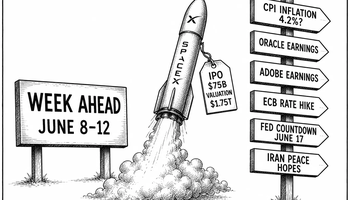




 Please wait processing your request...