
 AU
AU
 UK
UK
 CA
CA
 NZ
NZ
 IND
IND

 US
US

 Share
Share
 X (Formerly Twitter)
 Whatsapp
 Facebook
 LinkedIn
 Telegram
 Email This Article
 Copy Link
 Summarize with AI
 Chat GPT
 Perplexity
Nike (NYSE:NKE) offers a 3.57% dividend yield with 20+ years of consecutive increases — but declining free cash flow and narrowing margins demand caution. Full 2026 dividend sustainability analysis and turnaround assessment.
Key Highlights
- Dividend Intact but Slowing: 20+ consecutive years of dividend increases with a 3.57% yield, but declining free cash flow and a rising payout ratio have narrowed the margin for continued dividend growth.
- 43% Below Peak: Insiders Are Buying — Trading near $45 against a 52-week high of $80.17, with CEO Elliott Hill and Apple's Tim Cook purchasing ~$4 million in shares — a notable confidence signal at depressed levels.
- Turnaround Underway, Patience Required: A $2 billion restructuring and strategic reset under new CEO Elliott Hill show promise, but revenue and margin headwinds are expected to persist through early 2026.
Nike, Inc. (NYSE:NKE) is one of the world's most recognized consumer brands and has been a reliable dividend-paying company for decades. However, as of 2025–2026, Nike occupies a cautionary position in dividend stock analysis: the company is experiencing declining free cash flow and narrowing margins — two warning signs that investors monitoring dividend sustainability must take seriously. This article examines Nike's dividend status, financial pressures, and what the current situation means for income investors.
Company Overview
Founded in 1964 and headquartered in Beaverton, Oregon, Nike is the world's largest athletic footwear and apparel company by revenue, generating approximately $45–48 billion in annual sales. The company's portfolio includes Nike, Jordan Brand, and Converse — brands with extraordinary global recognition and pricing power in their markets.
Nike's business model is structured around design, marketing, and brand management rather than manufacturing — the company outsources production to contract manufacturers primarily in Asia. This asset-light model has historically generated exceptional returns on capital and abundant free cash flow to support dividends and share repurchases.
The company has paid and grown its dividend consistently for over 20 consecutive years, making it a candidate for Dividend Aristocrat status. The current annualized dividend of approximately $1.40–1.48 per share provides a modest yield of around 2–3% depending on the share price — below the high-yielders discussed elsewhere in this series, but with a track record of consistent growth.
Stock Performance — April 2026
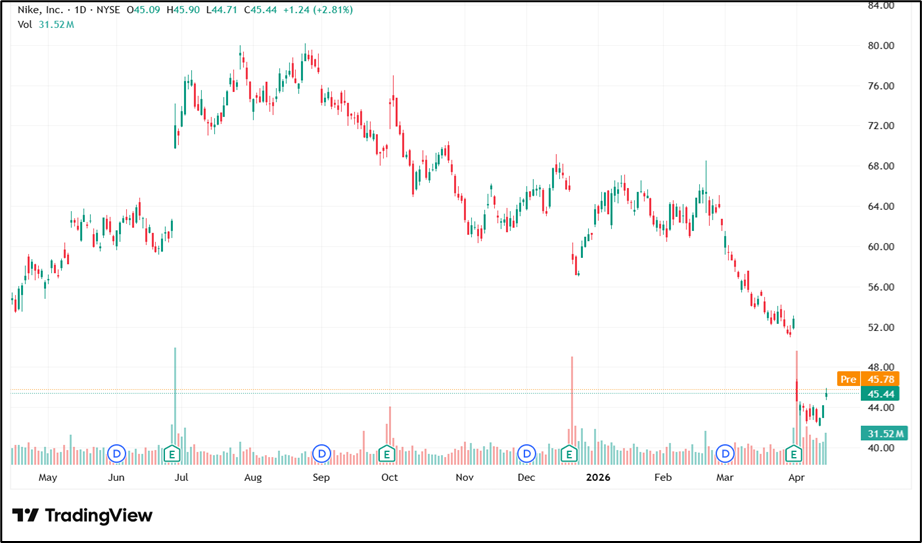
As of April 15, 2026, NKE shares closed at $45.47, up 3.29% on the day (+$1.45), driven by news of significant insider buying — CEO Elliott Hill and Apple CEO Tim Cook (a Nike board member) collectively purchased ~$4 million in stock. After-hours trading extended gains modestly to $45.72 (+$0.25, +0.55%). The stock opened at $45.08, reached an intraday high of $45.90, and touched a low of $44.71 during the session.
|
Price (Apr 15, 2026) $45.47 |
Daily Change +3.29 / +$1.45 |
After Hours $45.72 |
|
Open $45.08 |
Day High $45.90 |
Day Low $44.71 |
|
52-Week High $80.17 |
52-Week Low $42.09 |
Market Cap $65.46B |
|
P/E Ratio 29.08 |
Dividend Yield 3.57% |
Quarterly Div $0.41 |
The 52-week range of $42.09 to $80.17 reflects a sharp decline from prior highs, pressured by weakening revenues, increased competition, and China market softness. Today's rebound was catalysed by insider confidence signals, with the CEO and a board member buying ~$4M in shares — a move markets interpreted as a strong vote for recovery. The stock remains well below its 52-week high, and analysts at J.P. Morgan and HSBC have recently reiterated cautious Hold ratings, suggesting the turnaround story still has much to prove.
The Problem: Declining Free Cash Flow and Margin Pressure
Beginning in fiscal year 2024 and accelerating into 2025 and 2026, Nike has faced a confluence of headwinds that are meaningfully pressuring its financial profile. These include inventory normalization challenges following pandemic-era supply chain disruptions, slowing growth in the critical China market, intensifying competition from Hoka, On Running, and other challenger brands in key performance categories, and strategic missteps in the direct-to-consumer channel that resulted in a pullback from wholesale partners at a cost to revenue.
Most concerning from a dividend sustainability perspective, Nike's free cash flow has declined materially from peak levels. Free cash flow is the ultimate funding source for dividends and buybacks in a consumer goods business, and its contraction raises questions — though not yet alarm — about dividend trajectory.
Operating margins have also narrowed due to promotional activity (discounting inventory), higher direct-to-consumer operating costs, and unfavorable foreign exchange translation. Management has initiated a significant restructuring program targeting approximately $2 billion in annualized cost savings — a necessary but disruptive process that will depress near-term earnings.
Dividend Status and Sustainability Assessment
Nike has not cut its dividend and remains committed to annual dividend increases as part of its capital allocation policy. The current quarterly dividend and its annualized equivalent remain well within the range of supportable payouts given the company's balance sheet strength and long-term earning power.
However, analyst community discussion has flagged Nike as a name where dividend growth could slow significantly — or in a more adverse scenario, where a pause in dividend growth could occur — if free cash flow does not recover meaningfully. The payout ratio has risen as earnings have declined, and the margin for error has narrowed.
For income investors focused purely on current yield, Nike's 3.57% dividend yield makes it less attractive than the high-yielders in this series. Its value proposition is as a dividend-growth stock — a company that grows its dividend at a rate exceeding inflation over time. That growth story is currently under stress.
Financial Overview
Nike's revenue has been on a declining trajectory on a constant-currency basis, with the company acknowledging that its product engine and consumer connection have fallen short of expectations. New CEO Elliott Hill — who returned to Nike after a period away — has articulated a plan to rebuild brand heat, strengthen wholesale relationships, and restore healthy inventory levels and pricing discipline.
The restructuring announced in 2024 targets $2 billion in annualized savings, primarily through headcount reductions and operational streamlining. These savings, if achieved, would be a meaningful tailwind to margins and free cash flow beginning in 2026 and 2027.
Management Outlook and Strategic Recovery
CEO Elliott Hill has been explicit about the work required to restore Nike to its historical growth and profitability trajectory. The company's strategic priorities include returning to sports performance as a core brand pillar (rather than lifestyle), rebuilding relationships with key wholesale partners, and rebuilding marketing investment in key sports and athlete endorsements.
For fiscal year 2026, management has guided toward continued revenue headwinds in the first half, with improving trends expected in the second half as strategic initiatives take hold. Gross margin is expected to remain under pressure due to promotional activity and cost absorption.


 Jun 05, 2026




 Please wait processing your request...