
 AU
AU
 UK
UK
 CA
CA
 NZ
NZ
 IND
IND

 US
US

 Share
Share
 X (Formerly Twitter)
 Whatsapp
 Facebook
 LinkedIn
 Telegram
 Email This Article
 Copy Link
 Summarize with AI
 Chat GPT
 Perplexity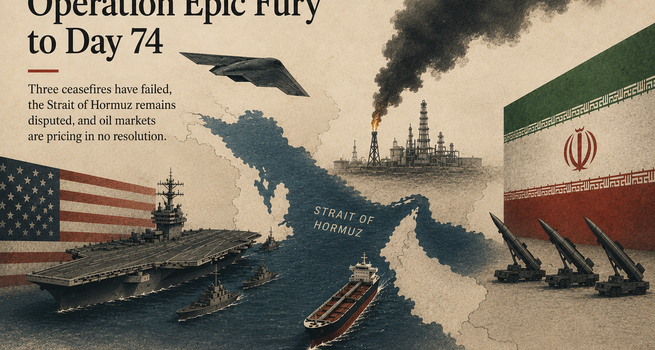
Seventy-four days into the US-Iran war, three ceasefires have failed, the Strait of Hormuz remains disputed, and oil markets are pricing in no resolution. A full timeline from Operation Epic Fury to the Beijing summit.
Key Highlights
- US and Israeli forces launched Operation Epic Fury on February 28, 2026, killing Supreme Leader Ayatollah Ali Khamenei and igniting a regional war that has spread to Lebanon, the Gulf, and global energy markets.
- Iran's closure of the Strait of Hormuz, through which roughly 20 percent of global oil transits, triggered fuel shortages across Asia and pushed US consumer Inflation to its highest reading since 2023.
- Three ceasefires have been declared since June 2025. All three have been violated. The current truce has been extended twice and described by Trump as on "massive life support" as of Day 73.
- The Pentagon's official war cost has reached $29 billion, with independent analysts projecting the long-term taxpayer burden at no less than $1 trillion.
- Negotiations remain deadlocked on uranium enrichment, the Strait of Hormuz, ballistic missiles, and sanctions relief, with Trump's Beijing summit the next potential inflection point.
The Build-Up: A Decade of Pressure (2018-2025)
The war did not begin on February 28, 2026. It was the product of nearly a decade of sanctions, failed diplomacy, and compounding military escalation.
In 2018, the Trump administration withdrew from the Joint Comprehensive Plan of Action, the 2015 nuclear deal that had frozen Iran's enrichment program in exchange for sanctions relief. Iran responded by steadily expanding its uranium stockpile. By June 2025, the IAEA confirmed Iran had accumulated over 408 kilograms of uranium enriched to 60 percent purity, enough, if further enriched, for multiple warheads.
In September 2025, the UN reimposed sanctions through the snapback mechanism, freezing Iranian Assets and accelerating a currency collapse. Treasury Secretary Scott Bessent called the freefall the "grand culmination" of maximum pressure. The economic spiral triggered the largest domestic protests Iran had seen since 1979. On January 8, 2026, Iranian security forces killed at least 30,000 civilians in a crackdown. The massacre provided the political rationale in Washington for what followed.
The Twelve-Day War (June 2025)
Before Operation Epic Fury, there was a direct predecessor.
On June 13, 2025, Israel launched the Twelve-Day War, deploying over 200 fighter jets across five waves of strikes against more than 100 Iranian targets, including nuclear facilities, military bases, and senior IRGC commanders. On June 22, the United States entered under Operation Midnight Hammer. B-2 Spirit stealth bombers delivered fourteen GBU-57A/B bunker buster bombs against the Fordow, Natanz, and Isfahan nuclear sites, with submarine-launched Tomahawk missiles completing the package.
On June 24, 2025, Trump declared the first ceasefire of this broader conflict, brokered by the United States and Qatar. Both sides violated it within hours, with Iran launching 14 missiles at Al Udeid Air Base and Israel striking a radar installation near Tehran. Despite the volatile start, the truce held for eight months, until Operation Epic Fury ended it on February 28, 2026.
Operation Epic Fury: The War Restarts (February-March 2026)
On February 28, 2026, US and Israeli forces launched simultaneous strikes under Operation Epic Fury and Operation Roaring Lion. Ayatollah Ali Khamenei was killed in strikes on a government compound in Tehran, along with multiple senior military and intelligence officials. At least 175 people, most of them likely children, died in a strike on a girls' elementary school in southern Iran that US officials subsequently acknowledged as a targeting error. Iran retaliated the same day with missiles and drones against Israel and US bases in Qatar, Kuwait, and the United Arab Emirates.
On March 1, an Iranian drone attack killed six US soldiers at Port Shuaiba, Kuwait, the first American combat deaths of the war. Hezbollah fired rockets toward Israel, dragging Lebanon into the conflict. On March 8, Iran named Mojtaba Khamenei, son of the slain supreme leader, as his father's replacement. Trump called the appointment "unacceptable." On March 12, Mojtaba Khamenei's first directive as supreme leader ordered the military to continue choking off the Strait of Hormuz. On the same day, six American crew members died in an Iraq crash of a KC-135 military refueling aircraft, raising total US military deaths to at least 13.
The energy stakes sharpened through mid-March. On March 11, Iran struck at least three vessels in the Strait of Hormuz, sending oil prices surging. On March 13, the US bombed Kharg Island, responsible for approximately 90 percent of Iran's oil exports. On March 17, Israeli forces killed Ali Larijani, head of Iran's National Security Council, and Gholamreza Soleimani, head of the Basij militia, the most significant blow to Iran's Leadership since February 28. The following day, Israel struck Iran's South Pars gas field, which accounts for between 70 and 75 percent of Iran's Natural Gas production, while Iran struck Qatar's Ras Laffan Industrial City, the world's largest LNG export Facility.
On March 19, the United States launched a dedicated aerial campaign targeting Iranian naval vessels and drone platforms to restore freedom of navigation. On March 23, Trump acknowledged for the first time that Washington and Tehran were in discussions. On March 27, an Iranian strike injured 12 US troops at Prince Sultan Air Base in Saudi Arabia. In late March, Saudi Arabia conducted covert strikes on Iranian soil, the first known direct Saudi military action against Iran, according to a report citing Western and Iranian officials. Diplomatic pressure and Saudi threats of further retaliation contributed to an informal de-escalation in the days that followed. On April 3, Iran shot down a US Air Force F-15E fighter jet, the first American combat aircraft lost in the war. One crew member was recovered the same day; a two-day rescue operation deep inside Iran retrieved the second.
Diplomacy, Ceasefires, and the Stalemate (April-May 2026)
Throughout March, Trump had set successive deadlines for Iran, first March 21, then March 23, then April 7, threatening to target energy infrastructure and bridges if no deal was reached. On April 7, he announced a two-week ceasefire brokered by Pakistan, the second of the conflict. Iran's National Security Council confirmed it, framing the pause as a strategic victory. Trump's condition was explicit: the halt in US strikes was tied to the "complete, immediate, and safe opening of the Strait of Hormuz."
The ceasefire fractured within hours. On April 8, Israel launched over 100 airstrikes on Lebanon in a 10-minute blitz, asserting Lebanon was not included in the truce. Trump and Vice President Vance backed Israel's position, directly contradicting Pakistan's stated terms. Iran paused Hormuz traffic in response. By April 9, ships were again being blocked in the strait and both sides accused the other of violations.
On April 11-12, Vice President JD Vance traveled to Islamabad for direct peace talks, joined by special envoy Steve Witkoff and Jared Kushner. The Iranian delegation, led by parliamentary speaker Mohammad Bagher Ghalibaf, included top diplomats, military officials, and finance experts, marking the highest-level direct engagement between the two countries since the 1979 Iranian Revolution. After 21 hours of negotiations, Vance announced no agreement had been reached. On April 13, Trump ordered the US Navy to blockade Iranian ports. The Strait of Hormuz entered what analysts described as a dual blockade, with Iran restricting Gulf access and the US blockading Iranian ports simultaneously.
On April 16, the United States brokered a 10-day ceasefire between Israel and Hezbollah in Lebanon, the third ceasefire declaration of the conflict. The following day, Iran and the United States jointly declared the Strait of Hormuz open to commercial shipping. Less than 24 hours later, Iran reclosed the waterway after the US declined to lift its naval blockade.
On April 19, American Marines seized an Iranian cargo ship attempting to evade the blockade. On April 21, hours before the two-week truce was set to expire, Trump extended it at Pakistan's request. On April 23, he announced a three-week extension of the Israel-Lebanon ceasefire. Iran seized two cargo ships around this period. On April 25, Trump canceled the planned trip by senior US negotiators to Pakistan, shifting talks to telephone.
On May 1, Trump rejected Iran's latest proposal at the White House and sent formal letters to Congress asserting hostilities had "terminated," arguing the 60-day War Powers Resolution clock did not apply given the existing ceasefire. On May 4-5, Secretary of State Marco Rubio declared the February operation "over" and Trump announced "Project Freedom," a US-led maritime escort operation for commercial shipping through the strait. Within hours, US and Iranian forces traded fire in the waterway.
Market Reaction: From Panic to Complacency
Markets moved with the war from the first day, and the price signals at each turning point reveal how investors assessed the conflict's duration and economic reach.
When Operation Epic Fury launched on February 28, a Saturday when oil markets were closed, the reaction was priced in the following Monday. Brent Crude surged 10 to 13 percent in early trading to around $80 to $82 per barrel, its biggest single-session jump since the Russia-Ukraine war. S&Amp;P 500 futures fell 0.6 percent and Dow futures dropped 0.4 percent, reflecting an immediate flight from risk. Treasury yields dipped slightly as Capital sought safety.
The sharpest move came from the Strait of Hormuz closure. As tanker traffic dropped by roughly 70 percent and then to near zero in early March, Brent crude surpassed $100 per barrel on March 8 for the first time in four years. By mid-March, Brent touched $120 per barrel as Gulf producers cut output by at least 10 million barrels per day. The IEA described the disruption as the largest oil Supply shock in the history of the global market. March 2026 recorded the largest single-month oil price increase on record, with Brent gaining 51 percent over the month. Dubai crude reached $166 per barrel on March 19, its highest level ever. Natural gas prices in Europe nearly doubled in the first week of March, rising from around 30 euros per megawatt hour to above 60 euros. California gasoline prices crossed $5 per gallon in the second week of March.
On March 23, when Trump first publicly acknowledged diplomatic discussions with Iran, Brent fell from $114 to $102 per barrel on the same day, a drop of roughly 11 percent, illustrating how sensitive the market had become to any signal of de-escalation. The move later reversed when Iran denied the talks and negotiations stalled.
The ceasefire announcement on April 7 triggered the most dramatic single-session relief rally of the conflict. Brent fell sharply on the news. The S&P 500, which had already begun recovering in late March on TACO trade dynamics, the market shorthand for the belief that Trump would back down from escalation before the economic pain became intolerable, closed at record highs two consecutive days around April 15-16. The index touched 7,230 on May 1, an all-time intraday high, despite oil prices still trading more than 50 percent above pre-war levels.
The April 17 opening of the Strait briefly sent crude falling more than 10 percent in a single session. The Reversal within 24 hours, as Iran reclosed the waterway, erased most of those gains. By late April, Brent had reached a wartime peak of $126 per barrel. As of early May, with the ceasefire nominally intact but the strait still functionally closed, Brent was trading above $100 per barrel. War risk insurance premiums for Hormuz transits, which sat at around 0.1 percent of hull value before the war, had surged to 2.5 percent at their peak in March and remained roughly eight times pre-war levels as of mid-May. A second market narrative emerged on trading desks to counter the TACO trade: the NACHO trade, shorthand for "Not A Chance Hormuz Opens," reflecting growing institutional skepticism that any ceasefire headline would produce a durable reopening of the waterway.
The Equity market's resilience through the conflict has puzzled analysts. The S&P 500 has returned to record highs even as the energy shock persists, driven in part by continued investor enthusiasm for artificial intelligence and technology stocks, which account for nearly half of the index's market Capitalization. Analysts at Morgan Stanley warned that the key risk for markets is duration: if oil prices above $100 per barrel persist for several more months, inflationary pressure broadens, the Federal Reserve's rate path tightens, and the probability of a US Recession rises materially. The IMF has noted that "some damage is already done" and that downside risks remain elevated even under a short-conflict scenario.
No Peace, No Escalation, No Exit
On May 11, Trump rejected Iran's latest counter-proposal, calling it "a piece of garbage" and saying the ceasefire was on "massive life support." Iran's parliamentary speaker Ghalibaf responded that Iranian forces were "prepared to deliver a lesson-giving response to any aggression." An adviser to Iran's supreme leader warned Trump: "We defeated you on the battlefield; so never think that you will emerge victorious in diplomacy as well."
On May 12, the Pentagon revised the official war cost to $29 billion, up from $25 billion reported in late April. Harvard public policy expert Linda Bilmes projected the total long-term taxpayer cost at no less than $1 trillion. The Energy Department raised its annual retail gasoline price forecast to $3.88 per gallon, up from $3.70. US consumer price inflation stood at 3.8 percent, the highest since 2023. On May 13, Trump departed for Beijing to meet Chinese President Xi Jinping. Iranian Foreign Minister Abbas Araghchi was simultaneously expected at the BRICS Foreign Ministers' meeting in Delhi, with Saudi and Egyptian counterparts also in attendance. US intelligence had assessed that China was preparing to deliver new air defense systems to Iran. Regional diplomatic sources indicated that meaningful progress on a settlement was unlikely before the Beijing summit produced a clear outcome.
Seventy-four days into the war, the human and economic toll is substantial. Thousands have been killed in Iran and Lebanon. More than one-sixth of Lebanon's population has been displaced. Three ceasefires have been declared and all three broken, with the current truce holding in name only while both sides continue to fire on each other in the Strait of Hormuz. The official cost is $29 billion and rising. The core disputes on nuclear enrichment, the strait, ballistic missiles, and sanctions have not narrowed. The next move belongs to Beijing.


 Jun 05, 2026




 Please wait processing your request...