
 AU
AU
 UK
UK
 CA
CA
 NZ
NZ
 IND
IND

 US
US

 Share
Share
 X (Formerly Twitter)
 Whatsapp
 Facebook
 LinkedIn
 Telegram
 Email This Article
 Copy Link
 Summarize with AI
 Chat GPT
 Perplexity
Key Highlights
- Extraordinary but High-Risk Yield — PSEC offers a headline-grabbing 19%+ forward dividend yield ($0.54 annualized, monthly payments) — one of the highest in the entire BDC universe — but this yield comes with a well-documented history of dividend cuts, declining NAV per share, and negative trailing EPS that demand serious investor scrutiny.
- Middle-Market Lending at Scale — As one of the largest BDCs in the U.S., Prospect Capital lends directly to 125+ private middle-market companies across first lien, second lien, and subordinated debt — a diversified but inherently credit-sensitive portfolio that is heavily exposed to interest rate cycles and borrower default risk.
- NAV Erosion is the Critical Red Flag — PSEC's share price has fallen over 21% in the past year and significantly more over the long term, suggesting dividends may be partially funded by capital erosion rather than earned income — making total return analysis, not just yield, essential before investing.
For income investors willing to accept higher risk in pursuit of exceptional yield, Business Development Companies (BDCs) represent a compelling — if nuanced — category. Prospect Capital Corporation (NASDAQ:PSEC) stands out even within the high-yield BDC universe: the company currently offers a forward dividend yield of approximately 19–20%, which, while extraordinary, requires careful analysis to understand its sustainability, risks, and structural characteristics. This article provides a comprehensive assessment of PSEC for income investors.
Company Overview
Prospect Capital Corporation is an externally managed Business Development Company (BDC) focused on lending to and investing in middle-market private companies. Founded in 2004 and headquartered in New York, PSEC is one of the largest BDCs in the United States by total assets, with a portfolio diversified across more than 125 portfolio companies spanning a wide range of industries.
BDCs are a unique asset class: they are closed-end investment companies that have elected to be regulated as BDCs under the Investment Company Act of 1940. Like REITs, BDCs are required to distribute at least 90% of their taxable income to shareholders, which is why they typically offer high dividend yields. This structure also means that BDC earnings and dividends are heavily influenced by interest rates, credit quality, and leveraged finance market conditions.
Prospect Capital's investment strategy focuses primarily on direct lending to private middle-market companies — businesses that are typically too large for bank loans but too small to access the public bond markets. The company's portfolio is diversified across first lien loans, second lien loans, subordinated debt, and equity investments in its portfolio companies.
Stock Performance — April 2026
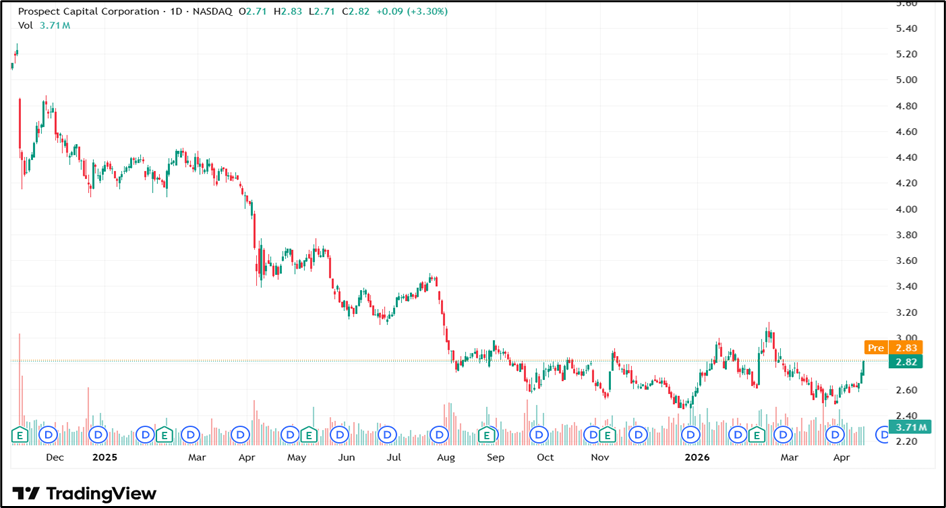
PSEC shares closed at $2.82 on April 15, 2026, up +$0.09 (+3.30%) on the day. Overnight trading saw a slight retreat of −$0.01 (−0.35%) to $2.81. The previous close was $2.73, and the stock opened at $2.72. The day's trading range was $2.71 to $2.825.
|
Price (Apr 15, 2026) $2.82 |
Daily Change +3.30% / +$0.09 |
Overnight $2.81 |
|
Previous Close $2.73 |
52-Week Range $2.45 – $3.77 |
1Y Perf. −21.23% |
|
Market Cap $1.372B |
Volume 3,668,748 |
Avg. Volume 4,302,450 |
|
Fwd Div & Yield $0.54 / 19.22% |
Ex-Div Date Apr 28, 2026 |
EPS (TTM) −$0.82 |
The 1-year performance of −21.23% reveals significant share price erosion, which is a critical consideration when evaluating a high-yield stock. The stock has declined from a 52-week high of $3.77 to current levels around $2.82 — a loss of approximately 25% of peak value. This is a pattern that has repeated for PSEC shareholders over multiple years and must be weighed carefully against the high dividend yield.
Financial Overview and Critical Risk Disclosure
PSEC's financial profile is complex and requires careful interpretation. The company's EPS (TTM) of −$0.82 indicates that trailing earnings have been negative — a significant red flag for dividend sustainability analysis. BDCs report both net investment income (NII) and total return (including unrealized gains/losses), and PSEC's NII has faced pressure from portfolio credit quality concerns and rising credit losses.
The company's net asset value (NAV) per share has declined over time — a concern because NAV erosion means shareholders are receiving dividends partially funded by a return of their own capital rather than earned income. Investors in high-yield BDCs must monitor the relationship between dividends paid and NAV trajectory carefully.
PSEC is externally managed by Prospect Capital Management, which raises governance concerns that are common across externally managed investment companies. Management fees and incentive fees paid to the external manager reduce the amount available to distribute to shareholders.
Dividend Analysis — Caution Required
The headline yield of approximately 19–20% must be viewed with significant caution. While the yield is extraordinary in nominal terms, the stock's persistent share price decline suggests that the market prices in considerable risk around dividend sustainability. The ex-dividend date of April 28, 2026 reflects a forward annual dividend of $0.54 per share.
PSEC has a history of dividend reductions. The company has cut its monthly dividend on multiple occasions over its history — a pattern that has contributed to the long-term share price erosion. Income investors should carefully research the current dividend coverage ratio before investing.
Management Outlook
PSEC's management has emphasized the company's diverse portfolio across more than 125 portfolio companies and the structural advantages of middle-market lending. The company's earnings date is estimated at May 7, 2026. Management commentary on portfolio credit quality, NAV trajectory, and dividend coverage will be critical data points for investors evaluating the sustainability of the current distribution.


 Jun 05, 2026




 Please wait processing your request...