
 AU
AU
 UK
UK
 CA
CA
 NZ
NZ
 IND
IND

 US
US

 Share
Share
 X (Formerly Twitter)
 Whatsapp
 Facebook
 LinkedIn
 Telegram
 Email This Article
 Copy Link
 Summarize with AI
 Chat GPT
 Perplexity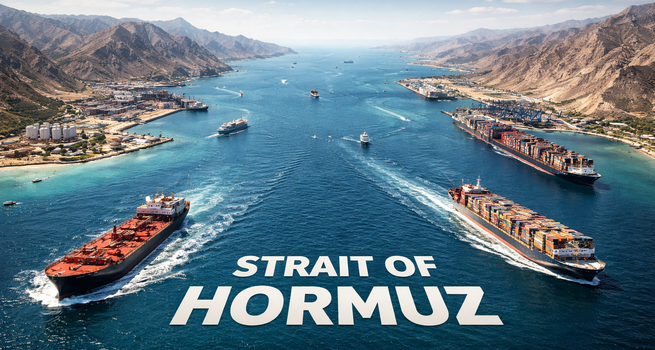
Key Highlights
- Ship transits through the Strait of Hormuz have fallen by nearly 97%, signalling severe disruption.
- The chokepoint handles roughly a quarter of global seaborne oil trade.
- Energy markets have reacted sharply, with oil and gas prices surging.
- Supply chain pressures are intensifying through higher freight, fuel and insurance costs.
- The disruption raises risks of global inflation persistence and slower growth.
A Chokepoint Under Pressure
Few maritime corridors carry as much economic weight as the Strait of Hormuz. Linking the Persian Gulf to global markets, the narrow passage is a critical artery for energy flows, handling close to 20 million barrels of oil per day, or roughly 25 per cent of global seaborne oil trade.
Recent data now suggests that ship transits through this vital route have come close to a standstill. Daily vessel movements, which averaged about 129 in late February, have dropped to single digits in early March, representing a decline of approximately 97 per cent.
This is not a routine disruption. It represents a structural shock to global energy logistics with immediate consequences for prices, supply chains and financial markets.
Global Energy Markets: Immediate Price Reaction
The first-order impact of the disruption has been a rapid repricing in energy markets. Oil prices have moved decisively above $90 per barrel, reflecting both supply constraints and an embedded geopolitical risk premium.
Natural gas markets have reacted even more sharply. With liquefied natural gas shipments also routed through Hormuz, reduced flows have tightened global supply expectations, particularly for Asian buyers.
Such price movements are consistent with historical precedents. Energy markets tend to respond quickly to disruptions in physical supply routes, even before actual shortages materialise. The anticipation of constrained flows is often enough to trigger volatility.
However, the scale of the current disruption distinguishes it from previous episodes. A near-total halt in shipping activity introduces a degree of uncertainty that markets are still attempting to quantify.
Shipping and Trade: A Breakdown in Flow Efficiency
The collapse in ship transits has immediate implications for global trade logistics. The Strait of Hormuz is not only an energy corridor but also a route for refined products, chemicals and fertilizers.
With vessel movements reduced to a fraction of normal levels, shipping capacity is effectively constrained. This has triggered a sharp increase in freight costs, particularly for tanker routes.
Tanker rates have risen significantly, reflecting both reduced supply of available vessels and increased risk premiums. At the same time, marine fuel prices have surged, adding another layer of cost pressure.
War-risk insurance premiums have also escalated, in some cases doubling or quadrupling per voyage. For shipowners and charterers, these costs materially alter the economics of trade routes.
The cumulative effect is a sharp increase in the cost of moving goods, which is likely to feed through to end consumers.
Inflation Dynamics: Energy to Food Transmission
One of the most critical aspects of the disruption is its potential to amplify inflation through multiple channels.
Energy prices serve as a foundational input across the global economy. Higher oil and gas prices increase transportation costs, which in turn raise the cost of goods. This effect is particularly pronounced in food markets.
Fertilizers, a key input in agricultural production, are also heavily dependent on energy markets. A significant portion of global fertilizer trade passes through the Strait of Hormuz. Disruptions to these flows can lead to higher input costs for farmers, ultimately translating into higher food prices.
This transmission mechanism has been observed in previous crises, including the pandemic and geopolitical conflicts. The current disruption risks reinforcing inflationary pressures at a time when many economies are still grappling with elevated price levels.
Regional Exposure: Asia at the Frontline
The geographic distribution of energy flows through the Strait of Hormuz creates an uneven impact across regions. Asia is particularly exposed.
A substantial majority of crude oil and liquefied natural gas passing through the strait is destined for Asian markets. This dependence makes the region vulnerable to supply disruptions and price spikes.
Countries with high energy import dependence may face a combination of:
- Rising import bills
- Currency depreciation pressures
- Increased inflation
- Slower economic growth
For policymakers in these economies, the challenge is balancing energy security with macroeconomic stability.
Financial Markets: Rising Risk Premiums
The disruption is also being reflected in financial markets through rising risk premiums.
Bond yields across several Middle Eastern economies have moved higher, indicating increased investor caution. Yield increases of between 0.24 and 0.64 percentage points suggest that markets are pricing in greater geopolitical and economic uncertainty.
Equity markets have also begun to reflect sectoral divergence. Energy producers and shipping companies have benefited from higher prices and rates, while sectors such as airlines and logistics have come under pressure.
This divergence highlights the redistribution of economic gains and losses in response to the shock.
Stock Market Outlook: Sector Rotation and Volatility
The current environment is conducive to sector rotation. Investors are shifting capital towards industries that benefit from higher commodity prices and away from those exposed to cost pressures.
Energy companies are experiencing improved revenue prospects, supported by higher realised prices. Shipping firms, particularly those involved in tanker operations, are benefiting from elevated freight rates.
Conversely, sectors reliant on stable input costs are facing margin compression. Airlines, for example, are highly sensitive to fuel prices, while logistics companies must contend with rising transportation costs.
The broader market implication is increased volatility, as investors reassess earnings expectations and risk profiles across sectors.
Macroeconomic Implications: The Return of Stagflation Risk
Perhaps the most significant long-term implication of the disruption is the re-emergence of stagflation risk.
The combination of rising energy prices and supply chain disruptions creates a challenging environment for economic growth. Higher costs reduce consumer purchasing power and corporate profitability, while supply constraints limit output.
Central banks face a difficult policy trade-off. Tightening monetary policy to control inflation risks exacerbating economic slowdown, while maintaining accommodative policy risks allowing inflation to become entrenched.
The outcome will depend largely on the duration of the disruption. A short-lived shock may be absorbed by markets, but a prolonged disruption could have more structural consequences.
Strategic Outlook: Duration and Policy Response
The key variable in assessing the impact of the Strait of Hormuz disruption is its duration.
If shipping flows resume quickly, the shock may prove temporary, with prices stabilising as supply chains adjust. However, a prolonged disruption could lead to:
- Reconfiguration of global trade routes
- Increased investment in alternative energy infrastructure
- Greater emphasis on energy security policies
Governments may also intervene through strategic reserves, subsidies or diplomatic efforts to stabilise the situation.
For markets, the uncertainty surrounding these outcomes is likely to remain a source of volatility.
Conclusion: A Fragile Global System Exposed
The near halt in ship transits through the Strait of Hormuz underscores the fragility of global trade infrastructure.
In an interconnected world, disruptions at critical nodes can propagate rapidly across markets and economies. The current situation highlights the extent to which global growth remains dependent on stable energy flows and efficient logistics networks.
While markets have begun to react, the full implications of the disruption are still unfolding. The balance between temporary shock and structural shift will determine the trajectory of energy markets, inflation and global economic growth in the months ahead.


 Jun 05, 2026




 Please wait processing your request...