
 AU
AU
 UK
UK
 CA
CA
 NZ
NZ
 IND
IND

 US
US

 Share
Share
 X (Formerly Twitter)
 Whatsapp
 Facebook
 LinkedIn
 Telegram
 Email This Article
 Copy Link
 Summarize with AI
 Chat GPT
 Perplexity
_03_27_2026_23_39_26_257676.jpg)
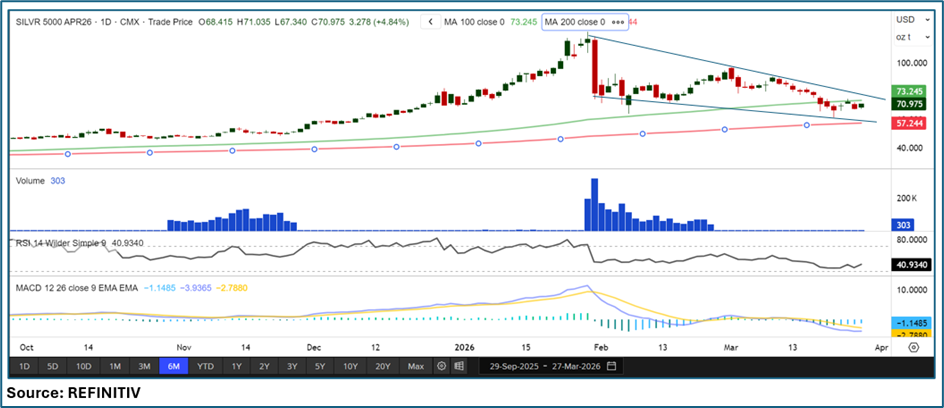
Silver Market Overview: Price Consolidation Within a Converging Channel
Silver prices are currently exhibiting a period of technical consolidation, trading within a converging channel that reflects narrowing price action. This formation, often associated with declining volatility, suggests a market in equilibrium where buying and selling pressures are gradually balancing out.
Such channel patterns typically emerge after directional moves and may indicate that market participants are reassessing positioning. In silver’s case, the recent structure points to a pause in the prior downward momentum rather than a decisive reversal. The narrowing range underscores indecision, with neither side establishing clear dominance.
200-Period Simple Moving Average: A Key Long-Term Support Level
A notable feature of the current setup is silver’s proximity to its 200-period simple moving average, a widely observed technical benchmark used to assess long-term trend direction. This level is currently acting as a stabilizing force in the market.
Historically, the 200-period moving average has served as a point of support during corrective phases. Silver’s ability to remain near this level suggests that broader structural support remains intact, even as short-term weakness has been evident. The price behavior around this zone indicates that market participants continue to engage at lower levels, limiting the extent of recent declines.
However, sustained interaction with such a critical level also reflects underlying fragility. While the support has not been decisively breached, repeated tests may influence market sentiment and shape expectations about longer-term direction.
RSI (14) Indicator: Near Oversold Territory with Early Signs of Recovery
Momentum indicators provide additional context to the current market environment. The 14-period Relative Strength Index (RSI), a commonly used measure of momentum, is hovering near oversold territory. This suggests that recent selling pressure may have approached an extreme.
Importantly, the RSI has begun to move higher from these lower levels. This gradual upward shift indicates a moderation in bearish momentum and hints at the possibility of short-term stabilization. While oversold conditions do not inherently signal a reversal, they often coincide with reduced selling intensity.
In the present context, the RSI’s behavior aligns with the broader theme of consolidation. It reflects a market that is no longer accelerating downward but has yet to demonstrate strong upward conviction.
Price Action and Market Behavior: Signs of Stabilization Without Breakout
Recent price action reinforces the view of a market transitioning into a more neutral phase. Downside moves have become less pronounced, and volatility has diminished as the converging channel tightens.
This pattern suggests that sellers may be losing momentum, while buyers are not yet sufficiently active to drive a sustained upward move. The result is a market that appears to be stabilizing rather than trending.
Such conditions are not uncommon in commodities like silver, where macroeconomic factors—including interest rates, currency movements, and industrial demand—often influence directional conviction. The current technical setup reflects this broader uncertainty.
Technical Structure: Interaction Between Trend Indicators and Price Compression
The interaction between the converging channel and the 200-period moving average highlights an important technical dynamic. On one hand, the channel indicates short-term compression and indecision. On the other, the long-term moving average provides a structural anchor.
This combination suggests that while short-term direction remains unclear, the broader market framework has not deteriorated significantly. The absence of a decisive move away from the 200-period average reinforces the idea of equilibrium rather than trend continuation.
At the same time, the proximity to key technical levels increases the importance of future price behavior. Market participants often monitor such zones closely, as they can influence positioning and risk management decisions.
Volatility and Market Participation: A Phase of Reduced Activity
Another notable aspect of the current environment is the apparent reduction in volatility. As the price range narrows within the converging channel, trading activity often becomes more measured.
Lower volatility can indicate a temporary decline in market participation or a period of waiting among investors. This aligns with the broader technical picture, where neither bullish nor bearish catalysts appear dominant.
In commodity markets, such phases are frequently followed by renewed activity once new information or macroeconomic developments emerge. For silver, this could relate to shifts in industrial demand expectations, inflation trends, or movements in the US dollar.
Risk Factors and Market Sensitivities
Despite signs of stabilization, several risks remain relevant. Oversold conditions, while indicative of reduced selling pressure, can persist for extended periods in weak markets. Similarly, support levels such as the 200-period moving average are not immune to breakdowns, particularly if broader macroeconomic conditions shift.
Silver’s dual role as both an industrial and precious metal adds further complexity. Changes in manufacturing activity, energy markets, and monetary policy can all influence price dynamics. This interconnectedness means that technical signals should be viewed within a wider economic context.
Conclusion: Silver in a Holding Pattern Near Key Technical Levels
Silver’s current technical configuration reflects a market in transition. The converging channel highlights a phase of consolidation, while the 200-period simple moving average provides an important layer of support. Meanwhile, the RSI’s movement from near-oversold territory suggests that downward momentum is easing.
Taken together, these elements point to a period of stabilization rather than clear directional movement. The market appears to be in a holding pattern, with price action constrained and momentum subdued.
In line with this balanced technical picture, there is no clear indication supporting a directional stance at present. Future developments—both technical and macroeconomic—are likely to play a decisive role in shaping the next phase of silver’s price behavior.


 Jun 05, 2026




 Please wait processing your request...