
 AU
AU
 UK
UK
 CA
CA
 NZ
NZ
 IND
IND

 US
US

 Share
Share
 X (Formerly Twitter)
 Whatsapp
 Facebook
 LinkedIn
 Telegram
 Email This Article
 Copy Link
 Summarize with AI
 Chat GPT
 Perplexity
Key Highlights
- Manhattan's Largest Office Landlord — 60+ Midtown buildings including the iconic One Vanderbilt tower, where trophy-asset leasing demand remains strong despite broader office market headwinds.
- Monthly Income at 6.6% Yield — One of the few REITs paying monthly dividends, offering investors regular cash flow from some of the world's most valuable commercial real estate.
- Flight to Quality Beneficiary — As tenants consolidate into premium office spaces, SL Green's best-in-class Midtown portfolio is outperforming the national office market — a critical differentiator in a challenged sector.
SL Green Realty Corp. (NYSE:SLG) is Manhattan's largest commercial landlord and one of the most closely watched names in the office REIT sector. With a dividend yield of approximately 6.6%, SL Green offers income investors meaningful yield from prime New York City office real estate — but also exposure to one of the most debated and volatile subsectors in real estate: the post-pandemic future of urban office space. This comprehensive article examines SL Green's investment case, financial position, dividend record, and management's perspective on the evolving office market.
Company Overview
Founded in 1980 and converted to REIT status in 1997, SL Green Realty Corp. is headquartered in New York City and focuses exclusively on Manhattan office properties. The company owns, manages, and leases approximately 28 million square feet of Manhattan office space across more than 60 buildings. Its portfolio is concentrated in premier Midtown Manhattan addresses — some of the most valuable commercial real estate in the world.
SL Green's flagship properties include One Vanderbilt Avenue — a 1.7 million square foot supertall tower adjacent to Grand Central Terminal that opened in 2020 and has achieved exceptional leasing success — and 245 Park Avenue, among other Midtown Manhattan trophy properties. The company also operates a structured finance business, providing debt and preferred equity financing secured by Manhattan real estate.
The company has been actively managing its portfolio in response to post-pandemic office demand trends, selling non-core assets and focusing capital on its highest-quality properties where tenant demand has remained strong. One Vanderbilt's success — which attracted major financial services and professional services tenants at premium rents — has validated SL Green's strategy of focusing on trophy, amenity-rich buildings.
The Office Market Context
To understand SL Green's investment case, one must understand the profound disruption the office market has experienced since 2020. Remote and hybrid work arrangements — adopted broadly during the COVID-19 pandemic — have permanently altered office space utilization patterns. National office vacancy rates remain elevated compared to pre-pandemic levels, and many suburban and lower-quality urban office markets are experiencing structural challenges.
However, Manhattan's premium office market has shown meaningful divergence from national trends. Trophy buildings in prime Midtown locations — properties like SL Green's portfolio — have achieved strong leasing activity and rental rate growth, as tenants concentrated their office footprints in high-quality spaces that justify the commute for employees. This 'flight to quality' has benefited SL Green disproportionately compared to owners of commodity office product.
Stock Performance and Valuation
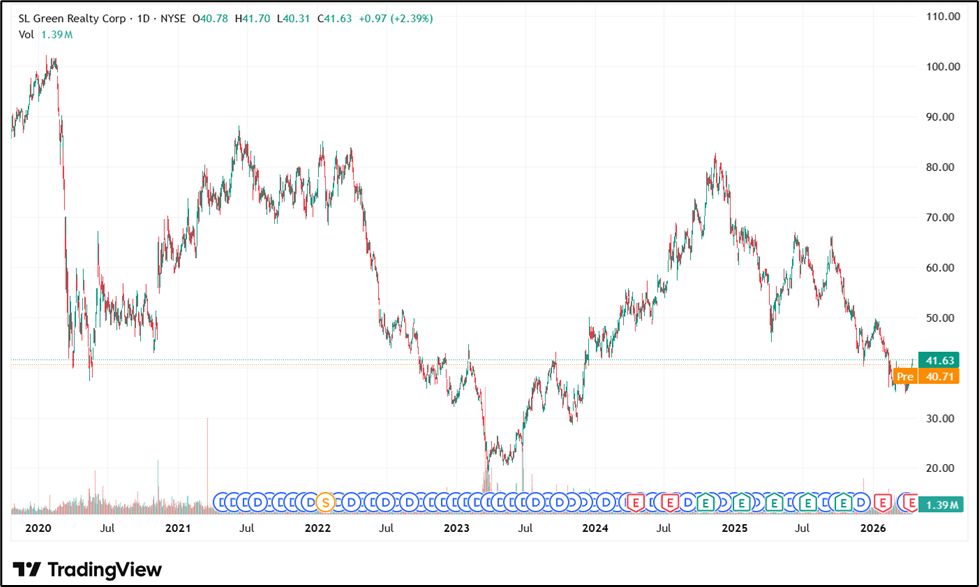
SL Green's stock has experienced significant volatility since 2020, declining sharply as office market concerns peaked and then partially recovering as Manhattan leasing data improved. The company's dividend yield of approximately 6.6% reflects both the above-market income available from commercial real estate and the discount at which office REITs trade relative to their pre-pandemic valuations.
SL Green pays its dividend on a monthly basis — joining EPR Properties and PennantPark Floating Rate Capital as monthly dividend payers in this series. Monthly distributions are valued by income investors for cash flow planning purposes.
Financial Overview
SL Green's financial profile reflects a company that has proactively managed through one of the most challenging periods in commercial real estate history. The company has sold non-core assets to reduce debt, focusing its capital on its highest-quality properties where tenant demand is strongest.
The company's same-store occupancy and leasing activity at One Vanderbilt and its other trophy properties has been encouraging, with financial services, law firms, and technology companies continuing to lease space in premier Midtown locations at rents that validate SL Green's asset quality thesis.
Debt management has been a key focus: the company has extended maturities, refinanced obligations, and reduced overall leverage in response to the higher interest rate environment. While office REITs broadly carry higher leverage than diversified REIT peers — reflecting the capital intensity of Manhattan office buildings — SL Green's proactive balance sheet management has addressed some of the refinancing risk concerns that plagued the sector in 2023–2024.
Dividend History and Monthly Distributions
SL Green converted from quarterly to monthly dividend payments, a move welcomed by income investors. The forward dividend yield of approximately 6.6% represents meaningful income for investors willing to accept the risks associated with the Manhattan office market.
The company's dividend trajectory has been through significant stress: SL Green reduced its dividend during the post-pandemic period as office demand uncertainty peaked. The current dividend level and monthly payment structure reflect a recalibrated approach focused on a sustainable payout level given the evolved office demand environment.
Management Outlook
CEO Marc Holliday has been one of the most vocal advocates for the recovery of Manhattan's premium office market. Management's key strategic messages include the continued strength of leasing demand at One Vanderbilt and other trophy properties, the continued 'flight to quality' dynamic benefiting best-in-class buildings, and the belief that Manhattan's office market — particularly for premium product — is in a fundamentally different position from challenged suburban or secondary-market offices.
For 2026, management has guided toward continued leasing progress, stabilization of same-store net operating income, and a focus on debt management and balance sheet optimization. The dividend is expected to be maintained at current levels, with any growth tied to the overall trajectory of FFO per share.


 Jun 05, 2026




 Please wait processing your request...