
 AU
AU
 UK
UK
 CA
CA
 NZ
NZ
 IND
IND

 US
US

 Share
Share
 X (Formerly Twitter)
 Whatsapp
 Facebook
 LinkedIn
 Telegram
 Email This Article
 Copy Link
 Summarize with AI
 Chat GPT
 Perplexity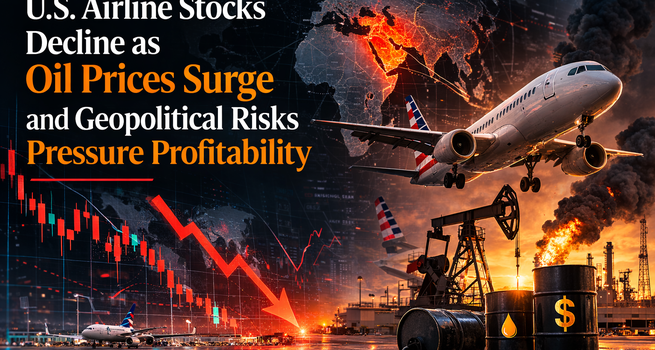
U.S. airline stocks have recently come under pressure as investors react to a sharp rise in oil prices, heightened geopolitical tensions in the Middle East, and broader macroeconomic concerns. The aviation sector, which typically operates on thin margins and is highly sensitive to fuel costs, has witnessed notable declines across major carriers as markets reassess profitability expectations and operational risks.
Oil Price Surge Weighs on Airline Profitability
The most significant factor driving the decline in airline stocks is the recent surge in crude oil prices. Escalating tensions in the Middle East, particularly involving Iran, have raised fears of potential supply disruptions in global energy markets. As a result, crude oil prices have climbed sharply this year, prompting investors to anticipate further volatility if the conflict intensifies.
Fuel expenses represent one of the largest operating costs for airlines. Jet fuel prices are closely linked to crude oil movements, and any sustained increase in oil prices can rapidly erode profit margins. Historically, fuel accounts for roughly 25-30% of total airline operating costs, making the industry highly vulnerable to sudden price spikes. In response to the recent rally in oil, shares of major U.S. carriers such as United Airlines, Delta Air Lines, and American Airlines have all moved lower as investors factor in the likelihood of rising operating expenses.
Middle East Tensions Disrupt Air Travel Operations
Beyond the direct impact of fuel costs, the geopolitical situation in the Middle East has also introduced operational challenges for global airlines. Ongoing tensions have led to airspace restrictions and closures across several parts of the region, forcing airlines to reroute flights and in some cases cancel services entirely.
These disruptions carry multiple cost implications. Longer flight paths increase fuel consumption, while additional operational adjustments may lead to scheduling complications and higher logistical expenses. In addition, insurers have raised premiums for flights operating through or near conflict-prone regions, further adding to airlines’ cost pressures. Thousands of flights have reportedly been affected by regional airspace disruptions, highlighting the broader operational risks facing the industry.
Inflation and Interest Rate Concerns Add Macro Pressure
The surge in oil prices has also revived concerns about global inflation. Higher energy prices tend to feed into broader inflationary pressures, which could influence central bank policy decisions. If inflation remains elevated, central banks may delay anticipated interest rate cuts, keeping borrowing costs higher for longer.
For airlines, this macroeconomic environment presents a dual challenge. On one hand, higher interest rates increase financing costs for aircraft purchases and fleet upgrades. On the other hand, persistent inflation can weaken consumer purchasing power, potentially dampening discretionary spending on travel.
Structural Sensitivity to Fuel Costs
Airlines are structurally more exposed to energy price fluctuations than many other industries. Alongside labor expenses, another major cost component fuel represents a substantial portion of total operating expenditure. Aircraft leasing, maintenance, and airport charges further add to the industry’s cost structure.
Given these dynamics, even a moderate increase in fuel prices can significantly affect earnings forecasts. Analysts often revise airline profitability estimates quickly following oil price spikes, which in turn triggers negative sentiment in airline equities.
Investor Rotation Toward Defensive and Energy Sectors
Periods of geopolitical uncertainty typically led investors to rotate capital away from cyclical sectors and toward industries perceived as more resilient. Energy companies, which benefit from higher oil prices, and defense contractors often see inflows during such periods. In contrast, travel-related sectors including airlines, cruise operators, and hospitality companies tend to face selling pressure.
This shift in investor positioning has further contributed to the recent decline in airline stocks, as market participants seek to reduce exposure to industries sensitive to geopolitical and macroeconomic volatility.
Outlook
In summary, the recent weakness in U.S. airline stocks reflects a combination of rising oil prices, geopolitical risks in the Middle East, and broader macroeconomic concerns. Higher jet fuel costs threaten airline profitability, while airspace disruptions and operational uncertainties add to industry challenges. At the same time, inflation fears and potential delays in interest rate cuts are prompting investors to reassess demand prospects for air travel.
Given the airline industry's strong sensitivity to energy prices, any sustained rally in crude oil is likely to continue exerting pressure on airline equities in the near term.

_06_12_2026_23_00_13_327450.jpg)
 Jun 12, 2026




 Please wait processing your request...