
 AU
AU
 UK
UK
 CA
CA
 NZ
NZ
 IND
IND

 US
US

 Share
Share
 X (Formerly Twitter)
 Whatsapp
 Facebook
 LinkedIn
 Telegram
 Email This Article
 Copy Link
 Summarize with AI
 Chat GPT
 Perplexity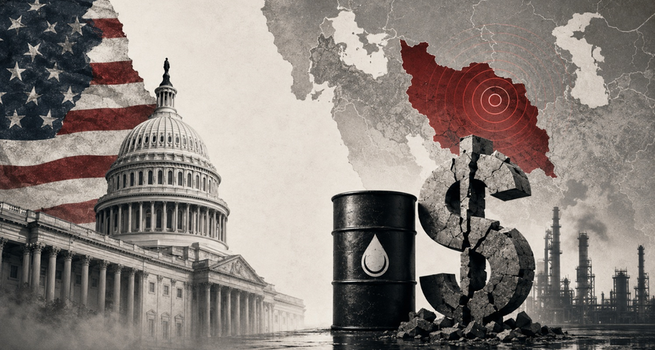
In 1974, Washington bought oil dominance with a security guarantee. In 2026, Gulf monarchies declined to honor it. With alternative settlement rails now operating at commercial scale and AI becoming the new dollar anchor, the arrangement that shaped half a century of global finance is being quietly renegotiated.
Source: Kalkine
On February 28, 2026, the United States and Israel launched Operation Epic Fury against Iranian military and energy infrastructure. Brent Crude surged past $119 a barrel within days. Shipping insurance premiums across the Persian Gulf spiked 500%, making commercial passage through the Strait of Hormuz economically unviable for most carriers. The IMF warned that a sustained standoff could erase $2.2 trillion from global GDP.
The financial consequences were severe. The geopolitical consequences were more revealing. Gulf monarchies that Washington had protected for five decades under the petrodollar compact declined to offer airspace or territory for the strikes. The very nations whose oil surplus recycling has suppressed American borrowing costs for half a century chose, at the decisive moment, not to underwrite the campaign. That silence is the most consequential signal in global macro today.
What the Compact Actually Promised
The 1974 Washington-Riyadh arrangement was not a currency agreement. It was a security contract denominated in dollars. OPEC would price oil exclusively in US currency; Washington would guarantee Hormuz passage and provide military cover. The resulting loop was structurally durable: oil Demand generated dollar demand, exporters recycled surpluses into Treasuries, and American borrowing costs stayed artificially compressed. It held for five decades because both sides received what they were promised. Operation Epic Fury has put both sides of that bargain under simultaneous strain.
Source: Kalkine
Three forces were already eroding petrodollar exclusivity before the first strike. The conflict has sharpened each.
The first is sanctions overreach. Each time Washington froze sovereign reserves or cut an economy off from SWIFT, it gave rivals a commercial case for alternatives. Russia, Iran, and Venezuela built non-dollar arrangements under direct pressure. Nations not yet sanctioned are quietly recalibrating their exposure, treating dollar dependency as a latent geopolitical Liability.
The second is infrastructure maturation. The mBridge platform, backed by the central banks of China, the UAE, Saudi Arabia, Thailand, and Hong Kong, processed over $55 billion in March 2026 alone. China's digital yuan is now embedded in 29 bilateral trade corridors across Southeast Asia, the Middle East, and Africa. This is no longer pilot-stage technology. It is functioning settlement infrastructure operating at commercial scale during an active military conflict, with Iranian crude continuing to reach China entirely outside US financial channels.
The third is geopolitical disillusionment. Gulf states declined to extend Washington full operational cooperation during the Iran campaign, placing the credibility of the security umbrella that anchors the petrodollar's political legitimacy under visible, public scrutiny for the first time.
The war did not create the alternative infrastructure. It validated it. These three pressures map directly onto the dollar's three structural pillars, and they are not weakening them equally.
Dollar dominance rests on three structural pillars. They are not moving in the same direction.
Energy pricing (petrodollar): The weakest pillar today. The Gulf crisis has fractured the security guarantee underpinning it. mBridge and yuan corridors are handling a growing share of South-South energy flows. Saudi Arabia's simultaneous presence in dollar markets and on Chinese-led digital platforms signals managed optionality, not loyalty. This pillar is weakening.
Financial markets (Treasuries and Liquidity depth): It remain the dollar's most durable foundation. No rival market matches the transparency, depth, or institutional trust of US sovereign Debt. However, China has cut its Treasury holdings from $1.3 trillion in 2013 to $682 billion today. The dollar's global reserve share has declined from 71% in 2008 to 56.3%. Emerging market central banks are purchasing gold at the fastest pace since the 1960s. The pillar is intact but under measurable, sustained pressure. The IMF projects the dollar's reserve share could decline to below 50% by 2030 if current Diversification trends persist, a threshold that would structurally raise US long-term borrowing costs and widen sovereign risk premiums across dollar-denominated debt markets.
Technology dominance (AI and semiconductors):It is the one pillar that is actively strengthening. US Leadership in frontier AI models, cloud infrastructure, and advanced semiconductors represents a new form of structural Leverage. Washington is now explicitly linking access to this infrastructure to continued dollar usage, a deliberate attempt to construct a new anchor as the energy anchor weakens. This pillar is strengthening, though its durability depends on whether China's domestic technology development can neutralise the leverage before it embeds.
Source: Kalkine
The Trump administration's Petro-AI-Dollar framework is the most strategically significant Monetary Policy development of 2026. The logic mirrors 1974 precisely: attach currency conditionality to a resource that every major economy needs. In 1974, that resource was security and oil access. Today, it is frontier compute, AI model access, and semiconductor Supply chains.
The approach has genuine structural potential. US dominance in large language models, GPU architecture, and cloud infrastructure is real and currently unmatched at scale. If dollar settlement becomes a condition of access to American AI ecosystems, it creates a new demand floor for the currency that operates independently of oil pricing.
The risk is replication. China is investing aggressively in domestic AI capability and advanced chip development specifically to avoid the dependency this framework would create. The window in which the AI anchor can be embedded before alternatives mature is finite, and Washington is aware of it.
Pressure Points That Could Stabilise the Dollar
De-dollarisation is not irreversible. Several scenarios could slow or partially reverse the current trajectory.
A credible US fiscal consolidation would strengthen demand for Treasuries and reassert the financial markets pillar. Sustained dollar weakness making dollar-denominated Assets cheaper for foreign buyers could attract renewed sovereign accumulation. A fragmentation of BRICS coordination, particularly a deepening India-China strategic rivalry, would remove the bloc's limited coherence as a challenger. A geopolitical resolution in the Gulf that restores confidence in the US security umbrella would stabilise the energy pillar. And if China's Capital Account remains closed indefinitely, the yuan's ceiling as a reserve currency stays structurally low, limiting mBridge's long-run ambition.
None of these scenarios are improbable. De-dollarisation is a directional trend, not a determined outcome. Its pace depends heavily on policy choices in Washington, Beijing, and Riyadh over the next several years.
The System Holds, But Its Monopoly Does Not
The US-Iran war has not ended the petrodollar. It has repriced it. The security guarantee has been revealed as conditional. Alternative infrastructure is handling real Volume. The reserve share is declining. But the dollar's financial market pillar holds, and the AI anchor is being actively constructed.
What is emerging is a fragmented architecture: dollar rails for Western-facing trade and long-term LNG contracts, mBridge and yuan corridors for South-South flows and sanctioned economies, gold as a reserve backstop, and AI access increasingly attached to dollar conditionality. For institutional investors, this translates into a global liquidity environment with higher political risk premiums, structurally greater Volatility in energy markets, and a US fiscal trajectory that can no longer assume the silent Subsidy of petrodollar recycling.
The petrodollar is not collapsing. But the fiscal cost of defending it, through military commitments, AI subsidy frameworks, and sustained Treasury market support, is rising. That cost will not appear in energy prices. It will appear in the American public Balance Sheet.


 Jun 05, 2026




 Please wait processing your request...