
 AU
AU
 UK
UK
 CA
CA
 NZ
NZ
 IND
IND

 US
US

 Share
Share
 X (Formerly Twitter)
 Whatsapp
 Facebook
 LinkedIn
 Telegram
 Email This Article
 Copy Link
 Summarize with AI
 Chat GPT
 Perplexity
Key Momentum Highlights
- The Energy Outlier: Despite suffering the heaviest absolute losses on the session, Energy (XLE) remains the undisputed momentum leader, driving deep into the Improving quadrant with an aggressive North-East vector.
- Tech's Momentum Divergence: Information Technology (XLK) dominated the daily tape, but its relative rotation trail reveals a sharp South-East curl, indicating a systemic loss of vertical momentum relative to the benchmark.
- Staples Breakout: Consumer Staples (XLP) successfully crossed the zero-line from the Lagging sector into the Improving quadrant, confirming a steady accumulation of defensive relative strength.
- The Synchronized Hook: A massive cluster of cyclical and defensive sectors trapped in the Lagging quadrant (XLU, XLV, XLI, XLF, XLB) are printing synchronized North-West hooks, signaling a sharp momentum Reversal and potential bottoming process.
The US Equity market session on May 1, 2026, presented a fascinating divergence between absolute price action and underlying momentum structures. While institutional Capital aggressively bid up mega-cap growth and liquidated energy and defensives on the daily tape, the Relative Rotation Graph (RRG) tells a different story. The momentum data suggests that the broader structural rotation toward tangible assets and value is still intact, even as Tech enjoys a temporary resurgence in daily flow.
Sector Momentum and Trajectory Summary
The following chart and table details the momentum quadrant positioning and visual trail vectors for the 11 major US S&P 500 sectors as of the May 1 close:
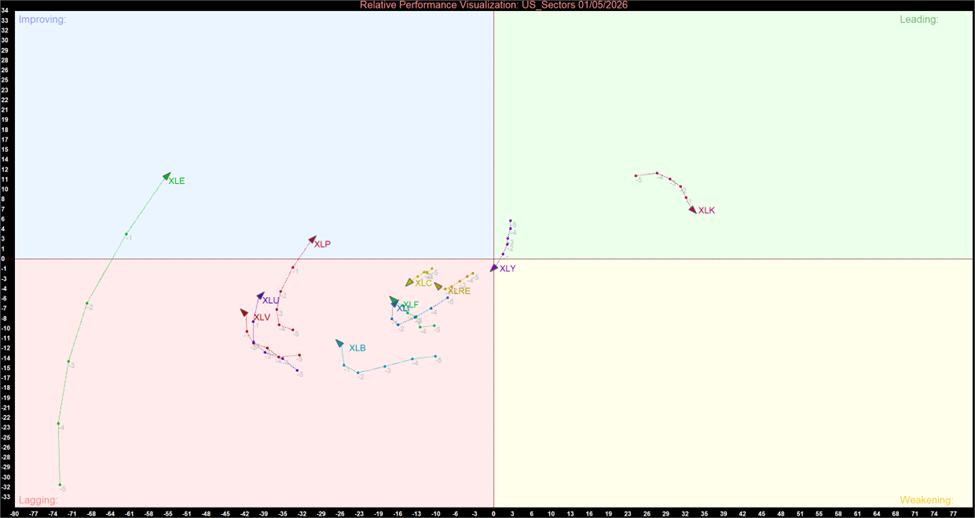
US Sector Relative Momentum Chart (at the closing price of 01/05/2026). Powered by: amibroker.com
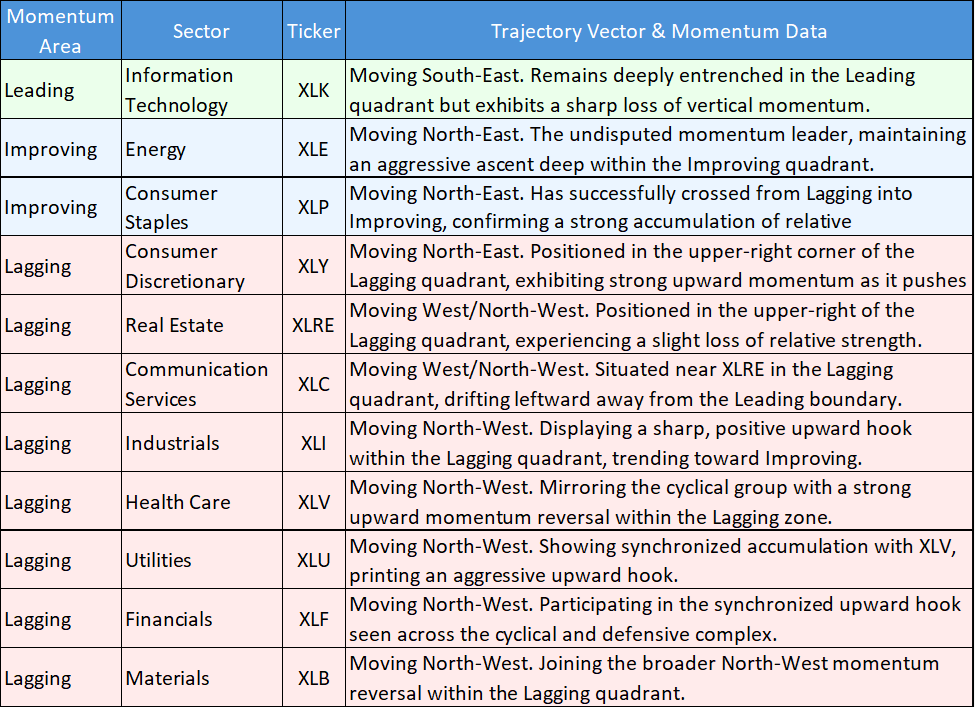
Quantitative Momentum Themes
The Tech Divergence
Information Technology (XLK) posted a stellar +1.49% absolute gain, yet its momentum vector is curling South-East. This quantitative divergence is a critical warning sign for growth bulls. It suggests that while Tech can still capture aggressive "risk-on" Capital flows on a daily basis, its broader Leadership trend against the S&P 500 is decelerating. It is losing the vertical momentum required to sustain long-term outperformance.
Energy's Structural Bid
Energy (XLE) dropped -1.34% on the day, but the RRG data completely ignores this daily noise. XLE remains isolated deep in the Improving quadrant, pointing sharply North-East. This confirms that the institutional accumulation of energy as an Inflation hedge and hard-asset proxy is a structural, multi-week trend that easily absorbed Friday's profit-taking.
The "North-West Hook" Phenomenon
Perhaps the most significant development on the chart is the synchronized behavior of the Lagging quadrant. Historically lagging sectors, including Utilities (XLU), Health Care (XLV), Industrials (XLI), and Financials (XLF), are all printing identical North-West momentum hooks. This indicates a systemic, underlying bid for value and Yield. While these sectors haven't crossed into Leadership yet, the collective upward momentum Reversal suggests institutions are quietly accumulating these names at lower valuations.
Staples Cross the Threshold
Consumer Staples (XLP) provided the concrete proof of the defensive rotation by officially crossing into the Improving quadrant. Supported by a steady North-East trajectory, XLP is systematically gaining relative strength, outperforming the benchmark on a Risk-adjusted basis even on days when high-Beta tech is leading the broader market.
The momentum data from May 1 demands that active managers look past the daily tech rally. The South-East deceleration in XLK warns against chasing mega-cap growth at these levels. Conversely, the aggressive North-East trajectory of XLE and the synchronized upward momentum hooks across the defensive and cyclical complex (XLU, XLV, XLI) strongly suggest that the underlying market gravity continues to favor a rotation into tangible assets, stable yields, and value. Portfolios should maintain their defensive and energy-tilted postures while using tech rallies as potential Rebalancing opportunities.


 Jun 05, 2026




 Please wait processing your request...