
 AU
AU
 UK
UK
 CA
CA
 NZ
NZ
 IND
IND

 US
US

 Share
Share
 X (Formerly Twitter)
 Whatsapp
 Facebook
 LinkedIn
 Telegram
 Email This Article
 Copy Link
 Summarize with AI
 Chat GPT
 Perplexity
Key Highlights
- Tech Secures Leadership: Information Technology (XLK) has successfully crossed into the Leading quadrant, cementing its role as the market's primary structural growth anchor.
- Real Estate Breaks Out: Real Estate (XLRE) achieved a critical milestone, officially crossing the vertical zero-line to upgrade from the Improving to the Leading quadrant.
- Financials Crack: In a concerning divergence, Financials (XLF) slipped below the horizontal axis, dropping from Leading into the Weakening quadrant.
- Comm Services Upgrades: Communication Services (XLC) has officially crossed into the Improving quadrant, actively attempting to build genuine relative strength alongside Consumer Discretionary.
The US sector rotation on April 14, 2026, reveals a market undergoing a massive structural realignment. The Relative Rotation Graph (RRG) highlights a changing of the guard at the top of the market. With Information Technology and Real Estate claiming ultimate leadership, and Financials breaking down into the Weakening zone, institutional capital is clearly prioritizing secular growth and hard-asset yield over traditional credit and value cyclicals.
Daily US Sector Momentum Summary 14/04/2026
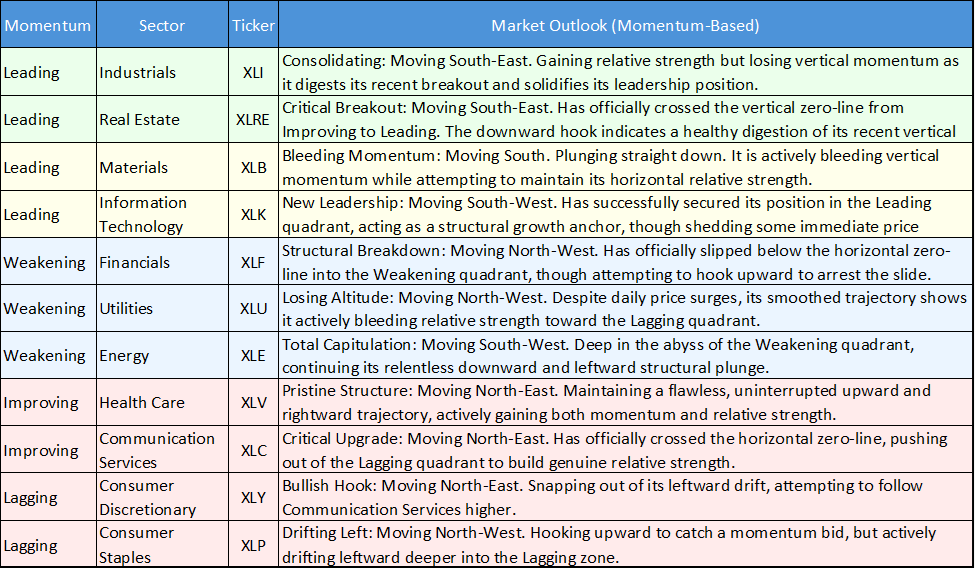
The following chart and table category all 11 sectors into their confirmed RRG quadrants based on their updated visual trajectories:
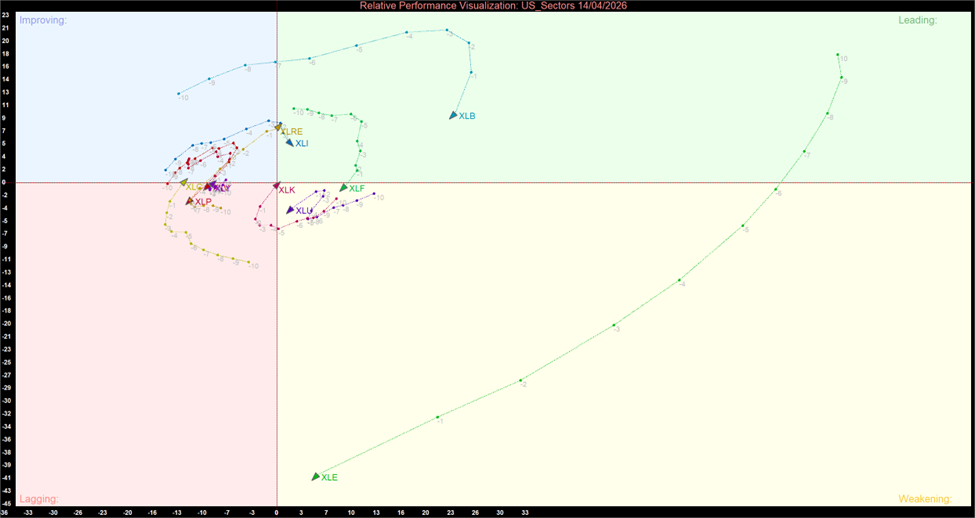
US Sector Relative Momentum Chart (at the closing price of 14th April 2026). Powered by: amibroker.com
Daily US Sector Momentum Summary Table
Key Market Themes
The New Leaders: Tech and Real Estate
The most significant developments on the April 14 chart occur squarely in the Leading quadrant. Information Technology (XLK) has officially claimed its spot as a market leader, confirming that institutional capital is firmly anchored in secular growth. Simultaneously, Real Estate (XLRE) achieved a massive structural breakout by crossing the vertical zero-line. The ascension of XLRE proves that the rotation into yield-sensitive assets over the past week was not a head-fake; it is a durable structural trend.
Financials Flash a Warning Sign
The breakdown of Financials (XLF) is the most concerning visual on the board. By dropping below the horizontal zero-line into the Weakening quadrant, the banking and credit sector is signaling underlying structural fragility. While the broader market advances, the loss of relative strength in Financials suggests that bond market volatility or shifting rate expectations are actively compressing institutional appetite for lending institutions.
The Defensive Divergence
The defensive block of the market has fractured entirely. While Health Care (XLV) continues to print a pristine North-East trajectory in the Improving quadrant, its traditional low-beta peers are falling apart. Consumer Staples (XLP) is stuck in the Lagging quadrant, and Utilities (XLU) is rapidly bleeding relative strength in Weakening. This divergence indicates that investors are becoming surgical with their defensive allocations, heavily favoring the demographic tailwinds of Health Care over the pure regulated yield of Utilities.
Consumer and Comm Services Attempt a Bottom
A bright spot for market breadth is emerging from the depths of the Lagging quadrant. Communication Services (XLC) achieved a critical upgrade, crossing the horizontal axis into the Improving quadrant. Right behind it, Consumer Discretionary (XLY) printed a sharp North-East hook. These sectors are finally attempting to build genuine relative strength, signaling that value hunters are actively stepping in to buy the dip in beaten-down consumer and digital communication names.
Bottom Line
The momentum landscape for April 14 confirms a highly selective, barbell-style market. The structural leadership of Technology and Real Estate indicates that investors are balancing aggressive growth with hard-asset yield. However, the breakdown in Financials serves as a loud warning against blind cyclical optimism. Active market participants should continue to lean into the undeniable North-East strength of Health Care and Real Estate, while monitoring the banking sector closely for signs of further contagion.


 Jun 05, 2026




 Please wait processing your request...