
 CA
 NZ
 UK
 AU
 IND

 US

 Share
 X (Formerly Twitter)
 Whatsapp
 Facebook
 LinkedIn
 Telegram
 Email This Article
 Copy Link
 Summarize with AI
 Chat GPT
 Perplexity

Key Highlights
- Energy (XLE) gained 0.27%, ranking first among all eleven sectors and emerging as the strongest-performing sector.
- Real Estate (XLRE) advanced 0.20%, providing additional support alongside Energy.
- Only two of the eleven sectors advanced, while nine declined, indicating a significant deterioration in market breadth.
- Health Care (XLV) fell 1.87%, recording the largest sector decline and experiencing the strongest selling pressure.
- Consumer Discretionary (XLY) and Consumer Staples (XLP) also declined sharply, falling 1.61% and 1.41%, respectively.
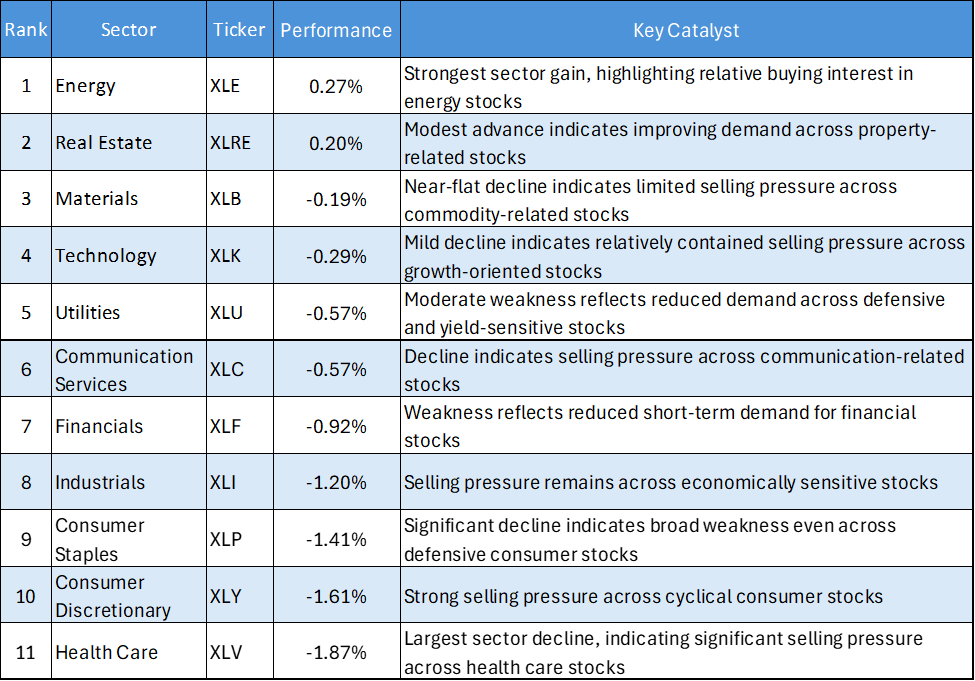
The latest US sector performance data for 20 August 2026 shows a notably weaker market environment. Energy (XLE) led the eleven sectors with a modest 0.27% gain, followed by Real Estate (XLRE) at 0.20%. In contrast, nine sectors declined, highlighting broad-based selling pressure across the US Equity market. Health Care, Consumer Discretionary, Consumer Staples and Industrials recorded some of the largest losses.
Performance Breakdown by Sector
Energy and Real Estate
Energy (XLE) was the strongest-performing sector, gaining 0.27% during the latest session. Although the advance was modest, Energy was the only sector other than Real Estate to record a positive return, placing it clearly at the top of the sector performance ranking.
The relative strength in Energy indicates that investors continued to show selective Demand for energy stocks despite the broader market weakness. Sustained outperformance would strengthen Energy's position within the current sector rotation and could encourage further Capital allocation toward the sector.
Real Estate (XLRE) also advanced, gaining 0.20% and ranking second among all eleven sectors. The positive performance provides additional support to the market, particularly given the broad declines across other sectors. Continued strength in Real Estate could indicate improving demand across rate-sensitive property stocks.
Materials and Technology
Materials (XLB) declined only 0.19%, making it the third-best-performing sector despite finishing in negative territory. The relatively small decline suggests that selling pressure across commodity-related stocks remained limited compared with most other areas of the market.
Technology (XLK) also experienced a relatively modest decline of 0.29%, ranking fourth. The limited weakness contrasts with the much larger losses recorded by several other major sectors and suggests that selling pressure across growth-oriented stocks remained comparatively contained during the latest session.
The combination of relatively small declines in Materials and Technology indicates that market weakness was not uniform across all sectors. However, the lack of gains outside Energy and Real Estate highlights the limited breadth of buying interest.
Utilities and Communication Services
Utilities (XLU) and Communication Services (XLC) both declined 0.57%. The performance places both sectors in the middle of the overall ranking, reflecting moderate selling pressure across defensive, yield-sensitive and communication-related stocks.
The weakness in Utilities is notable because defensive sectors typically provide relative stability during periods of broader market pressure. Meanwhile, the decline in Communication Services indicates that selling pressure extended into communication-related companies.
The simultaneous weakness across these sectors reinforces the deterioration in overall market breadth, with only a very small number of sectors able to maintain positive performance.
Financials, Industrials and Consumer Sectors
Financials (XLF) declined 0.92%, indicating a more meaningful deterioration in demand for financial stocks. The decline was significantly larger than the losses recorded by Materials and Technology and suggests that investors were reducing exposure to economically sensitive areas.
Industrials (XLI) fell 1.20%, extending the weakness across economically sensitive stocks. The decline contrasts with the relatively resilient performance of Energy and Materials and highlights the uneven performance across cyclical sectors.
Consumer Staples (XLP) declined 1.41%, while Consumer Discretionary (XLY) fell 1.61%. The weakness across both consumer segments is particularly significant because it demonstrates that selling pressure was not limited to cyclical areas. Consumer Staples, traditionally considered a defensive sector, also experienced substantial selling pressure.
The combination of weakness across Financials, Industrials and both consumer sectors indicates that investors were broadly reducing exposure across economically sensitive and defensive areas rather than rotating strongly into traditional defensive segments.
Health Care
Health Care (XLV) was the weakest-performing sector, declining 1.87% during the latest session. The decline placed Health Care at the bottom of the eleven-sector ranking and represented the largest sector loss of the session.
The significant weakness in Health Care indicates concentrated selling pressure across the sector. Its underperformance is particularly important because Health Care can often attract defensive capital when broader market conditions deteriorate.
Continued weakness in XLV could therefore reinforce concerns about the breadth of the current market environment. A recovery in Health Care would provide stronger evidence that selling pressure is easing, while further declines could signal continued weakness across the broader market.
Strategic Summary
The latest US sector performance data points to a significant deterioration in market breadth, with only two of the eleven sectors recording gains. Energy led with a 0.27% advance, followed by Real Estate at 0.20%, while Materials and Technology experienced only modest declines.
At the opposite end of the ranking, Health Care fell 1.87%, followed by Consumer Discretionary at 1.61%, Consumer Staples at 1.41% and Industrials at 1.20%. The broad-based weakness across both cyclical and defensive sectors suggests that selling pressure was widespread rather than concentrated in a single area.
A sustained recovery across the weaker sectors would provide stronger confirmation of improving market conditions. Conversely, continued weakness across Health Care, Consumer Discretionary, Consumer Staples and Industrials could maintain pressure on overall US equity market breadth.


 Nov 16, 2026





 Please wait processing your request...