
 CA
 NZ
 UK
 AU
 IND

 US

 Share
 X (Formerly Twitter)
 Whatsapp
 Facebook
 LinkedIn
 Telegram
 Email This Article
 Copy Link
 Summarize with AI
 Chat GPT
 Perplexity

Key Highlights
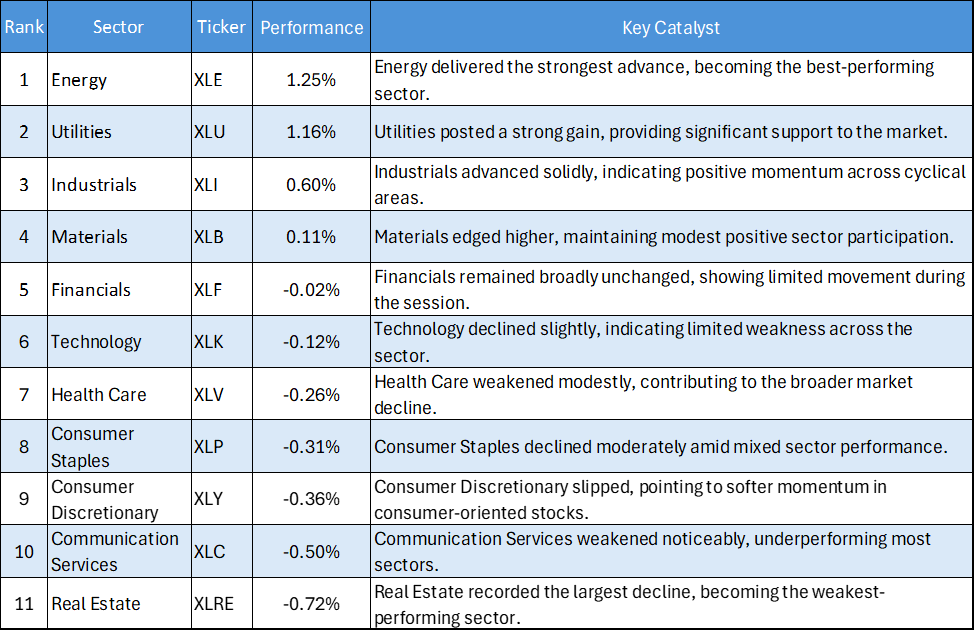
- Energy Leads the Market: Energy (XLE) gained 1.25%, making it the strongest-performing sector during the session.
- Utilities Follow Closely: Utilities (XLU) rose 1.16%, ranking as the second-best-performing sector.
- Industrials Advance: Industrials (XLI) increased 0.60%, providing additional support to the market.
- Materials Edge Higher: Materials (XLB) gained 0.11%, while Financials (XLF) was almost unchanged at -0.02%.
- Technology and Consumer Sectors Retreat: Technology (XLK) declined 0.12%, while Consumer Staples (XLP) and Consumer Discretionary (XLY) fell 0.31% and 0.36%, respectively.
- Real Estate Records the Largest Decline: Real Estate (XLRE) dropped 0.72%, making it the weakest-performing sector among the eleven sectors.
The US Equity market displayed mixed sector performance on 11 August 2026, with four of the eleven sectors finishing higher and seven declining. Energy provided the strongest Leadership after gaining 1.25%, followed closely by Utilities at 1.16%. Industrials also posted a solid advance, while Materials edged higher. In contrast, weakness was concentrated across Real Estate, Communication Services, Consumer Discretionary, Consumer Staples and Health Care. The negative Market Breadth indicates that sector participation remained selective, despite strong gains in Energy and Utilities.
Daily US Sector Performance Summary
Energy Takes the Lead
Energy (XLE) gained 1.25%, clearly outperforming the other sectors and emerging as the strongest source of market strength during the session. The sector maintained a narrow performance advantage over Utilities, which advanced 1.16% to rank second among the eleven sectors. Energy's leadership indicates continued relative strength, although its gain was considerably more moderate than the exceptionally strong performance recorded in the previous session.
Utilities Posts a Strong Advance
Utilities (XLU) rose 1.16%, ranking second among the eleven sectors and providing meaningful support to the broader market. The strong performance of Utilities contrasted with weakness across Real Estate and several consumer-oriented sectors, suggesting selective Demand for defensive and income-oriented areas. The combination of Energy and Utilities leadership indicates that market strength was concentrated in specific areas rather than broadly distributed across the market.
Industrials and Materials Move Higher
Industrials (XLI) gained 0.60%, making it the third-best-performing sector and extending positive performance into a cyclical area. Materials (XLB) also finished higher, although its gain was limited to 0.11%. Together, the positive performance of Industrials and Materials provided additional support, but their gains were not sufficient to offset declines across most of the remaining sectors.
Technology and Consumer Sectors Retreat
Information Technology (XLK) declined 0.12%, indicating limited weakness during the session. Consumer Staples (XLP) fell 0.31%, while Consumer Discretionary (XLY) declined 0.36%, highlighting softer performance across both defensive and consumer-facing areas. The weakness across Technology and consumer sectors suggests that buying interest remained selective rather than broad-based.
Communication Services and Real Estate Weaken
Communication Services (XLC) declined 0.50%, making it one of the weaker-performing sectors during the session. Real Estate (XLRE) dropped 0.72%, recording the largest decline among all eleven sectors. Health Care (XLV) also fell 0.26%, while Financials (XLF) was nearly unchanged, slipping just 0.02%. The broad weakness across these sectors reinforced the uneven nature of market participation.
Bottom Line
The US equity market showed mixed sector performance on 11 August 2026, with four of the eleven sectors finishing higher and seven declining. Energy was the clear leader, gaining 1.25%, while Utilities followed closely with a 1.16% advance. Industrials and Materials also posted positive returns, providing additional support to the market.
Overall, the sector distribution points to selective rather than broad-based buying interest. Energy and Utilities provided the main sources of leadership, while weakness in Real Estate, Communication Services and consumer sectors weighed on market breadth. The performance pattern suggests a notable rotation toward Energy and Utilities, while most other sectors remained under pressure.


 Nov 16, 2026




 Please wait processing your request...