
 AU
AU
 UK
UK
 CA
CA
 NZ
NZ
 IND
IND

 US
US

 Share
Share
 X (Formerly Twitter)
 Whatsapp
 Facebook
 LinkedIn
 Telegram
 Email This Article
 Copy Link
 Summarize with AI
 Chat GPT
 Perplexity
_05_13_2026_03_44_55_944893.jpg)
Key Highlights
- The Tech Anchor Fails: Information Technology (XLK) suffered a severe structural Liquidation, plunging -1.51% to finish as the worst-performing sector. The market's solitary mega-cap anchor has officially given way to heavy distribution.
- Aggressive Defensive Flight: Capital violently rotated into non-cyclical safety. Health Care (XLV) exploded for a 1.96% gain, and Consumer Staples (XLP) surged 1.28%, marking a massive quantitative shift toward low-Beta protection.
- Growth Triad Continues to Bleed: The structural fracture within mega-cap growth is accelerating. Alongside Tech's drop, Consumer Discretionary (XLY) fell -0.90%, confirming that the consumer-facing growth trade is actively being unwound.
- Cyclical Accumulation Pauses: After printing confirmed momentum breakouts earlier in the week, the physical economy stalled. Industrials (XLI) and Materials (XLB) printed fractional losses of -0.39% and -0.23%, respectively, as risk appetite evaporated.
The US Equity market session on May 12, 2026, delivered a definitive "risk-off" tape, entirely reversing the structural dynamics of the previous session. The empirical data points to a sudden, aggressive institutional de-risking event. Capital was forcefully extracted from the market's primary growth engines and immediately redeployed into the deepest, most traditional defensive bunkers. When the market's solitary anchor (XLK) implodes while low-beta staples soar, it signals a profound deterioration in macroeconomic conviction.
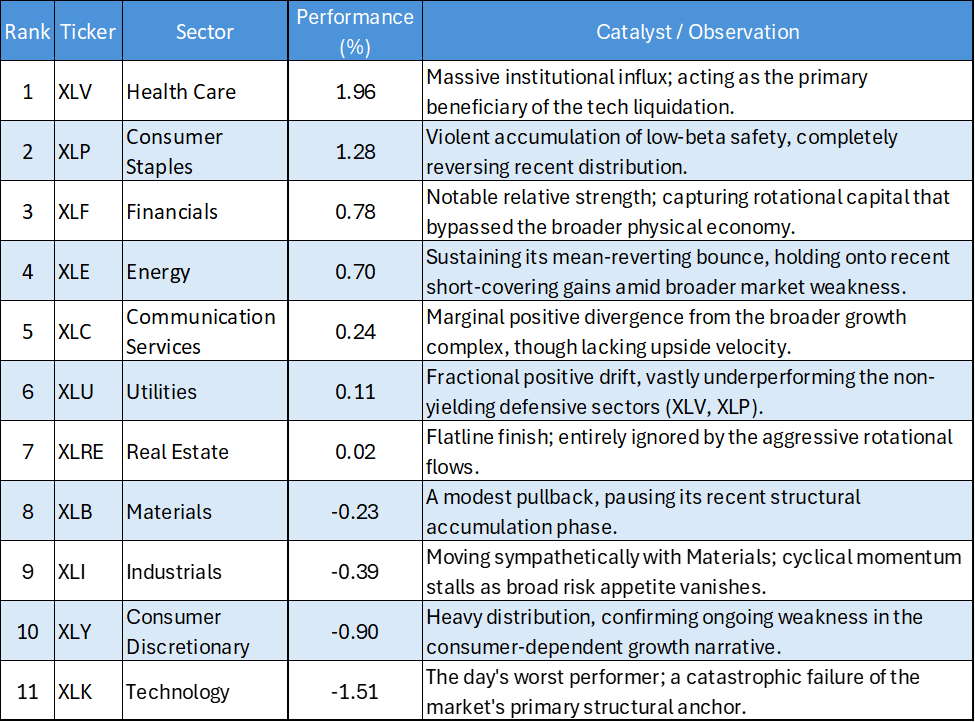
Daily US Sector Performance Summary 12/05/2026
The following table summarizes the day's performance across the 11 major US S&P 500 sectors, ordered from strongest to weakest:
Key Market Themes
The Failure of the Tech Anchor
For multiple sessions, Information Technology (XLK) has acted as the solitary structural anchor, absorbing capital while the rest of the market fractured. The May 12 data confirms that this fortress has been breached. A -1.51% single-day drop in a sector of this market-cap weighting creates a massive Liquidity void. This is not healthy consolidation; this is an empirical signal of active institutional distribution at the top of the market. Without XLK providing upward structural gravity, the broader S&P 500 is highly vulnerable to accelerated downside momentum.
The True Flight to Safety
Earlier in the week, defensive flows were confusing, with Yield-proxies (XLU) catching bids while staples (XLP) were sold. The May 12 tape resolved this ambiguity with a violent flight to traditional, non-yielding safety. The synchronized explosions in Health Care (XLV, +1.96%) and Consumer Staples (XLP, +1.28%) are the quantitative footprints of widespread portfolio hedging. Active managers are no longer just rotating within growth or cyclical pockets; they are actively raising cash equivalents and buying structural insurance.
Financials Decouple from Cyclicals
An interesting quantitative divergence occurred within the value complex. While the physical economy sectors (XLI, XLB) stalled out and finished in the red, Financials (XLF) posted a robust 0.78% gain. This decoupling suggests that while institutions are unwilling to underwrite a sustained Manufacturing re-acceleration today, they are positioning for a specific rate-environment dynamic that specifically benefits bank balance sheets and net interest margins, even as tech and cyclicals sell off.
The Growth Triad is in Ruins
The structural fracture observed yesterday has devolved into a full-scale breakdown. With Tech (XLK) dropping -1.51% and Consumer Discretionary (XLY) falling -0.90%, two-thirds of the mega-cap Growth Triad are under severe selling pressure. The fractional +0.24% gain in Communication Services (XLC) does nothing to offset the massive capital extraction from the broader growth complex. The data definitively proves that the passive "buy big tech" algorithm is currently disabled.
The empirical data from May 12 leaves no room for bullish complacency. The collapse of the Tech anchor (XLK) removes the market's primary safety net. The massive, synchronized capital flight into Health Care (XLV) and Consumer Staples (XLP) is a mathematically undeniable risk-off signal. Active managers must immediately respect the structural damage inflicted on the growth complex. Portfolios should be defensively repositioned, utilizing the strength in XLV and XLP as ballast, while maintaining strict downside risk parameters on any remaining tech or cyclical exposures until secondary momentum data confirms a washout.


 Jun 05, 2026




 Please wait processing your request...