
 CA
 NZ
 UK
 AU
 IND

 US

 Share
 X (Formerly Twitter)
 Whatsapp
 Facebook
 LinkedIn
 Telegram
 Email This Article
 Copy Link
 Summarize with AI
 Chat GPT
 Perplexity

Key Highlights
- Industrials Leads: XLI advanced 3.82%, supported by a broad recovery in industrial shares and renewed Demand for cyclical exposures.
- Technology Rebounds: XLK gained 3.73% as semiconductor stocks recovered sharply following the previous week's AI-related sell-off.
- Consumer Discretionary Strengthens: XLY increased 2.92%, reflecting improved investor confidence and renewed risk appetite.
- Broad-Based Market Rally: All 11 supplied sector ETFs finished higher, indicating a substantial improvement in market participation.
- Energy Lags: XLE recorded the smallest advance at 0.52%, as falling Crude Oil prices weighed on energy-sector sentiment.
- Oil Prices Ease Inflation Concerns: Lower crude prices following reduced geopolitical tensions supported broader equities and improved risk appetite.
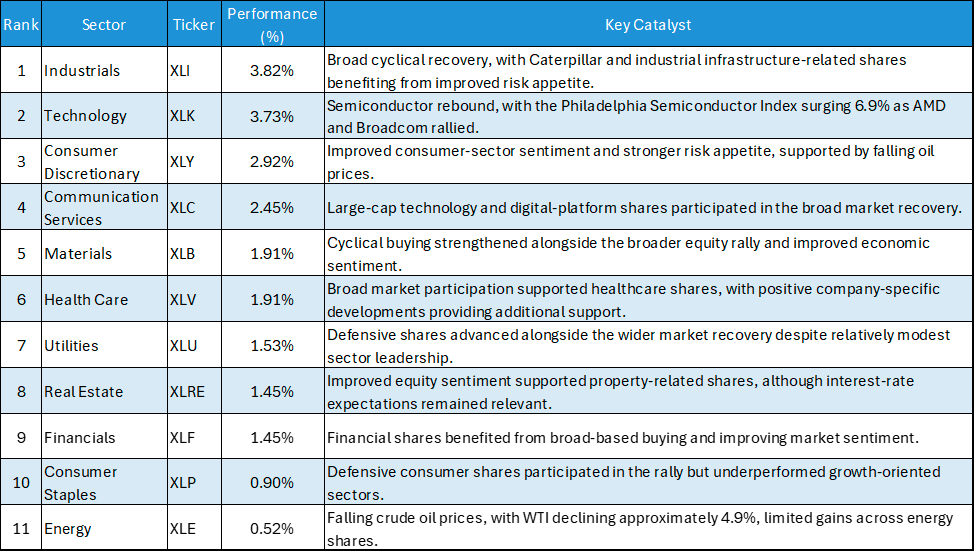
US sector performance on 9 November 2026 reflected a broad-based recovery following the previous week's significant market weakness. Industrials (XLI) led the supplied sector ETFs with a 3.82% advance, narrowly ahead of Technology (XLK), which gained 3.73%. Consumer Discretionary (XLY) followed with a 2.92% increase, while Communication Services (XLC) advanced 2.45%. Materials (XLB) and Health Care (XLV) both gained 1.91%. The remaining sectors also finished higher, although Energy (XLE) lagged with a comparatively modest 0.52% advance.
The rally extended across the major US Equity benchmarks, with the S&P 500 rising approximately 2.35%, the Dow Jones Industrial Average gaining 2.15% and the Nasdaq Composite advancing 2.74%. Falling crude oil prices helped ease inflation concerns, while semiconductor shares recovered strongly after experiencing substantial losses during the previous week. The improvement in market breadth, with all 11 sectors advancing, suggested that investors were returning to equities across both cyclical and growth-oriented industries rather than concentrating exclusively on technology.
Performance Breakdown by Sector
Industrials and Technology Lead the Recovery
Industrials (XLI) was the strongest sector, advancing 3.82% as investors returned to cyclical equities following the previous week's market weakness. Industrial heavyweight Caterpillar was a notable contributor, rising approximately 7.2% and benefiting from renewed demand for infrastructure and industrial equipment exposures. The broader recovery also reflected improving investor confidence as falling oil prices reduced concerns about renewed inflationary pressure. The sector's Leadership suggests that the recovery extended beyond technology, with investors also increasing exposure to companies linked to industrial activity and capital investment.
Technology (XLK) followed closely, gaining 3.73% as semiconductor shares experienced a substantial rebound. The Philadelphia Semiconductor index advanced approximately 6.9%, supported by strong performances from Advanced Micro Devices and Broadcom, which gained approximately 13.3% and 8.8%, respectively. The recovery followed a difficult previous week, when concerns about potential artificial intelligence regulation and restrictions affecting data-centre development triggered substantial selling across semiconductor and technology companies. Despite the rebound, Nvidia remained under pressure, declining approximately 4.2% amid company-specific developments. The divergence highlights that the technology recovery was broad but not uniform across its largest constituents.
Consumer Discretionary (XLY) advanced 2.92%, reflecting improved investor appetite for economically sensitive businesses. Falling oil prices provided additional support by potentially reducing transportation and operating expenses while easing pressure on household purchasing power. Communication Services (XLC) also strengthened, rising 2.45%, as large-cap digital platforms and growth-oriented companies participated in the wider recovery. The simultaneous strength across these sectors suggests that investors were becoming more comfortable increasing exposure to businesses with greater sensitivity to economic activity and consumer demand.
Cyclical and Defensive Sectors Participate in the Rally
Materials (XLB) and Health Care (XLV) both gained 1.91%, demonstrating that the recovery extended beyond the leading industrial and technology sectors. Materials benefited from improved sentiment towards economically sensitive businesses, while healthcare shares attracted buying interest alongside the broader market advance. The participation of both sectors indicates that investors were not exclusively rotating into high-growth technology companies.
Utilities (XLU) increased 1.53%, while Real Estate (XLRE) and Financials (XLF) each advanced 1.45%. These gains indicate that investors were also willing to increase exposure to traditionally defensive and interest-rate-sensitive industries. However, their comparatively modest performances suggest that the strongest demand remained concentrated in cyclical and growth-oriented sectors.
Consumer Staples (XLP) gained 0.90%, making it the second-weakest sector, ahead of Energy. Although defensive consumer companies participated in the recovery, their performance lagged the broader market as investors favoured sectors with greater potential to benefit from improving economic sentiment.
Energy (XLE) recorded the smallest advance, increasing 0.52%. Crude oil prices declined sharply, with West Texas Intermediate falling approximately 4.9% to around US$86 per barrel. Brent Crude also weakened as concerns about renewed military strikes on Iran eased. Lower oil prices reduced inflation concerns and supported the broader equity market, but simultaneously limited the appeal of energy producers and other companies sensitive to commodity-price movements.
Bottom Line
Industrials (XLI) led US sector performance on 9 November 2026, gaining 3.82%, followed closely by Technology (XLK), which advanced 3.73%. Consumer Discretionary (XLY) and Communication Services (XLC) also recorded strong gains, while all 11 supplied sector ETFs finished higher. Falling crude oil prices helped ease inflation concerns, while semiconductor shares rebounded sharply following the previous week's AI-related sell-off. Energy (XLE) was the weakest sector, advancing just 0.52%. Investors will monitor semiconductor momentum, industrial demand, geopolitical developments, crude oil prices and upcoming inflation data to determine whether the broad-based recovery can continue.

 Nov 10, 2026




 Please wait processing your request...