
 CA
 NZ
 UK
 AU
 IND

 US

 Share
 X (Formerly Twitter)
 Whatsapp
 Facebook
 LinkedIn
 Telegram
 Email This Article
 Copy Link
 Summarize with AI
 Chat GPT
 Perplexity

Key Highlights
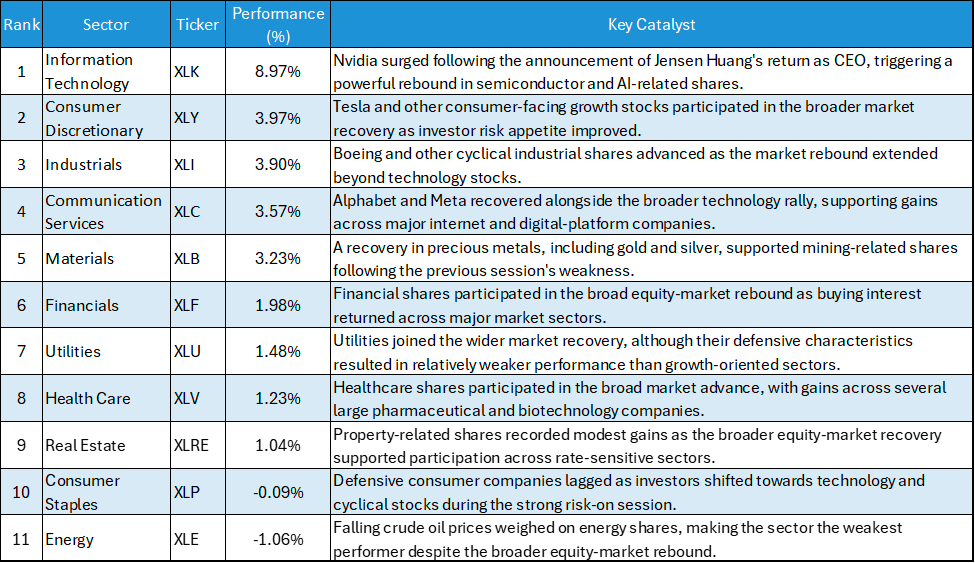
- Technology Leads the Advance: Information Technology (XLK) was the strongest-performing sector, gaining 8.97%, substantially outperforming the broader sector group.
- Cyclical Sectors Strengthen: Consumer Discretionary (XLY) advanced 3.97%, while Industrials (XLI) gained 3.90%, indicating improved momentum across economically sensitive sectors.
- Communication Services and Materials Recover: Communication Services (XLC) increased 3.57%, followed by Materials (XLB), which advanced 3.23%.
- Financials Maintain Positive Momentum: Financials (XLF) gained 1.98%, while Utilities (XLU) and Health Care (XLV) recorded more moderate advances.
- Defensive Sectors Lag: Consumer Staples (XLP) and Energy (XLE) were the only sectors to finish in negative territory, declining 0.09% and 1.06%, respectively.
US sector performance on Monday, 23 November 2026, demonstrated a broad-based improvement in market momentum, with nine of eleven sector ETFs recording positive returns. Information Technology (XLK) led the advance, gaining 8.97%, significantly outperforming the remaining sectors. Consumer Discretionary (XLY) and Industrials (XLI) followed with gains of 3.97% and 3.90%, respectively. Communication Services (XLC) and Materials (XLB) also recorded strong advances, while Financials (XLF) delivered a more moderate positive performance. At the weaker end of the ranking, Consumer Staples (XLP) and Energy (XLE) were the only sectors to decline. The performance distribution indicated a pronounced improvement in growth-oriented and cyclical sector momentum, although the strength remained uneven across the market.
Performance Breakdown by Sector
Technology and Growth-Oriented Sectors Lead the Recovery
Information Technology (XLK) was the clear leader, advancing 8.97% and establishing the strongest relative momentum among the eleven sector ETFs. Its performance was substantially ahead of the second-ranked sector, Consumer Discretionary (XLY), highlighting the concentration of buying interest in technology-related equities. The strength in XLK also positioned the sector well ahead of the broader group, suggesting a pronounced improvement in its short-term relative performance.
Consumer Discretionary (XLY) gained 3.97%, while Communication Services (XLC) advanced 3.57%. Both sectors demonstrated positive momentum, supporting the broader improvement across growth-oriented areas of the Equity market. Their advances, alongside the strong performance of Information Technology, indicated that buying interest was not restricted to a single sector. Instead, several growth-sensitive segments participated in the recovery, although their relative performance remained considerably weaker than XLK.
The divergence between XLK and the remaining sectors is particularly important when assessing market momentum. Although nine sectors recorded positive returns, the technology sector contributed the most pronounced performance signal. Investors should therefore monitor whether the strength broadens into other growth-oriented sectors or remains concentrated in technology.
Industrials and Materials Strengthen Cyclical Momentum
Industrials (XLI) increased 3.90%, placing it third in the sector performance ranking. Its advance was closely aligned with Consumer Discretionary, indicating improving momentum across two economically sensitive areas of the market. Materials (XLB) also recorded a solid gain of 3.23%, reinforcing the positive performance observed across cyclical sectors.
The simultaneous strength in Industrials, Materials and Consumer Discretionary suggests that the improvement in market momentum extended beyond technology-related equities. These sectors collectively demonstrated stronger relative performance than defensive areas such as Consumer Staples and Energy.
Financials (XLF) also advanced 1.98%, maintaining positive momentum, although its performance was more moderate than that of the leading sectors. The participation of Financials further supported the broad-based nature of the session's advance. Nevertheless, the difference between the leading and middle-ranking sectors indicates that buying pressure was not equally distributed across the market.
Defensive Sectors Lag as Market Participation Improves
Utilities (XLU), Health Care (XLV) and Real Estate (XLRE) recorded gains of 1.48%, 1.23% and 1.04%, respectively. Although these sectors delivered positive returns, they underperformed the majority of growth-oriented and cyclical sectors. Their relatively modest advances suggest that market momentum was stronger in areas that had previously demonstrated greater sensitivity to changes in investor risk appetite.
Consumer Staples (XLP) was nearly unchanged, declining 0.09%, while Energy (XLE) recorded the weakest performance, falling 1.06%. These were the only two sectors to finish in negative territory, contrasting with the positive performance across the remaining nine ETFs.
The relative weakness of Consumer Staples and Energy highlights the uneven distribution of sector momentum. While the majority of the market participated in the advance, defensive and commodity-related exposure did not demonstrate the same strength. Investors should monitor whether this divergence persists or whether momentum begins to rotate towards the weaker sectors in subsequent sessions.
Bottom Line
US sector performance on 23 November 2026 demonstrated a broad-based improvement in momentum, with nine of eleven sectors recording positive returns. Information Technology led decisively with an 8.97% advance, while Consumer Discretionary, Industrials, Communication Services and Materials also delivered strong performances. Financials and defensive sectors recorded more moderate gains, whereas Consumer Staples and Energy were the only sectors to decline. Overall, the session indicated improving market participation and stronger momentum across growth-oriented and cyclical sectors. However, the substantial performance gap between technology and the remaining sectors highlights the importance of monitoring whether the recovery broadens or becomes increasingly concentrated in the leading sector.


 Nov 24, 2026




 Please wait processing your request...