
 AU
AU
 UK
UK
 CA
CA
 NZ
NZ
 IND
IND

 US
US

 Share
Share
 X (Formerly Twitter)
 Whatsapp
 Facebook
 LinkedIn
 Telegram
 Email This Article
 Copy Link
 Summarize with AI
 Chat GPT
 Perplexity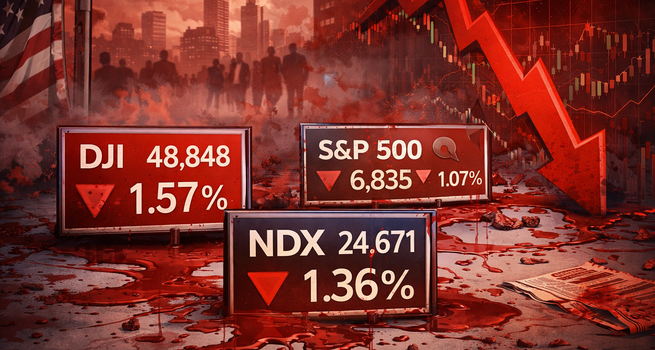
Key Highlights
- Dow Jones falls 1.57%, S&P 500 drops 1.07%, Nasdaq 100 declines 1.36%.
- Financials and technology services lead large-cap losses.
- Trade policy uncertainty reintroduces macro volatility to equity markets.
- Institutional de-risking visible across high-beta and cyclical stocks.
- Market breadth signals broad repositioning rather than isolated weakness.
US equity markets retreated sharply, with all major indices closing lower as trade policy uncertainty resurfaced as a dominant macro risk factor. The pullback reflects renewed investor caution following escalating tariff rhetoric and legal developments surrounding US trade measures.
According to session data, the Dow Jones Industrial Average (US30) declined 1.57%, the S&P 500 (US500) fell 1.07%, and the Nasdaq 100 (US100) dropped 1.36%. The losses erased gains from the previous session and underscored the sensitivity of equity valuations to geopolitical and regulatory developments.
Trade Policy Uncertainty Drives Risk Reduction
Markets reacted to renewed concerns over US tariff policy after the administration raised the prospect of a 15% tariff framework under Section 122 emergency provisions. The announcement followed a Supreme Court decision striking down certain tariff measures introduced last year, adding complexity to the legal and political trajectory of US trade policy.
The uncertainty has prompted investors to trim exposure to risk assets. Trade tensions directly influence corporate margins, supply chains and earnings visibility. For institutional investors, ambiguity around tariff implementation introduces downside risks to both growth forecasts and valuation multiples.
Equity markets, which have priced in resilient earnings and moderating inflation expectations, appear increasingly sensitive to policy shocks that could disrupt forward guidance.
Financials Lead the Decline
The sell-off was broad-based, with financial stocks among the most heavily impacted. Shares of American Express Company fell 7.87%, marking one of the steepest declines within the Dow components. The drop reflects concerns that trade-related uncertainty could dampen consumer spending and credit demand.
Major banks also registered significant losses. JPMorgan Chase & Co. declined 4.91%, while Wells Fargo & Company fell 5.08%. Morgan Stanley dropped 4.82%, reinforcing weakness across capital markets–exposed institutions.
Financial stocks are particularly sensitive to macroeconomic expectations, including credit growth, interest rate trajectories and market liquidity. The coordinated decline suggests positioning adjustments rather than company-specific developments.
Technology and Growth Stocks Under Pressure
Technology services and high-multiple growth names also weakened. Oracle Corporation declined 6.20%, extending pressure in the software segment. Palantir Technologies Inc. fell 3.75%, reflecting ongoing volatility in AI-exposed equities.
Consumer and mega-cap technology names participated in the broader risk-off move. Tesla, Inc. declined 4.01%, while Amazon.com, Inc. eased 3.08%. Even diversified technology firms such as International Business Machines Corporation fell 4.56%.
The dispersion of losses across sectors indicates institutional portfolio rebalancing rather than a narrow thematic correction.
Volatility and Market Structure
The magnitude of individual stock declines relative to index-level losses highlights an important structural feature: volatility at the single-stock level remains elevated. While headline index declines ranged between 1% and 1.6%, several large-cap constituents recorded moves of 4% to 8%.
Such divergence often reflects selective de-risking and liquidity repositioning rather than indiscriminate liquidation. It also suggests that underlying market breadth is weaker than index performance alone might imply.
Market participants are now recalibrating expectations around earnings growth, supply-chain resilience and the regulatory environment. Equity risk premiums may adjust if trade tensions translate into measurable macroeconomic slowdown.
Earnings Season and Forward Outlook
The timing of renewed trade volatility coincides with a critical earnings window for several large-cap companies. Forward guidance will be closely scrutinised for commentary on input costs, demand elasticity and cross-border exposure.
Valuations in both financial and technology sectors remain above long-term historical medians on certain forward metrics. That positioning increases sensitivity to downside revisions in earnings expectations or macro forecasts.
While equity markets have demonstrated resilience through prior policy shocks, sustained uncertainty around tariffs and legal frameworks could elevate implied volatility and compress risk appetite.
Conclusion
The latest session reflects a market reassessing policy risk. With the Dow, S&P 500 and Nasdaq 100 all declining more than 1%, the sell-off signals a broad-based repositioning across cyclical and growth segments.
Financials and technology services led losses, indicating concerns over both macroeconomic demand and valuation sensitivity. The breadth of declines suggests institutional risk reduction rather than isolated corporate weakness.
Trade policy remains a central variable in the equity outlook. If uncertainty persists, volatility may remain elevated as investors weigh the balance between resilient earnings trends and rising geopolitical risk.
For now, the market’s message is clear: policy ambiguity has re-entered the risk equation, and equity positioning is adjusting accordingly.

_06_12_2026_23_00_13_327450.jpg)
 Jun 12, 2026




 Please wait processing your request...