
 AU
AU
 UK
UK
 CA
CA
 NZ
NZ
 IND
IND

 US
US

 Share
Share
 X (Formerly Twitter)
 Whatsapp
 Facebook
 LinkedIn
 Telegram
 Email This Article
 Copy Link
 Summarize with AI
 Chat GPT
 Perplexity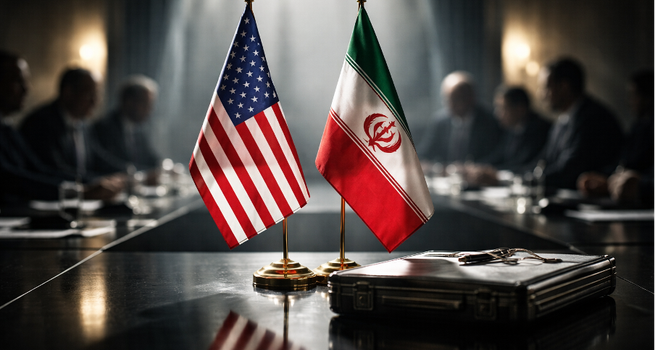
Key Highlights
- US–Iran nuclear negotiations resume in Geneva amid heightened military tensions.
- Tehran signals flexibility if nuclear and non-nuclear issues are separated.
- Washington continues to press on ballistic missile and regional security concerns.
- Sanctions relief sequencing remains a central sticking point.
- Regional military deployments increase geopolitical risk premium across energy markets.
Diplomatic Architecture Under Strain
Indirect negotiations between the United States and Iran have resumed in Geneva, reflecting renewed efforts to stabilise one of the most persistent flashpoints in global geopolitics. The discussions, mediated by Oman, focus primarily on Iran’s nuclear programme and the potential lifting of US sanctions.
Iranian officials have indicated that a workable framework may be achievable if nuclear issues are treated independently from broader geopolitical concerns. The distinction is not semantic. It defines the negotiating perimeter. By narrowing talks to uranium enrichment levels, inspection mechanisms, and sanctions sequencing, Tehran appears to be attempting to compartmentalise areas of disagreement that could otherwise stall progress.
From Washington’s perspective, the negotiating agenda remains wider. The US position continues to link nuclear constraints with discussions on ballistic missile capabilities and regional security activity. That structural divergence shapes the probability distribution of outcomes.
The Central Question: Scope of the Deal
At the heart of the impasse lies a definitional dispute. For Tehran, a nuclear agreement should address enrichment limits and sanctions relief. For Washington, nuclear compliance is inseparable from broader security concerns.
The US has repeatedly stated that uranium enrichment poses proliferation risks, particularly at higher purity thresholds. While Iran maintains that its programme is civilian in nature, Western policymakers view enrichment capability itself as latent weapons capacity.
Iran’s leadership, including Supreme Leader Ali Khamenei, has long asserted that nuclear weapons are prohibited under religious doctrine. This argument, however, does not resolve technical disputes regarding enrichment levels and monitoring protocols.
The issue separation proposed by Iranian officials could provide a procedural compromise. It would not eliminate disagreement, but it could reorder negotiations in stages. Financial markets, particularly energy and currency traders, are sensitive to such sequencing because sanctions relief would have direct implications for oil exports and capital flows.
Military Signalling and Strategic Leverage
Diplomacy is unfolding against a backdrop of visible military posturing. The United States has increased its regional deployments, including naval and air assets, signalling readiness to escalate should negotiations collapse.
Among the deployments is the USS Gerald R. Ford, which has repositioned within operational distance of key Middle Eastern theatres. Such movements are not merely tactical; they alter bargaining dynamics by raising the perceived cost of diplomatic failure.
President Donald Trump has publicly reiterated that diplomatic resolution is preferred but has coupled that stance with explicit warnings of consequences should talks fail. That dual-track strategy blends coercive diplomacy with negotiation.
Iran has responded rhetorically by warning of retaliation if attacked. The risk of miscalculation remains non-trivial, particularly given past exchanges involving missile strikes and counter-strikes.
For Gulf oil producers and global commodity markets, this military overlay translates into a geopolitical risk premium. Energy futures often price in the probability of supply disruption well before physical flows are affected.
Sanctions Relief: The Economic Core
Sanctions remain the primary economic lever. Iran’s economy has faced persistent inflationary pressure, currency depreciation, and restricted access to global capital markets. Relief from US financial restrictions would ease liquidity constraints and potentially increase oil exports.
However, sequencing remains contentious. Tehran seeks upfront recognition of its right to enrich uranium and phased sanctions removal. Washington prefers verified compliance before meaningful relief.
This difference reflects broader trust deficits accumulated over decades. From a policy standpoint, sanctions are not simply punitive; they are bargaining instruments. The pace and order of their removal determine domestic political optics on both sides.
Iran’s leadership faces internal pressure from economic stagnation and social unrest. Any agreement perceived domestically as capitulation could generate political backlash. Conversely, prolonged sanctions intensify fiscal stress and constrain public spending capacity.
Regional Implications and Market Sensitivity
The Middle East’s strategic equilibrium is fragile. Any escalation between Washington and Tehran would likely reverberate through regional proxies and allied states.
Ballistic missile capabilities and Iran’s regional alignments remain core US concerns. Secretary of State Marco Rubio has described missile issues as central to long-term stability, even if not immediately incorporated into the current negotiation framework.
For investors, the implications are multi-layered:
- Energy markets could experience volatility driven by perceived supply risk.
- Defence and aerospace equities may reflect elevated geopolitical uncertainty.
- Emerging market currencies in the region could face short-term liquidity swings.
- Risk premiums across global assets may widen modestly if escalation probabilities rise.
However, markets have become partially desensitised to episodic tensions. Only a clear breakdown accompanied by kinetic escalation would materially alter global asset allocation flows.
Negotiation Dynamics: Incrementalism Over Breakthroughs
Observers note that negotiations have continued despite pauses, suggesting neither side has fully disengaged. That continuity indicates at least minimal mutual interest in avoiding outright collapse.
Iranian officials have described discussions as serious and intensive, while mediators have characterised exchanges as constructive. Such language should be interpreted cautiously. Diplomatic optimism often coexists with structural deadlock.
The more plausible path is incremental progress rather than sweeping breakthrough. A limited framework addressing enrichment caps and inspection mechanisms could precede broader talks. That sequencing would align with Iran’s proposal to separate nuclear from non-nuclear issues.
Failure, however, would shift the equilibrium toward coercive measures. The probability of miscalculation would rise, and markets would recalibrate accordingly.
Strategic Outlook: Controlled Risk, Not Resolution
The negotiations reflect a convergence of necessity rather than trust. For Washington, preventing nuclear proliferation remains a strategic priority. For Tehran, sanctions relief is economically urgent.
Yet even a partial agreement would not resolve deeper geopolitical antagonism. Ballistic missile programmes, regional alliances, and ideological rivalry would remain outside any narrow nuclear accord.
The current round of talks is therefore less about reconciliation and more about risk management. It aims to prevent escalation rather than to normalise relations.
Financial markets, particularly in energy and defence sectors, will continue to monitor signals from Geneva. The baseline scenario remains controlled tension with intermittent diplomatic engagement. The tail risk scenario involves rapid escalation following negotiation failure.
In that sense, the separation of nuclear and non-nuclear issues may offer a temporary diplomatic bridge. Whether it evolves into a durable framework depends not only on technical verification mechanisms but also on political willingness in both capitals.
For now, the process continues. The alternative carries higher economic and geopolitical costs.

_06_12_2026_23_00_13_327450.jpg)
 Jun 12, 2026




 Please wait processing your request...