
 AU
AU
 UK
UK
 CA
CA
 NZ
NZ
 IND
IND

 US
US

 Share
Share
 X (Formerly Twitter)
 Whatsapp
 Facebook
 LinkedIn
 Telegram
 Email This Article
 Copy Link
 Summarize with AI
 Chat GPT
 Perplexity
Key Highlights
- Recession-Resilient Income — 100% rent collection record backed by 40+ year weighted average lease terms with gaming giants like Caesars, MGM, and Hard Rock — among the most secure income streams in the REIT sector.
- Built-In Inflation Protection — CPI-linked annual rent escalators automatically grow rental income with inflation, making VICI one of the most inflation-resistant REITs available.
- Consistent Dividend Growth — Dividend raised every single year since its 2018 IPO, with a sustainable 75–80% AFFO payout ratio and a current yield of 6.34% at an attractively discounted P/E of 10.77x.
Real Estate Investment Trusts (REITs) have long been a cornerstone of income-oriented portfolios, and VICI Properties Inc. (NYSE:VICI) represents one of the most unique and resilient within the sector. As the owner of some of the most iconic gaming and entertainment real estate in the United States — including properties on the Las Vegas Strip — VICI combines the stability of long-term triple-net leases with a compelling dividend yield of approximately 6.34%. This article offers a comprehensive analysis of VICI Properties for income shareholder in 2026.
Company Overview
VICI Properties was formed in 2017 following the bankruptcy reorganization of Caesars Entertainment. Since its IPO, VICI has grown rapidly through strategic acquisitions to become one of the largest REITs in the United States by enterprise value. The company's portfolio includes 93 experiential properties across 22 U.S. states and Canada — encompassing approximately 127 million square feet of gaming, hotel, and entertainment space.
VICI's tenants include some of the most recognizable names in the gaming and hospitality industry: Caesars Entertainment, MGM Resorts International, Apollo Global Management, and Hard Rock International. One of VICI's defining characteristics is its triple-net lease structure, whereby tenants are responsible for property taxes, insurance, and maintenance — significantly reducing VICI's operating costs and providing predictable, inflation-linked income streams.
Beyond its gaming real estate roots, VICI has been strategically diversifying into non-gaming experiential assets, including bowling alleys, arcades, and wellness facilities, as it builds toward becoming the premier experiential REIT in the world. The company's lease agreements typically include annual rent escalators tied to the Consumer Price Index (CPI), making VICI a natural inflation hedge.
Stock Performance — April 2026
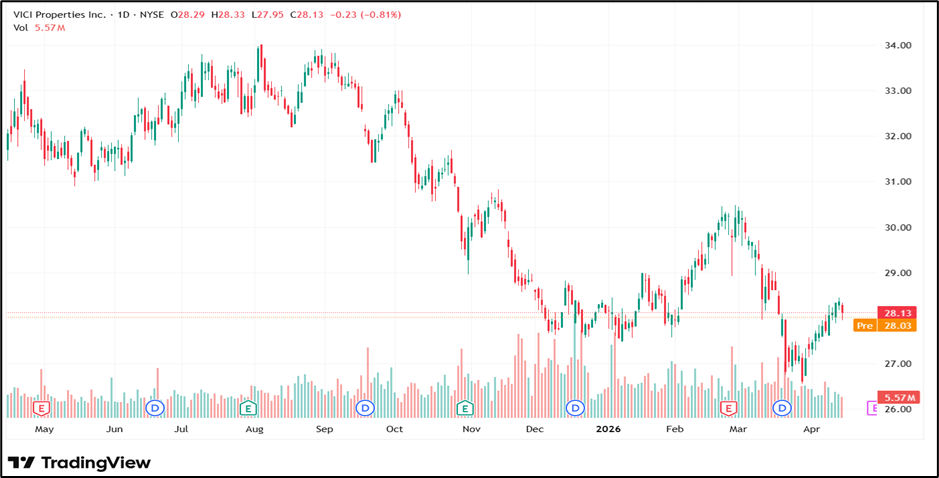
VICI Properties closed at $28.13 on April 15, 2026, down 0.81% (−$0.23) on the day. After-hours trading saw a partial recovery, with the stock rising +$0.042 (+0.15%) to $28.17. The stock opened at $28.29, reached a high of $28.33, and fell to a low of $27.95 during the session.
|
Price (Apr 15, 2026) $28.13 |
Daily Change −0.81% / −$0.23 |
After Hours $28.17 |
|
Open $28.29 |
Day High $28.33 |
Day Low $27.95 |
|
52-Week High $34.01 |
52-Week Low $26.55 |
Market Cap $3.01KCr |
|
P/E Ratio 10.77 |
Dividend Yield 6.34% |
Quarterly Div. $0.45 |
The stock's 52-week range of $26.55 to $34.01 reflects the interest-rate sensitivity inherent to all REITs. VICI's share price has faced pressure since the Federal Reserve began its rate-hiking cycle, as higher risk-free rates tend to compress REIT valuations by increasing the discount rate applied to future cash flows. At current levels, many analysts view VICI as attractively valued, trading at a significant discount to its 52-week high.
Financial Overview
VICI Properties generates its revenues primarily through rental income from its portfolio of experiential real estate. The company's business model is characterized by exceptional revenue predictability: as of the latest reporting period, 100% of rents were collected on time, and the weighted average lease term across its portfolio exceeds 40 years — one of the longest in the REIT sector.
Adjusted Funds From Operations (AFFO) — the primary profitability metric for REITs — has grown consistently since VICI's formation. The company has demonstrated strong per-share AFFO growth, driven by both accretive acquisitions and built-in lease escalators. With a P/E ratio of approximately 10.77x, VICI trades at a meaningful discount to its intrinsic value in the view of many analysts.
VICI maintains a conservative balance sheet with investment-grade credit ratings from all three major rating agencies. The company has been proactive in managing its debt maturity profile, having refinanced significant portions of its debt at fixed rates during the low-rate environment, insulating it from floating-rate risk.
Dividend History and Analysis
VICI Properties has increased its dividend every year since its IPO in 2018. The current quarterly dividend stands at $0.45 per share, equating to an annualized payout of $1.80 per share. At a share price of $28.13, this equates to a dividend yield of approximately 6.34%.
VICI's CPI-linked rent escalators provide a built-in mechanism for dividend growth: as rents increase with inflation, AFFO per share grows, supporting higher dividend payments over time. This structure makes VICI particularly appealing during inflationary periods — the very environment in which many other income assets struggle.
The company's AFFO payout ratio is healthy and sustainable, typically ranging between 75% and 80%, leaving ample retained cash flow for reinvestment and balance sheet management.
Management Outlook and Guidance
VICI's CEO Ed Pitoniak has articulated a long-term vision of VICI becoming the world's largest owner of experiential real estate — extending well beyond gaming into sports stadiums, entertainment venues, and experiential retail. The company continues to evaluate acquisition opportunities in both gaming and non-gaming sectors, with a disciplined focus on accretive cap rates.
Management has guided toward continued AFFO per share growth in the low-to-mid-single-digit range for 2026, driven by lease escalators, new tenant agreements, and selective acquisitions. The dividend is expected to grow in line with AFFO, maintaining the company's track record of annual dividend increases.


 Jun 05, 2026




 Please wait processing your request...