
 AU
AU
 UK
UK
 CA
CA
 NZ
NZ
 IND
IND

 US
US

 Share
Share
 X (Formerly Twitter)
 Whatsapp
 Facebook
 LinkedIn
 Telegram
 Email This Article
 Copy Link
 Summarize with AI
 Chat GPT
 Perplexity
Key Highlights
- Dividend Reinstated and Growing — After suspending payouts in 2020, Disney brought back its dividend in 2023 and has grown it consistently since — making DIS one of the S&P 500's most compelling dividend-growth recovery stories.
- Streaming Finally Profitable — Disney+, Hulu, and ESPN+ reached combined profitability in 2024, unlocking the free cash flow foundation needed to sustain and accelerate future dividend growth.
- Undervalued with Strong Analyst Backing — Trading ~18% below its 52-week high with 27 of 28 analysts rating it a Buy and a consensus price target of ~$131, DIS offers both capital upside and dividend growth potential.
The Walt Disney Company (NYSE:DIS) occupies a unique position in the landscape of dividend-paying stocks: it is not defined by a current high yield, but rather by one of the most significant dividend reinstatement stories in recent corporate history. Having suspended its dividend during the COVID-19 pandemic in 2020, Disney reinstated and then began growing its dividend in 2024 and 2025 — a milestone that signals management's confidence in the durability of the company's earnings recovery. This article examines Disney's dividend journey, current financial position, and prospects as a dividend-growth story.
Company Overview
Founded in 1923 by Walt and Roy Disney, The Walt Disney Company is one of the world's most recognizable and diversified entertainment conglomerates. Headquartered in Burbank, California, Disney operates through multiple business segments: Entertainment (including linear TV networks, direct-to-consumer streaming, and content studios), Sports (primarily ESPN and ESPN+), and Experiences (theme parks, resorts, and consumer products).
Disney's asset portfolio is extraordinary in its breadth and quality: the company owns the Marvel, Star Wars, Pixar, and Disney brands — among the most valuable intellectual property franchises in entertainment history. Its theme park and resort business includes Disneyland, Walt Disney World, Disneyland Paris, and stakes in parks in Japan, Hong Kong, and Shanghai.
The company has navigated a period of profound transformation since 2020 — managing the pandemic-driven closure of its parks, the explosive then moderating growth of Disney+, and the strategic repositioning of its media businesses in an era of streaming-driven disruption.
The Dividend Journey: Suspension, Reinstatement, and Growth
Disney had been a reliable dividend payer for decades before suspending its dividend in May 2020, citing pandemic-related uncertainty and the need to preserve liquidity as its parks and theatrical businesses were shut down globally. The suspension was widely understood as a temporary measure, though it lasted through 2021, 2022, and 2023 — longer than many investors anticipated.
In November 2023, Disney reinstated its dividend with a semiannual payment, and then in early 2024 increased the payout — a signal that CEO Bob Iger and the board had confidence in the underlying earnings recovery. Through 2025 and into 2026, Disney continued growing its dividend, marking one of the most meaningful dividend reinstatement and growth stories in the S&P 500.
The current Disney dividend yield remains modest compared to the highest-yielding names in the S&P 500 — reflecting both the company's strategic intent to allocate capital to growth (streaming profitability, park expansions) and the market's valuation of Disney's long-term growth potential. However, the trajectory of dividend growth is what makes Disney compelling as a dividend-growth investment.
Financial Overview
Disney's financial recovery has been driven by three key developments: the return to profitability of its direct-to-consumer streaming business (Disney+, Hulu, ESPN+), robust performance of its theme parks and experiences segment, and ongoing cost restructuring initiated by Iger upon his return as CEO in late 2022.
The streaming segment — after years of enormous losses driven by content investment and subscriber acquisition — reached profitability in 2024, a milestone that significantly changed the financial narrative for Disney. Parks, Experiences, and Products remains the highest-margin segment and has benefited from premium pricing and strong consumer demand for Disney-branded experiences.
ESPN's future remains a key strategic question: Disney has been exploring various structural alternatives for the sports media giant, including potential joint ventures or partial sales. A resolution of ESPN's structure could be a significant value-unlocking event for shareholders.
Stock Performance- April 2026
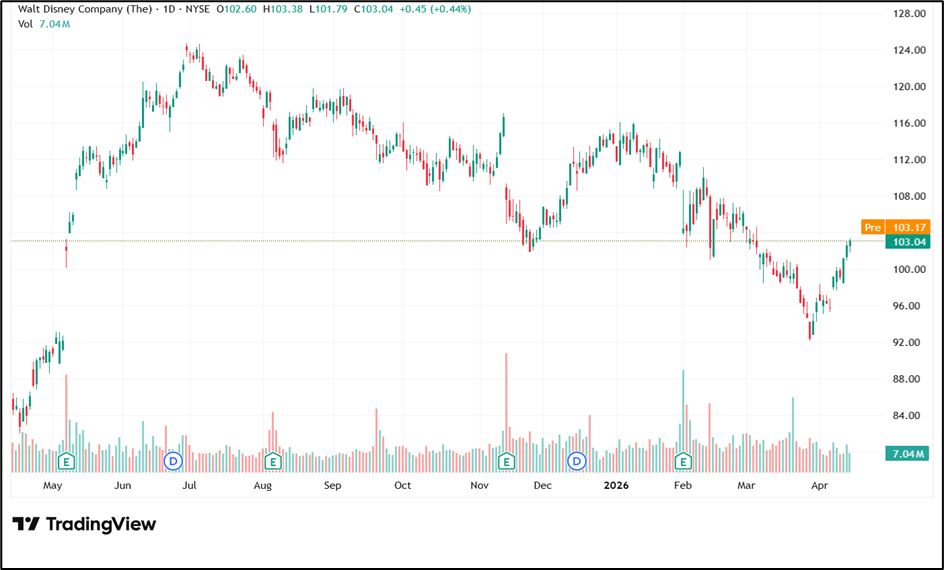
As of April 15, 2026, DIS shares closed at $103, up 0.26% on the day (+$0.27) from the prior close of $102.59. After-hours activity saw the stock ease slightly to $102.64 (−$0.22, −0.21%). The session saw a high of $103.09 and a low of $101.79. The day's modest gain came amid ongoing investor attention around new CEO Josh D'Amaro's recently announced restructuring, including plans to cut up to 1,000 positions.
|
Price (Apr 15, 2026) $103 |
Daily Change +0.26 / +0.27 |
After Hours $102.64 |
|
Prev. Close $102.59 |
Day High $103.09 |
Day Low $101.79 |
|
52-Week High $124.69 |
52-Week Low $82.01 |
Market Cap $181.74B |
|
P/E Ratio 15.16 |
Dividend Yield 1.51% |
Annual Div. $1.50 |
The 52-week range of $82.01 to $124.69 reflects a volatile year shaped by leadership transition — Bob Iger handed the reins to Josh D'Amaro — alongside headwinds from streaming competition, layoff announcements, and a collapsed OpenAI deal. Yet the stock has recovered meaningfully from its 52-week low, and with 27 of 28 analysts rating it a Buy, an average price target of ~$131 suggests significant upside potential at current levels. Upcoming Q2 2026 earnings on May 6 will be a key catalyst for the stock.
Dividend Growth Outlook
Disney's dividend growth trajectory from 2024 through 2026 has been meaningful, with management signaling that dividend growth will be sustained as free cash flow generation improves. The company's capital allocation framework prioritizes: investment in high-return growth projects (park expansions, streaming content), debt reduction, and increasing returns to shareholders through dividends and buybacks.
For income investors, Disney is not a high-current-yield investment — it is a dividend-growth investment. The yield today is modest, but the combination of earnings growth, streaming profitability inflection, and management's stated commitment to dividend growth suggests the dividend could grow meaningfully over a multi-year horizon.
Management Outlook
CEO Bob Iger has articulated a vision of Disney as a company that delivers both creative excellence and financial discipline. Key milestones to watch include the continued profitability of the combined streaming platform (Disney+, Hulu, ESPN+), the resolution of ESPN's structural future, and the execution of the company's ambitious parks expansion program — including new theme park projects in multiple countries.


 Jun 05, 2026




 Please wait processing your request...