
 AU
AU
 UK
UK
 CA
CA
 NZ
NZ
 IND
IND

 US
US

 Share
Share
 X (Formerly Twitter)
 Whatsapp
 Facebook
 LinkedIn
 Telegram
 Email This Article
 Copy Link
 Summarize with AI
 Chat GPT
 Perplexity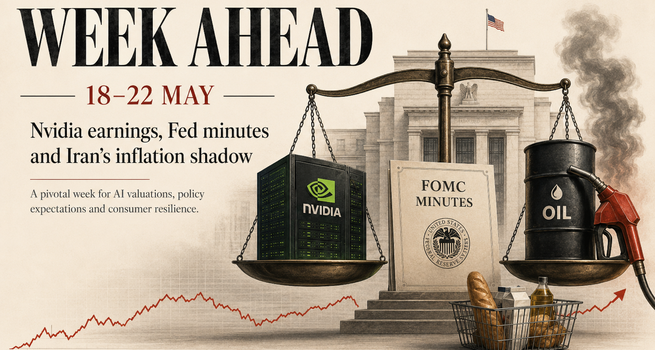
U.S. markets face a pivotal week as Nvidia Earnings, FOMC minutes carrying four dissents, flash PMI readings, and a dense retail earnings calendar converge to test the durability of the S&P 500's sharp rebound from March lows.
Two narratives have driven U.S. Equity markets in almost parallel tracks through 2026: the artificial intelligence infrastructure boom and the Inflation pressure stemming from the Iran conflict. This week places both under direct examination at the same time. Nvidia's results on Wednesday will either validate or challenge the Valuation Premium that has powered the S&P 500's 18% rebound from its March low. Walmart's commentary on Thursday will provide the most direct evidence yet on whether energy-driven inflation is beginning to materially suppress consumer activity. Running beneath both is the Federal Reserve, whose April meeting minutes arrive Wednesday and will frame the June rate decision more precisely than any speech has managed to date. Flash PMIs and housing data on Thursday, alongside the final University of Michigan consumer sentiment reading on Friday, will Fill in the broader picture of an economy navigating elevated energy costs and softening growth momentum simultaneously.
Monday, May 18
Federal Reserve
Atlanta Fed First Vice President Cheryl Venable delivers welcoming remarks. No material policy signal is expected, but the appearance sets the tone for a week in which the Central Bank's communication posture is under heightened scrutiny.
Tuesday, May 19
Earnings
Home Depot (NYSE:HD) and Target (NYSE:TGT) both report before the open, offering the week's first major retail read. Home Depot's results will indicate whether elevated Mortgage rates and energy costs are suppressing home improvement activity or whether the Pro segment is providing a sufficient offset. Target adds a direct discretionary retail signal, with results showing whether promotional activity is sustaining traffic volumes or compressing margins under household budget pressure. Together, the two prints frame the consumer picture ahead of Walmart on Thursday.
Economic Data
Pending home sales for April, prior at 1.5% and consensus at 1.6%, offer a Demand-side read on the housing market ahead of Thursday's Supply-side housing starts and permits figures. A miss here would reinforce the affordability pressure narrative running alongside Home Depot's morning results.
Federal Reserve
Philadelphia Fed President Anna Paulson speaks in the evening, followed by Atlanta Fed First Vice President Cheryl Venable with closing remarks. With the FOMC minutes due the following day, both appearances will be watched for any early framing of how the committee views the post-CPI inflation picture.
Wednesday, May 20
Wednesday is the week's most consequential day. Three distinct events land simultaneously, each capable of moving markets independently.
Earnings
Nvidia (Nasdaq:NVDA) reports after market close in the most anticipated earnings release of the current season. Shares are up more than 40% since the March low and over 1,900% since the Bull Market began in October 2022, making the results as much a valuation test as an operational one. Investors will focus on whether data centre demand justifies the Capital-expenditure/">Capital Expenditure commitments made by hyperscalers, and on whether rivals are meaningfully eroding Nvidia's Market Share position. Any softening in forward guidance would carry consequences well beyond the semiconductor sector, affecting cloud-adjacent software and the broader AI infrastructure Investment thesis.
Also reporting Wednesday are Analog Devices (NASDAQ:ADI), TJX Companies (NYSE:TJX), Lowe's (NYSE:LOW), and Intuit (NASDAQ:INTU). ADI provides a read on industrial semiconductor demand across automotive and communications end markets; TJX on off-price retail resilience and consumer trade-down behaviour; Lowe's on home improvement spending and the consumer's willingness to commit to discretionary projects under budget pressure; and Intuit on small Business financial health and software spending.
Federal Reserve
The FOMC minutes from the April 28-29 meeting are released at 2:00 pm ET. The meeting produced four dissents, the largest number since 1992. Governor Stephen Miran dissented in favour of a quarter-point cut, while regional Fed presidents Lorie Logan, Neel Kashkari, and Beth Hammack supported holding rates but opposed the easing bias embedded in the statement. The minutes will be read for how explicitly dissenters framed their objections and whether the committee is beginning to internally price a stagflationary scenario. Hotter-than-expected CPI and PPI data released this week have already narrowed the perceived window for a June reduction.
Thursday, May 21
Thursday carries the week's heaviest data and earnings load.
Earnings
Walmart (NASDAQ:WMT) reports before the open as the defining consumer read of the quarter. As the world's largest retailer, its commentary on spending trends, traffic volumes, and energy cost pass-through to household budgets will carry the most direct evidence yet of whether inflation is beginning to suppress consumer activity in observable ways. Deere (NYSE:DE) also reports before the open, with its agricultural equipment demand and guidance carrying a read on farm Economics and capital spending cycles under Commodity price pressure.
Economic Data
S&P Global releases flash PMI readings for May. The services PMI prior of 51.0 and Manufacturing-pmi/">Manufacturing PMI prior of 54.5 suggest an economy still in expansion, but the prices-paid sub-index will receive particular scrutiny for any re-acceleration signal tied to elevated energy costs. The Philadelphia Fed Manufacturing Survey, prior at 26.7, provides a regional cross-check. Housing starts, prior at 1.50 million, and building permits, prior at 1.37 million, round out the day. Starts are expected to decline while permits edge marginally higher, consistent with a sector operating under sustained affordability pressure. Initial jobless claims also land Thursday, providing the week's most current labour market read.
Friday, May 22
Economic Data
The final University of Michigan consumer sentiment reading for May, prior at 49.2, will indicate whether household confidence has stabilised or continued its multi-month deterioration. The reading has been tracking record lows, increasingly visible in the cautious spending signals embedded across the earnings calendar. U.S. leading economic indicators for April, prior at -0.6%, provide a forward-looking activity composite. A second consecutive decline would reinforce the case that growth momentum is softening even as inflation remains elevated.
Geopolitical Backdrop
The US-Iran conflict continues into its twelfth week with no credible resolution framework in sight. Conciliatory and escalatory rhetoric have alternated across recent weeks without producing a durable shift in the underlying risk premium embedded in energy prices. The US national average gasoline price topped $4.50 a gallon for the first time in nearly four years earlier this month, functioning as a direct tax on household purchasing power and a structural floor under headline inflation that the Fed cannot cut through.
The conflict's market transmission operates across every event on this week's calendar. For the earnings reads, elevated energy costs are the primary variable in assessing whether Home Depot, Walmart, and other retailers can sustain consumer traffic or whether household budgets are beginning to compress discretionary spending in observable ways. For the policy channel, the same dynamic keeps headline inflation above target and limits the Fed's flexibility on rate cuts regardless of what the growth data shows. Markets are pricing the conflict as persistent but contained, an equilibrium that remains fragile to any escalation in the Strait of Hormuz or a credible diplomatic breakthrough.
The Week in Context
By Friday's close, three questions will have been materially repriced. First, whether Nvidia's results justify the AI infrastructure valuation premium that has concentrated the S&P 500's gains in a narrow set of names. Second, whether Walmart's consumer commentary confirms that Iran-driven inflation is beginning to suppress spending in ways that prior quarters did not show. Third, whether the FOMC minutes reveal a committee moving toward a more neutral policy bias or one holding firm against a stagflationary backdrop it cannot easily cut through. Each question has a distinct answer. Together, they will define the May-June policy and earnings narrative before markets reopen the following week.


 Jun 05, 2026




 Please wait processing your request...