
 CA
 NZ
 UK
 AU
 IND

 US

 Share
 X (Formerly Twitter)
 Whatsapp
 Facebook
 LinkedIn
 Telegram
 Email This Article
 Copy Link
 Summarize with AI
 Chat GPT
 Perplexity

Key Highlights
• Simon absorbed about one million square feet returned by bankrupt retailers, chiefly Saks Off Fifth, yet held occupancy at 96.0% with base minimum rent up 6.3%.
• Federal Realty signed a record 819,273 square feet of comparable leases at rents 15% higher on a cash basis, with small-shop space at its highest level since 2007.
• Simon named a new chief executive, Eli Simon, after chairman David Simon died in March 2026, while Federal Realty raised its Dividend for a 59th consecutive year.
A landlord's rent is only as durable as the retailers paying it, which is why tenant quality is central to Simon Property Group (NYSE:SPG) and Federal Realty (NYSE:FRT), two S&P 500 retail real estate Investment trusts. Both showed in the second quarter of 2026 how a strong tenant base lets owners replace failing retailers quickly and at higher rents. Simon absorbed about one million square feet returned by bankrupt retailers, chiefly Saks Off Fifth, yet held occupancy at 96.0%. Federal Realty signed a record Volume of comparable leases, and its largest tenants are mostly investment-grade names.
What Tenant Quality Means in Rent Terms
A tenant's quality has two sides: its Credit strength, often signalled by ratings from agencies such as S&P and Moody's, and the productivity of its stores. Strong retailers renew, pay on time and absorb rent increases; weak ones generate bad debt, vacancies and the cost of re-letting: months of lost rent, tenant allowances and leasing commissions.
For landlords, the payoff shows up in funds from operations, the REIT industry's main Earnings measure, which adds back property Depreciation and excludes gains on property sales. Better tenants mean steadier FFO and more room to grow the dividend.
Simon (NYSE:SPG): Sales Productivity Sets the Rent
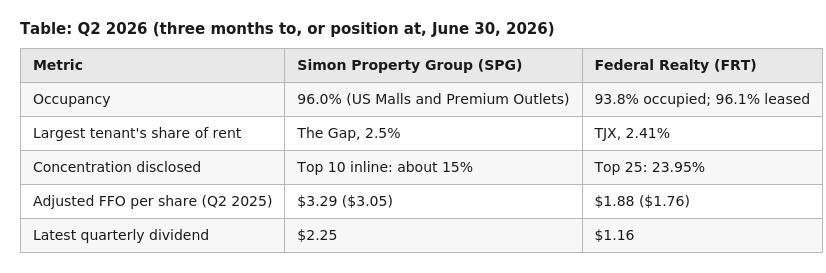
Simon, which owned or had interests in 254 properties covering 206 million square feet at June 30, 2026, reported on August 10, 2026. Its second-quarter results showed retailer sales across its US malls and Premium Outlets of $838 per square foot over the trailing 12 months, up 13.9%. Base minimum rent, the fixed rent before percentage-of-sales or recovery charges, rose 6.3% to $62.42 per square foot.
That link is the crux. When tenants' sales grow faster than their rent, their occupancy cost falls, making them willing to renew and expand. Real Estate FFO, Simon's adjusted measure, rose 7.9% to $3.29 per diluted share. GAAP Net Income fell to $1.49 per diluted share from $1.70. The board declared a third-quarter dividend of $2.25, up 4.7% year on year.
Management said it signed more than 1,200 leases for over 4.8 million square feet in the quarter and that its watch list of troubled tenants was at a low point. Year to date, initial base rent on new deals was up 17% while tenant allowances per square foot were down 12%, a sign that retailers are competing for space rather than needing larger incentives to sign. The former Saks space, which produced about $18 million of rent, is being re-let with a target of roughly $44 million.
Anchors Occupy the Space, Inline Shops Pay the Rent
Simon's second-quarter supplemental shows why headline anchor names can mislead. Macy's occupies 11.6% of US square footage but pays just 0.3% of base minimum rent. The real income comes from inline stores: The Gap, the largest, accounts for 2.5%, with luxury groups LVMH and Kering, alongside Tapestry and American Eagle Outfitters, each around 1.5-1.6%. The top ten inline tenants together pay roughly 15% of US base minimum rent.
That mix leans on apparel and luxury spending, so Simon's tenant quality is closely tied to discretionary consumption.
Federal Realty (NYSE:FRT): A Rated, Diversified Rent Roll
Federal Realty's 103 properties hold about 3,700 tenants in 28.8 million commercial square feet, plus about 2,500 residential units. Its second-quarter release, published on July 31, 2026, reported 124 comparable leases for 819,273 square feet, an all-time record, at rents 15% higher on a cash basis than the previous leases. Small-shop space was 93.9% leased, up 50 basis points year on year.
The June 2026 supplemental lists TJX Companies, rated A/A2, as its largest tenant at 2.41% of annualised base rent, followed by Ahold Delhaize, NetApp and Cisco Systems. The top 25 tenants provide 23.95% of rent. Near-term rollover is modest: leases expiring in 2026 cover about 3% of portfolio square footage.
Core FFO rose 6.8% to $1.88 per diluted share. On the call, the finance chief said more than two-thirds of year-to-date lease-termination fees came from investment-grade or investment-grade-backed tenants, and that the credit reserve sat at 60-85 basis points of rental income.
Comparing the Two Rent Rolls
The two landlords take different paths to tenant strength. Simon's model leans on retailer sales productivity, where growing sales relative to rent keeps large chains renewing and expanding. Federal Realty's model leans on tenant Diversification and credit quality, spreading risk across thousands of smaller tenants including grocers and technology office users alongside fashion retailers.
Leadership and index Context
Simon enters this phase under new leadership. Chairman and chief executive David Simon died on March 22, 2026, and the board appointed Eli Simon chief executive and president, with Larry Glasscock as non-executive chairman. Simon was also removed from the S&P 100 effective September 21, 2026, but remains in the S&P 500. Federal Realty, led by chief executive Donald Wood, raised its quarterly dividend to $1.16, or $4.64 annualised, marking a 59th consecutive year of increases.
Risks to the Tenant-Quality Case
Bankruptcies still happen, as Saks Off Fifth showed, and Simon's reliance on apparel and luxury leaves it exposed if higher-income spending cools. Federal Realty's occupied rate trails its leased rate by 230 basis points, so rent from signed deals depends on stores opening on time.
Credit ratings are not guarantees, and several named tenants, including Gap and Albertsons, sit below investment grade. Termination fees and property-sale gains can also flatter or distort single-quarter results.
Indicators Worth Tracking
For Simon, the re-letting of the former Saks space, trailing sales per square foot, and delivery of its raised 2026 Real Estate FFO guidance of $13.20-13.30 per share matter most. For Federal Realty, whether occupancy moves towards the mid-to-upper 94% range management expects by year-end, the credit reserve, and its raised Core FFO guidance of $7.48-7.56 are the key markers.


 Nov 02, 2026





 Please wait processing your request...