
 CA
 NZ
 UK
 AU
 IND

 US

 Share
 X (Formerly Twitter)
 Whatsapp
 Facebook
 LinkedIn
 Telegram
 Email This Article
 Copy Link
 Summarize with AI
 Chat GPT
 Perplexity

Key Highlights
• Welltower's senior housing operating same-store NOI grew 20.5% while Revenue grew 9.2%, showing the Operating Leverage of rising occupancy.
• Both REITs raised 2026 guidance, with Welltower now targeting normalised FFO of $6.36-$6.44 per share and Ventas $3.85-$3.90 per share.
• Welltower is concentrating on senior housing, selling an $7.2 billion outpatient medical portfolio, while Ventas maintains a broader mix including research and triple-net assets.
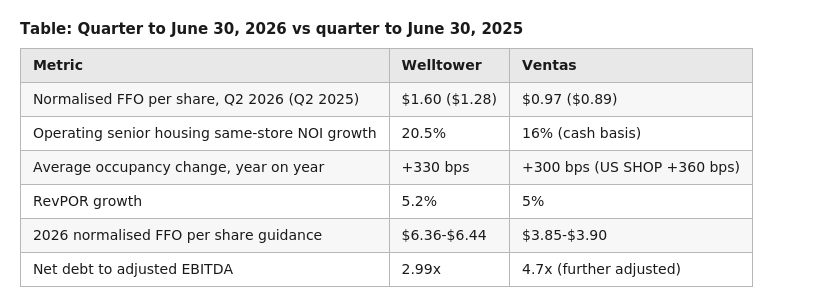
Both now carry the operating results of many of their communities directly, so each extra occupied unit feeds straight into net Operating Income at Welltower (NYSE:WELL) and Ventas (NYSE:VTR), two NYSE-listed S&P 500 health care REITs. In the quarter to June 30, 2026, Welltower reported a 330 basis point year-on-year rise in average occupancy in its senior housing operating portfolio, and Ventas reported 300 basis points. Both raised their 2026 Earnings guidance. The question now is less whether Demand is rising than how far each company can convert it into profit.
Why Operating Exposure Changes the Maths
Health care REITs can own senior housing in two ways. Under a triple-net lease, an operator pays a fixed rent and bears most costs, so the landlord's income changes little when occupancy moves. Under an operating structure, which Ventas calls SHOP and Welltower calls SHO, the REIT receives the community's profit after costs and the operator's management fee.
That second model has operating leverage. Revenue depends on occupancy multiplied by revenue per occupied room, while staffing, utilities and property costs rise more slowly. When occupancy and pricing climb together, profit grows faster than revenue.
Demand is supported by demographics. The first baby boomers, born in 1946, turn 80 during 2026, and Ventas management points to limited new construction as a further support for occupancy.
The second-quarter figures show the leverage effect clearly. Welltower's SHO same-store revenue grew 9.2%, but same-store NOI grew 20.5%. Ventas's SHOP same-store cash Operating Revenue grew 9%, cash NOI grew 16%, and its NOI Margin widened by 210 basis points.
Welltower (NYSE:WELL): Scale and a Sharper Focus
Welltower's second-quarter results, released on July 27, 2026, showed normalised funds from operations of $1.60 per diluted share, up 25% from $1.28 a year earlier. Net Income was $0.61 per diluted share, compared with $0.45.
The company is concentrating on senior housing. It is selling an 18 million square foot outpatient medical portfolio in a transaction valued at about $7.2 billion, with $1.9 billion of those disposals completed in 2026 so far. It also completed the C$4.1 billion Amica Acquisition in Canada in April 2026.
Across the whole Welltower portfolio, same-store NOI grew 15.5% in the quarter, and the company now expects total same-store NOI growth of 13.75-16% for 2026. The gap to the senior housing rate reflects slower growth elsewhere in the portfolio.
Its Investment pace is large. Welltower made $6.3 billion of gross investments in the second quarter and had $15.5 billion closed or under contract in the year to date. It ended June with net Debt of 2.99 times adjusted EBITDA and about $9.5 billion of available liquidity, and raised its quarterly Dividend by 15% to $0.85 per share.
Ventas (NYSE:VTR): A Broader Mix
Ventas owns about 1,450 properties in North America and the UK, including more than 900 senior housing communities. Its portfolio also includes outpatient medical and research buildings and triple-net leased assets, which grew same-store cash NOI by 4.6% and 3.1% respectively in the second quarter.
The Ventas results of July 29, 2026, showed normalised FFO of $0.97 per share, up 9% from $0.89. Total company same-store cash NOI rose 10%. In its US SHOP portfolio, same-store cash NOI rose 18% and average occupancy increased by 360 basis points.
Ventas also highlights Ventas OI, its operational insights platform for its operating communities. Under an operating structure, the landlord shares directly in the results of better management.
Ventas is also stepping up acquisitions. It closed $2.2 billion of investments in the second quarter and $3.4 billion in the year to date, and raised its 2026 investment expectation to $4.5 billion from $3 billion. Chairman and chief executive Debra Cafaro said demographic demand is strong and getting stronger as the baby boomers begin turning 80 this year.
How the Two Strategies Differ
Welltower's results show a higher growth rate, a lower Leverage Ratio and a portfolio moving further towards operating senior housing. That increases its sensitivity to occupancy and labour costs, in both directions.
Ventas has a more mixed income base. Its outpatient, research and triple-net Assets grow more slowly but provide steadier rent, which can cushion a slowdown in senior housing. Its higher leverage ratio, however, gives it less financial headroom than Welltower while it grows its SHOP portfolio.
Risks to the Occupancy Case
Occupancy gains become harder as buildings fill, because there are fewer empty units left to lease. Later growth then depends more on pricing, which residents and their families may resist.
Operating exposure also brings cost risk. Wage inflation, staffing shortages or higher insurance costs would reduce margins, because the REIT, not a tenant, absorbs them. New Supply is another variable, since any renewed wave of construction could weaken pricing power.
Large acquisition programmes carry integration and valuation risk: paying high prices for communities today assumes that occupancy and pricing keep improving. Ventas's net income per share dipped to $0.14 from $0.15, showing that GAAP results can lag the headline non-GAAP measures.
Occupancy Signals for the Months Ahead
For Welltower, the key indicators are quarterly SHO occupancy and RevPOR growth, delivery against its 18.5-21.5% SHO same-store NOI guidance for 2026, and completion of the remaining outpatient medical sales, expected before the end of 2026.
For Ventas, the markers are US SHOP occupancy, SHOP margin trends and progress towards its $4.5 billion investment target. For both, third-quarter results will show whether occupancy growth is holding up and whether margins keep widening as buildings fill.


 Nov 03, 2026





 Please wait processing your request...