
 CA
 NZ
 UK
 AU
 IND

 US

 Share
 X (Formerly Twitter)
 Whatsapp
 Facebook
 LinkedIn
 Telegram
 Email This Article
 Copy Link
 Summarize with AI
 Chat GPT
 Perplexity
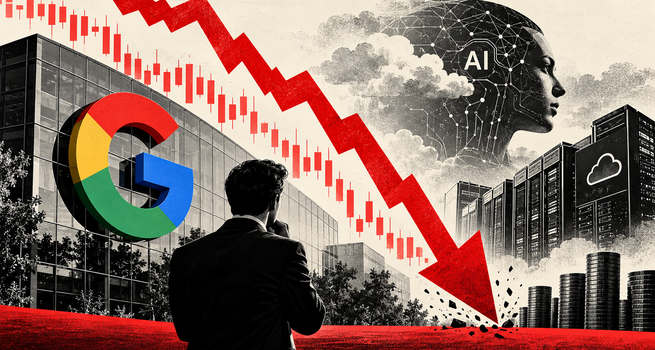
Key Highlights
- Alphabet (NASDAQ: GOOGL) shares fell as much as 13 percent after a rare miss on both Revenue and earnings, its first such miss in nearly four years.
- Core search Advertising growth slowed to 12 percent, feeding fears that AI tools are eating into the Business that funds everything else.
- Free Cash Flow turned negative for a second straight quarter as Capital Expenditure hit $51.4 billion, with guidance pointing to even higher spending in 2027.
- Google Cloud revenue more than doubled, underscoring that Alphabet's troubles are narrower than the size of the sell-off might suggest.
For most of the past two years, the stockmarket has treated spending on artificial intelligence as a sign of virtue rather than risk. The more a technology firm poured into chips and data centres, investors reasoned, the more confident it must be in the returns to come. On October 29th Alphabet, Google's parent, tested that logic and found it wanting. Shares fell by as much as 13 percent, wiping out more than $400 billion in Market Value in a single session, after the firm missed Wall Street's revenue and profit forecasts for the first time in nearly four years.
A Miss With a Narrow Cause
The headline numbers were not, on their own, alarming. Revenue rose by a quarter from a year earlier, to $127.6 billion, and Operating Income climbed by roughly 30 percent. The trouble lay in the composition. Search advertising, the business that has underwritten Alphabet's ambitions since 1998, grew by just 12 percent, its slowest pace in recent memory and short of what analysts had pencilled in. Executives blamed currency effects and the rollout of AI Mode, a chatbot-style search interface that monetises less efficiently than a conventional results page. Investors heard something blunter: that generative AI may be eating the business that was supposed to pay for it.
The Arithmetic of Ambition
What turned a disappointing quarter into one of the steepest one-day declines in Alphabet's history was the cash-flow statement rather than the income statement. Capital expenditure reached $51.4 billion in the quarter, part of a plan to spend $195 billion to $205 billion this year and more again in 2027. Free cash flow, as a result, swung to a Deficit of about $9.1 billion, the second consecutive quarterly shortfall. For a company that has long been synonymous with cash generation, two quarters of outflows is a novel and uncomfortable position. It raises a question that applies well beyond Alphabet: at what point does the AI build-out stop being funded by surplus cash and start competing with it.
Not Everything Is Slowing Down
Set against the gloom, Google Cloud had a good quarter by any standard, with revenue more than doubling to $30.7 billion and operating margins widening as new data-centre capacity found paying customers. That Alphabet can point to one division growing at triple-digit rates while another decelerates is, in a sense, the whole debate in miniature. Bulls argue that Cloud and newer products such as Gemini will eventually take over as the engine funding AI Investment from an ageing but still-healthy search franchise. Sceptics note that Cloud, while large, is not yet large enough to replace what search contributes, and that a second straight quarter of negative free cash flow suggests the handover has not yet begun.
The Bigger Picture
Alphabet's results landed alongside a broader reassessment of capital spending across the technology industry, visible in the share prices of chipmakers, cloud providers and the optical and networking firms that Supply them. Microsoft, by contrast, posted stronger cloud growth and stayed free-cash-flow positive even as its own spending rose, a comparison that made Alphabet's numbers look worse by proximity. None of this means the AI investment cycle is ending. It does suggest that the market's patience for spending that outruns the cash it generates is thinner than it was a year ago, and that companies will increasingly be judged not on how much they spend, but on how quickly that spending turns into cash coming back the other way.


 Oct 29, 2026





 Please wait processing your request...