
 AU
AU
 UK
UK
 CA
CA
 NZ
NZ
 IND
IND

 US
US

 Share
Share
 X (Formerly Twitter)
 Whatsapp
 Facebook
 LinkedIn
 Telegram
 Email This Article
 Copy Link
 Summarize with AI
 Chat GPT
 Perplexity
Key Highlights
- Meta commits to initial 1GW MTIA deployment built on Broadcom's XPU platform, targeting multi-gigawatt scale by 2027.
- MTIA becomes the first AI silicon manufactured on a 2-nanometer process node.
- Broadcom CEO Hock Tan steps down from Meta's board, transitioning to an advisory role on silicon strategy.
- The deal cements Broadcom's position as the dominant custom silicon partner to hyperscalers, alongside its existing Google TPU agreement.
- Nvidia's near-monopoly on AI training compute faces structural long-term pressure as custom silicon matures.
- Meta's first quarter 2026 financial results are scheduled for release after market close on April 29, 2026.
Meta Platforms (NASDAQ:META) and Broadcom (NASDAQ:AVGO) announced on Tuesday a strategic, multi-year agreement that significantly deepens their existing collaboration on custom artificial intelligence silicon, extending a shared roadmap through 2029. The deal signals a structural shift in how the world's largest social media operator intends to power its AI ambitions at scale, with an explicit goal of reducing dependence on third-party GPU vendors. The ripple effects extend well beyond these two companies, touching every major player in the AI infrastructure ecosystem and carrying meaningful implications for investors who have bet on the sector's continued growth.
Infrastructure at Unprecedented Scale
At the core of the announcement is an initial commitment to deploy over one gigawatt of Meta's Training and Inference Accelerator chips, engineered on Broadcom's foundational XPU custom accelerator platform. This initial phase is positioned as the entry point to a sustained, multi-gigawatt buildout, with subsequent tranches expected to accelerate through 2027 and beyond. The MTIA chips will be the first AI compute accelerators fabricated on a 2-nanometer process node, a manufacturing milestone that confers meaningful gains in energy efficiency and transistor density relative to the current generation.
What distinguishes the architecture of this arrangement is its breadth. Beyond silicon design, Broadcom will supply advanced Ethernet networking infrastructure, encompassing high-radix switches, optical connectivity products, PCIe switches, and high-speed SerDes technologies. This positions the partnership as an end-to-end infrastructure contract, not merely a chip supply agreement. The stated objective is to eliminate latency bottlenecks across Meta's expanding AI compute clusters, which span tens of thousands of interconnected nodes.
Broadcom's Strategic Masterstroke
Broadcom's role in this deal deserves more scrutiny than it typically receives. The company has quietly executed one of the most consequential pivots in semiconductor history, transforming from a diversified connectivity chipmaker into the preferred custom silicon partner for the world's most capital-intensive AI deployments.
The Meta agreement does not exist in isolation. Broadcom recently finalised a long-term agreement to supply custom TPU silicon to Alphabet's Google, a relationship that has been in place for years and continues to deepen. With Meta now locked into the XPU platform through 2029, Broadcom has secured two of the five or six companies globally that operate at the compute scale required to justify custom silicon economics. The strategic logic is compounding: each hyperscaler engagement generates proprietary design knowledge, manufacturing relationships with TSMC, and networking integration expertise that makes Broadcom progressively harder to displace.
The end-to-end nature of the Meta agreement is particularly significant. By bundling chip design with high-radix Ethernet switches, optical connectivity, PCIe switches, and SerDes technologies, Broadcom is embedding itself into the physical architecture of Meta's data centres at every layer of the stack. This is not a transactional supplier relationship. It is a structural dependency that would take years and enormous engineering investment to unwind.
Broadcom shares rose approximately 3% in extended trading following the announcement. The stock has gained around 10% year-to-date in 2026, outpacing the S&P 500's gain of roughly 2% over the same period. That outperformance reflects a market beginning to price in the scale of long-term custom silicon revenue that these hyperscaler agreements represent, revenue streams that are both large and highly predictable once multi-year contracts are signed.
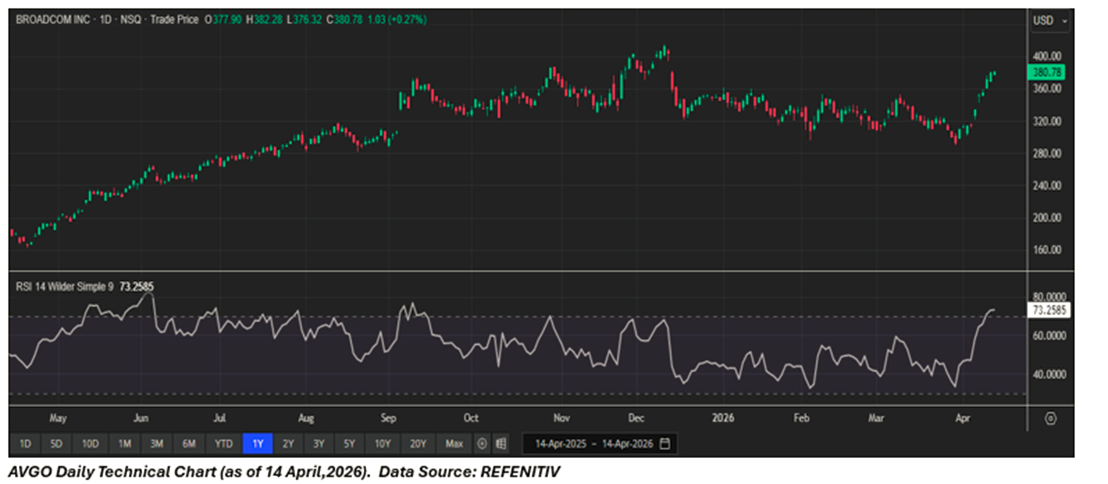
For investors, Broadcom's positioning is worth examining carefully. The company now has credible visibility into multi-year, multi-billion-dollar revenue from at least two of the world's largest compute buyers. Unlike GPU sales, which are subject to order volatility and competitive displacement, co-designed custom silicon agreements tend to be sticky: the switching costs are enormous, the design cycles are long, and the IP is jointly developed. This is a qualitatively different revenue profile from most semiconductor companies.
A Strategic Pivot in AI Capital Allocation
Meta's internal silicon strategy reflects a broader industry thesis: that purpose-built accelerators optimised for specific workloads deliver superior total cost of ownership compared to general-purpose GPUs at hyperscale volumes. The MTIA architecture targets inference workloads and low-precision processing, where custom design can eliminate computational overhead inherent in Nvidia's more general-purpose hardware stack.
This calculus is particularly consequential given the scale of Meta's infrastructure ambitions. The company committed in January to capital expenditure of up to $135 billion in 2026 alone. Deals struck in recent months include up to six gigawatts of AMD GPU deployments, Nvidia chip procurements, and custom silicon from Arm Holdings. Against this backdrop, the Broadcom agreement reinforces a multi-vendor, workload-specific procurement strategy designed to optimise price performance across different AI applications.
What It Means for Other Players
The Meta-Broadcom deal sends clear signals across the competitive landscape, and not all of them are benign.
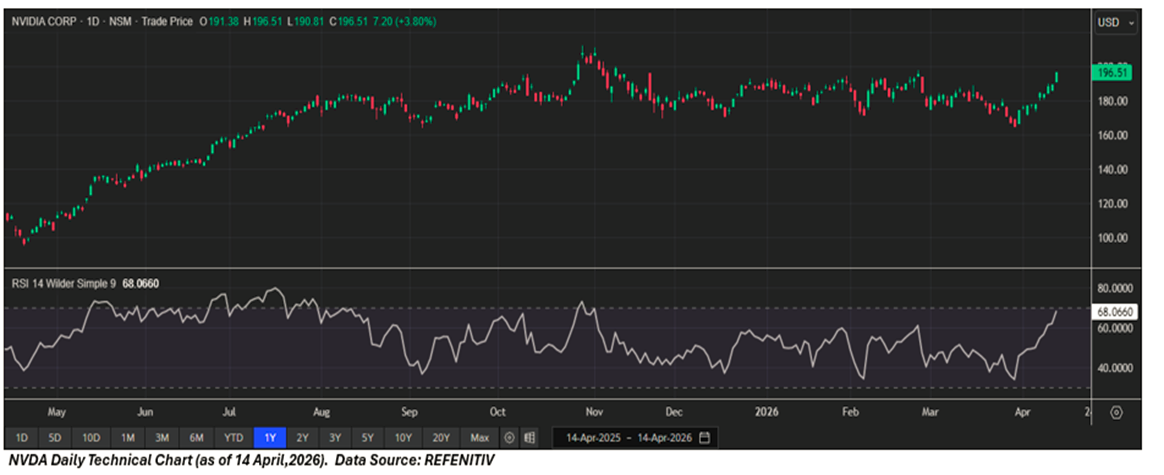
Nvidia (NASDAQ:NVDA), faces the most consequential long-term question. The company's dominant position in AI training compute remains intact for now, no custom silicon programme has yet demonstrated the ability to displace H100 or B200-class GPUs for large-scale frontier model training. However, inference workloads are a different matter. As MTIA matures and Meta scales its custom silicon deployment, a growing proportion of inference traffic will route through custom accelerators rather than Nvidia hardware. Nvidia shares gained 3.80% to USD 196.51 as of 14 April 2026, with the stock remaining up 75.14% over the past year.
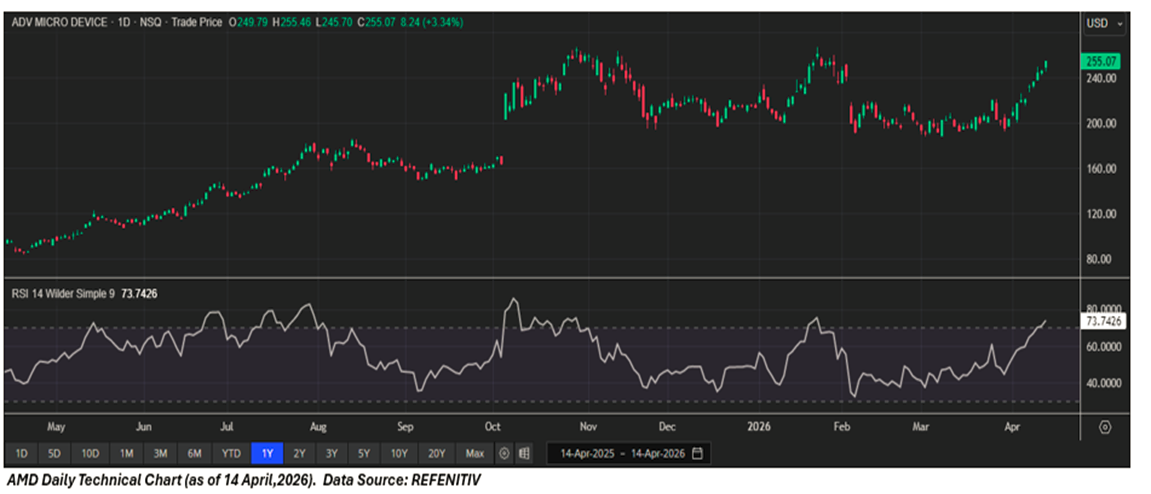
AMD (NASDAQ:AMD), occupies an interesting position. Meta's commitment to up to six gigawatts of AMD GPU deployments suggests AMD retains a meaningful role in Meta's compute mix, likely concentrated in training workloads where general-purpose GPU performance still matters. However, AMD's long-term relevance in the hyperscaler segment may depend increasingly on its ability to offer workload-specific customisation, not just competitive general-purpose performance. The stock advanced 3.34% to USD 255.07 as on 14 April 2026, extending one-year gains to 167.68%
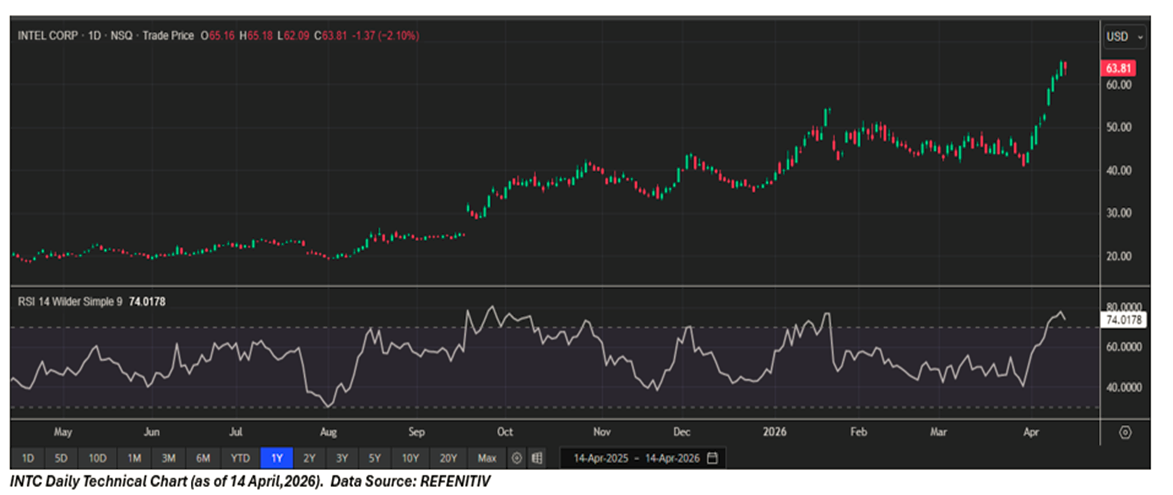
Intel (NASDAQ:INTC), finds itself increasingly marginalised. The company's Gaudi AI accelerators have struggled to gain traction at hyperscale, and the Meta-Broadcom announcement reinforces a bifurcating market in which the winners are either Nvidia (general-purpose dominance) or Broadcom (custom silicon dominance). INTC shares were down 2.10% to USD 63.81 on 14 April 2026, although remains up by 221.46% over the past year.
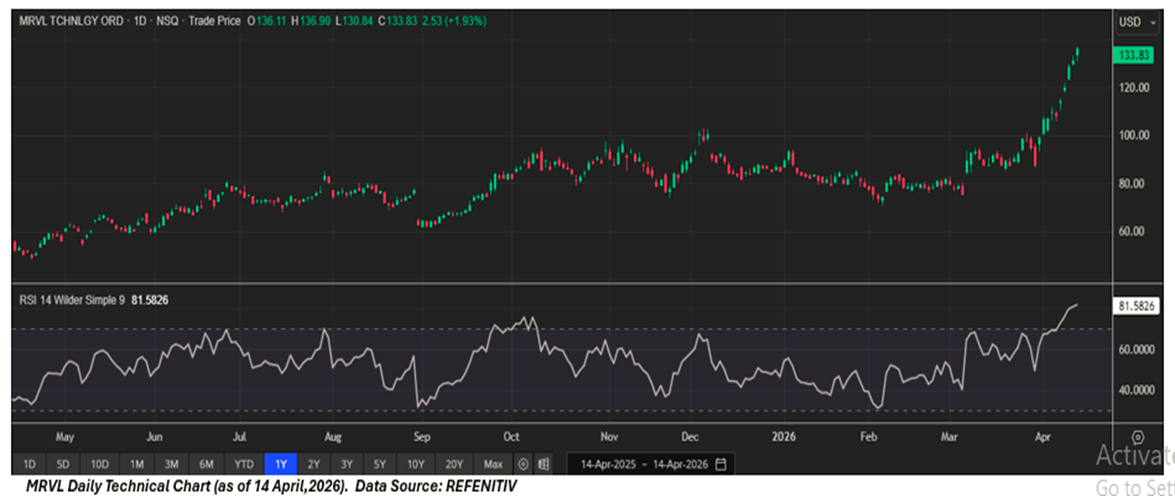
Marvell Technology (NASDAQ:MRVL), is the most directly comparable competitor to Broadcom in custom AI silicon. The Meta announcement underscores Broadcom's lead in securing the largest and most strategically visible deployments. The shares were 1.93% up to USD 133.83 on 14 April 2026 and remains up by 150.99% over the past year.
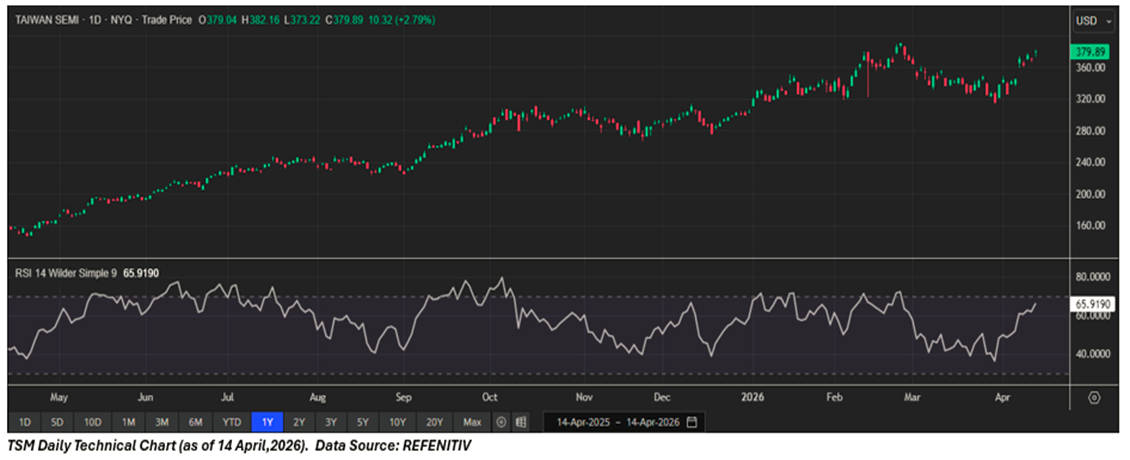
TSMC (NYSE:TSM), is perhaps the quietest beneficiary. The 2nm fabrication of MTIA chips, combined with the extraordinary volume commitments embedded in a multi-gigawatt deployment, represents a substantial and high-margin production order. The share price jumped 2.79% to USD 379.89 on 14 April 2026 and remains up by 141.46% over the past year.
Board Transition and Governance Implications
Coinciding with the announcement, Broadcom's president and chief executive Hock Tan informed Meta's board last week that he would not stand for re-election, exiting after approximately two years of service. He will move into an advisory capacity, focused specifically on Meta's custom silicon roadmap. The transition is presented as a structural response to the deepening commercial relationship between the two companies.
Separately, Tracey Travis, a former finance chief at Estee Lauder who joined Meta's board in 2020, will also depart.
What It Means for AI Infrastructure Investors
- The custom silicon wave is no longer a thesis, it is a capital commitment. Meta's $135 billion capex envelope for 2026 is contracted infrastructure that will be deployed.
- Networking infrastructure is underappreciated. The deal's inclusion of high-radix Ethernet switches, optical connectivity, and SerDes technologies highlights a critical but often overlooked layer of the AI stack.
- Nvidia's premium requires a closer look. As custom silicon programmes mature, a structurally larger share of AI compute spending will flow to Broadcom and other custom design partners.
- The multi-vendor procurement model is a structural shift. Meta's deliberate sourcing from AMD, Nvidia, Arm, and Broadcom signals active management of supplier concentration risk.
- Free cash flow conversion is the next test. Infrastructure spending must ultimately be justified by monetisable AI products.
Earnings Catalyst on the Horizon
Meta confirmed that its first quarter 2026 financial results will be published after market close on Wednesday, April 29, 2026. Given the scale of infrastructure spending announced in recent months, guidance on free cash flow conversion and near-term data centre build timelines is likely to receive close scrutiny.


 Jun 05, 2026




 Please wait processing your request...