
 CA
 NZ
 UK
 AU
 IND

 US

 Share
 X (Formerly Twitter)
 Whatsapp
 Facebook
 LinkedIn
 Telegram
 Email This Article
 Copy Link
 Summarize with AI
 Chat GPT
 Perplexity
Key Highlights
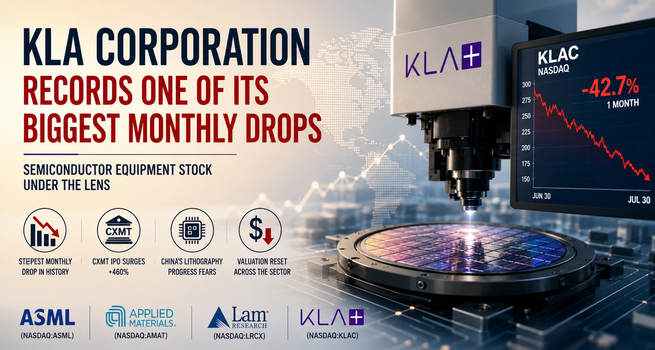
- KLA Corporation fell from an all-time high near 307 dollars to below 175 dollars in a single month, one of its steepest drops on record
- The move rivals the pace of KLA's 2008 crisis decline, compressed into weeks instead of sixteen months
- CXMT, surged over 460 percent on its Shanghai debut, the primary catalyst behind the selloff
- A report on Chinese domestic lithography progress dragged ASML Holding, Applied Materials and Lam Research down alongside KLA
- The drop came despite a record quarter, a dividend increase and raised guidance at KLA, and Morgan Stanley and Deutsche Bank both framed their target cuts as sector-wide multiple compression rather than a weaker outlook
The Scale of the Decline
KLA Corporation (NASDAQ: KLAC) has recorded one of the steepest monthly declines in its history as a public company. Shares peaked at an all-time high near 307 dollars on June 30, following a ten for one stock split completed earlier that month. Within four weeks, the stock had fallen toward 170 dollars in early post-earnings trading, a peak to trough decline exceeding 40 percent. The magnitude and speed of the move place it among the sharpest single-month corrections in the company's trading history.
Context sharpens this figure. During the 2008 financial crisis, KLA shares fell 75.6 percent from a peak of 62.46 dollars in July 2007 to 15.24 dollars by November 2008, over roughly sixteen months. The current correction, smaller in absolute terms, compressed a comparable order of loss into weeks rather than a year. Drawdowns this rapid and concentrated are rare outside systemic financial crises, which is what makes the decline notable in its own right.
The Semiconductor Equipment Sector Under Pressure
KLA does not operate in isolation. It sits within a small group of companies that together control the tools required to manufacture advanced chips, and the July selloff exposed how tightly their valuations move together. ASML Holding (NASDAQ: ASML) holds a near monopoly in extreme ultraviolet lithography, the technology required to print circuits below seven nanometres. Applied Materials (NASDAQ: AMAT) supplies the broadest portfolio of deposition, etch and planarisation equipment across the industry. Lam Research (NASDAQ: LRCX) specialises in plasma etch and thin film deposition, dominant in the high aspect ratio processes used for advanced memory and logic. KLA's own role is inspection and metrology, verifying that each of these preceding steps was executed correctly, a function whose value has grown as chip geometries have shrunk toward zero tolerance for error.
This concentration means a single competitive or geopolitical headline can move the entire group at once, regardless of any individual company's quarterly performance. That is precisely what occurred in the final week of July, when two distinct developments arrived within days of each other and repriced the sector as a unit rather than KLA alone.
The Primary Catalyst: CXMT's Listing Debut
The most consequential of the two events was the listing of ChangXin Memory Technologies, commonly known as CXMT, China's largest DRAM producer. Shares surged more than 460 percent on their Shanghai STAR Market debut in the final week of July, briefly making CXMT one of the most valuable listed companies in mainland China. The offering raised approximately 8.6 billion dollars, the largest semiconductor listing in the exchange's history.
The surge mattered beyond its size. CXMT's pricing power in DRAM, maintained even against major domestic buyers, signalled that global memory shortages had shifted leverage decisively toward memory producers, a dynamic investors read as a possible sign that the current memory pricing cycle is closer to its peak than previously assumed. For KLA, whose process control equipment sits directly in the memory manufacturing value chain, and whose own margins are already pressured by elevated DRAM component costs, a shift in memory cycle sentiment carries direct valuation implications. The scale and speed of the reaction reset how investors priced exposure to the broader memory and equipment ecosystem within days.
A Second Catalyst: China's Lithography Progress
A separate but related development compounded the selloff. A report indicated that a Shanghai based, state-backed firm had begun mass production of immersion deep ultraviolet lithography systems, tools long dominated by ASML. Unlike the CXMT listing, which centred on memory pricing, this report raised a more direct competitive question: whether the equipment supply chain underpinning export control leverage over China's semiconductor ambitions is beginning to erode.
The market's reaction was immediate and sector-wide. ASML, Applied Materials, Lam Research and KLA were each down as much as seven percent intraday, since even a limited domestic Chinese lithography source alters the long-term competitive assumptions underpinning the entire sector's valuation. Analysts later noted that current production volumes, roughly five units this year rising to twenty next year, are unlikely to displace an established global supply chain in the near term. The initial repricing, however, had already occurred before that context was absorbed.
Reinforcing Conditions and the Guidance Disconnect
Short interest in KLA had climbed to roughly 36.6 percent of float ahead of the CXMT listing, a level that mechanically amplifies price moves once a reversal begins. The stock had also just completed a post-split run to a fresh high, a setup that often precedes sharp reversals once sentiment shifts.
Guidance did much of the remaining work. September quarter revenue guidance of 3.8 to 4.2 billion dollars and non-GAAP EPS guidance of 1.06 to 1.26 dollars per share nominally cleared consensus, but the margin was thin, a fraction of the double digit beats that had propelled the stock in prior quarters. Non-GAAP gross margin guidance of 62.5 percent sat at the upper end of the prior range rather than clearly above it. For a name trading at a premium multiple, that left little room for upside surprise, and shares fell roughly 8 percent in after hours trading.
This was not the first time the pattern had played out. KLA shares fell roughly 9 percent in January 2026 after a quarter that also beat estimates and guided above consensus, on the logic that strong results were already priced in. Applied Materials and Lam Research have seen comparable reactions to their own beats, suggesting the equipment sector as a whole has grown more sensitive to guidance durability than to the size of a beat.
Set against that, KLA's own capital allocation signalled confidence rather than caution. The ten for one split arrived alongside a 21 percent dividend increase and a fresh 7 billion dollar buyback authorization, with 876 million dollars returned to shareholders in the June quarter alone. Fiscal 2026 revenue reached 13.58 billion dollars, up from 12.16 billion dollars a year earlier, and management raised its 2026 wafer fab equipment forecast to approximately 150 billion dollars. CEO Rick Wallace said momentum was accelerating into 2027.
The combination is what makes the decline notable. A company beating estimates, raising its dividend and lifting its own outlook still saw its stock fall, because the guidance midpoint offered too thin a margin above expectations just as CXMT and the lithography report were repricing the sector around it.
Wall Street Recalibrates
Two major banks cut their price targets on KLA following the print, both citing valuation compression across the equipment sector rather than any KLA-specific concern.
Morgan Stanley lowered its target to 253 dollars from 274 dollars while maintaining an Overweight rating, attributing the reduction explicitly to derating across the semiconductor capital equipment cohort rather than to KLA's own numbers.
Deutsche Bank cut its target to 195 dollars from 220 dollars while maintaining a Hold rating, describing results and guidance as in line with expectations, meaning the lower target reflected a valuation reset rather than a disappointing quarter. KLA trades at a price to earnings ratio above 57, underscoring that this was a multiple story rather than an earnings story.
Conclusion
This was a story about sentiment, not substance. KLA's own numbers held up, and it raised its dividend and its outlook in the same window its stock fell. CXMT's listing rattled confidence in memory pricing, the lithography report turned that into a sector-wide selloff, and even Wall Street's own target cuts were framed as multiple compression rather than a weaker business. What markets are really pricing now is how fast China's equipment ambitions move from headline to reality.


 Nov 24, 2026





 Please wait processing your request...