
 AU
AU
 UK
UK
 CA
CA
 NZ
NZ
 IND
IND

 US
US

 Share
Share
 X (Formerly Twitter)
 Whatsapp
 Facebook
 LinkedIn
 Telegram
 Email This Article
 Copy Link
 Summarize with AI
 Chat GPT
 Perplexity
Key Highlights
- PATH is attempting to emerge from a prolonged post-Pandemic software sector correction as enterprise automation and AI workflow Demand continue expanding globally
- The stock has begun stabilising technically after an extended downtrend, with price action forming a constructive higher-low structure
- EMA-21 has started flattening while EMA-50 is gradually stabilising, signalling the potential early stages of a broader technical recovery
- RSI has recovered from deeply oversold conditions into the neutral-to-bullish 45–60 range, suggesting downside momentum is fading materially
- Institutional accumulation activity has improved during recent consolidation phases, with bullish sessions increasingly accompanied by stronger Volume
- UiPath continues positioning itself as a leader in robotic process automation (RPA), AI-enabled workflow automation, and enterprise productivity software
- AI copilots and autonomous enterprise agents are becoming increasingly important growth catalysts for the company’s long-term platform strategy
- Investors are beginning to reassess UiPath as a next-generation enterprise AI automation company rather than a slowing legacy software name
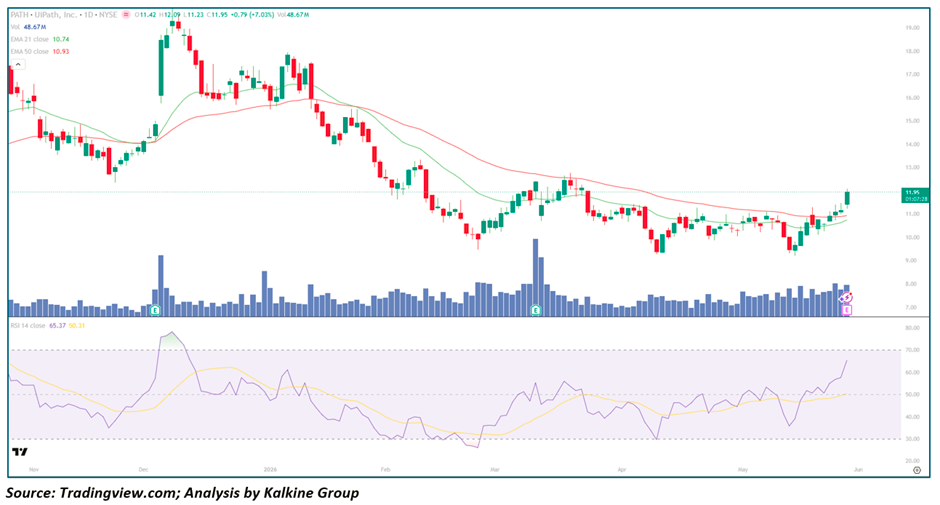
Trend Structure: From Hypergrowth Software Darling to AI Automation Recovery Candidate
Phase 1 — Pandemic-Era Automation Boom and Valuation Expansion (2021 – 2022)
UiPath entered public markets during one of the strongest enterprise software momentum cycles in history:
- Investors aggressively rotated into automation and cloud software companies during the pandemic-driven digital transformation surge
- PATH traded at elevated growth multiples as enterprises accelerated workflow automation spending
- RSI frequently entered overbought territory while momentum investors aggressively accumulated high-growth SaaS names
- The company established itself as one of the leading pure-play robotic process automation providers globally
However, elevated valuations and slowing macroeconomic conditions later triggered a major correction cycle.
Phase 2 — Multi-Year Software Revaluation and Institutional Reset (2022 – 2024)
Following the broader software sector selloff, UiPath entered a prolonged correction phase:
- Rising interest rates and slowing enterprise software spending pressured high-growth SaaS valuations significantly
- Price entered a sustained downtrend characterised by lower highs and persistent institutional distribution
- EMA-21 and EMA-50 remained in bearish alignment for an extended period
- RSI spent prolonged periods near oversold territory as investor sentiment deteriorated across the automation software space
- Despite operational execution remaining relatively stable, institutional investors aggressively reduced exposure to speculative software names
This phase ultimately reset expectations and established a more sustainable long-term valuation framework.
Phase 3 — AI Workflow Automation Narrative and Technical Stabilisation (2025 – Present)
The current phase reflects early signs of a broader stabilisation and recovery process:
- PATH has begun forming higher lows, suggesting selling pressure is gradually weakening
- Moving averages are beginning to flatten after a prolonged decline cycle
- AI workflow automation and enterprise copilots are increasingly driving renewed institutional interest
- Volume accumulation patterns have improved materially during recent consolidation phases
- Investors are increasingly viewing UiPath as a beneficiary of enterprise AI agent deployment and automation modernization trends
The broader technical structure increasingly resembles an early-stage recovery base rather than continued Capitulation.
Moving Averages: Bearish Structure Begins Transitioning Toward Stabilisation
EMA-21
- Price action has started stabilising around the EMA-21 as short-term momentum improves
- The flattening slope reflects weakening downside pressure and improving buyer participation
- Sustained trading above the EMA-21 would reinforce the developing bullish recovery thesis
EMA-50
- EMA-50 remains major medium-term resistance overhead
- However, the declining slope has begun moderating significantly compared to earlier phases of the downtrend
- A future bullish crossover could attract momentum-oriented institutional participation
Momentum Analysis: RSI Reflects Improving Recovery Conditions
- RSI has recovered into the constructive 45–60 range after prolonged oversold conditions
- Momentum indicators suggest downside exhaustion rather than renewed bearish acceleration
- Unlike earlier rallies that failed quickly, the current RSI structure appears more stable and disciplined
- Momentum conditions leave room for a stronger upside expansion if catalysts strengthen further
Volume Analysis: Institutional Accumulation Gradually Returns
- Bullish sessions have increasingly generated stronger volume participation than corrective pullbacks
- Institutional selling pressure appears materially weaker compared to prior breakdown phases
- Recent consolidation behaviour reflects accumulation rather than panic Liquidation
- No major distribution patterns are currently dominating the chart structure
This improving volume profile strengthens the probability of a broader technical recovery over time.
Fundamental Catalysts: AI Agents and Enterprise Workflow Automation Drive Growth
AI-Powered Enterprise Automation
UiPath continues evolving beyond traditional robotic process automation:
- AI copilots and autonomous enterprise agents are becoming central to the company’s platform strategy
- Enterprises increasingly seek AI-driven workflow automation to improve productivity and operational efficiency
- UiPath’s integration of generative AI capabilities continues enhancing platform competitiveness
Enterprise Digital Transformation
- Large enterprises continue modernising operational infrastructure and automating repetitive workflows
- Long-term demand for automation remains structurally strong despite macroeconomic slowdowns
- UiPath remains one of the most established players within the enterprise automation ecosystem
Expanding AI Workflow Ecosystem
- Integration with major cloud and AI providers continues strengthening UiPath’s enterprise positioning
- Businesses increasingly require unified workflow automation platforms capable of managing AI agents securely
- The company’s broad enterprise relationships provide meaningful long-term monetization opportunities
Profitability and Operational Discipline
- Management continues focusing aggressively on improving operating efficiency and profitability
- Margin stabilisation efforts have strengthened institutional confidence relative to earlier speculative growth phases
- Investors increasingly favour software firms capable of balancing growth with improving Cash Flow metrics
Key Technical Levels
Resistance: EMA-50 → prior breakdown resistance → major recovery breakout zone
Support: EMA-21 → recent higher-low structure → long-term consolidation base
Conclusion
UiPath is increasingly showing signs of transitioning from a deeply corrected software stock into a potentially compelling AI automation recovery story. While the stock remains well below its historical highs, technical stabilisation signals including higher lows, flattening moving averages, improving RSI conditions, and strengthening accumulation patterns suggest downside pressure may finally be fading.
At the same time, the company’s expanding exposure to AI copilots, autonomous enterprise agents, and workflow automation modernization positions UiPath directly within one of the most important long-term enterprise software trends emerging globally. Although execution and competitive risks remain important considerations, PATH now appears increasingly attractive as a high-risk, high-upside turnaround candidate within the evolving AI enterprise software ecosystem.


 Jun 05, 2026




 Please wait processing your request...