
 AU
AU
 UK
UK
 CA
CA
 NZ
NZ
 IND
IND

 US
US

NVIDIA Corporation
NVIDIA Corporation (NASDAQ: NVDA) is a full-stack computing infrastructure company. The Company is engaged in accelerated computing to help solve the challenging computational problems. The Company’s segments include Compute & Networking and Graphics. The Compute & Networking segment includes its Data Center accelerated computing platforms and artificial intelligence (AI) solutions and software; networking; automotive platforms and autonomous and electric vehicle solutions; Jetson for robotics and other embedded platforms, and DGX Cloud computing services. The Graphics segment includes GeForce GPUs for gaming and PCs, the GeForce NOW game streaming service and related infrastructure, and solutions for gaming platforms; Quadro/NVIDIA RTX GPUs for enterprise workstation graphics; virtual GPU software for cloud-based visual and virtual computing; automotive platforms for infotainment systems, and Omniverse Enterprise software for building and operating industrial AI and digital twin applications.

Recent Business and Financial Updates
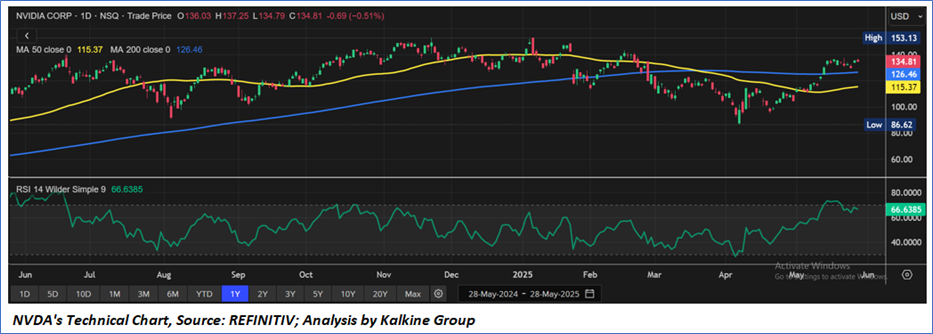
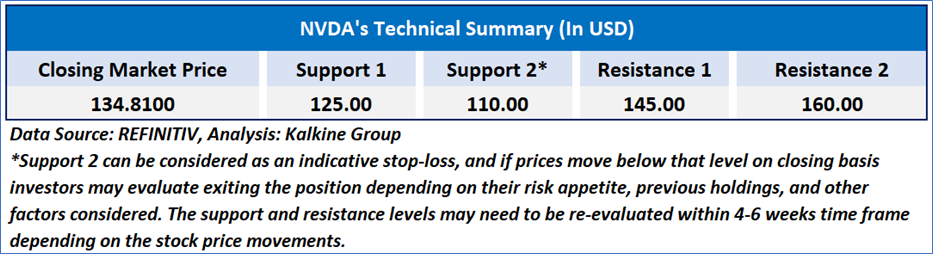
Technical Observation (on the daily chart):
The 14-day Relative Strength Index (RSI) is currently at 66.64, currently upward trending crossing 60 levels indicating bullishness with decent momentum, with the expectations of consolidation or upward momentum if the USD 115.00-USD 120.00 support holds. In addition, the current price is above both the 50-day Simple Moving Averages (SMAs) and 200-day SMA, which may work as medium to long term support levels.
NVIDIA Corporation showcased decent performance in Q1 2026, with revenue of USD 44.1 billion and an EPS of USD 0.96, surpassing forecasts, driven by a 73% year-over-year data center revenue increase to USD 39 billion, fueled by the Blackwell architecture’s 70% contribution and a 30x AI inference throughput boost, alongside a 64% sequential networking revenue growth to USD 5 billion, annualizing Spectrum X at over USD 8 billion, and strategic sovereign AI initiatives like a 5-gigawatt AI campus in the UAE, positioning NVIDIA as a leader in AI infrastructure with significant growth potential despite export challenges in China. Additionally, the company’s gaming revenue reached a record USD 3.8 billion, up 48% sequentially, reflecting strong demand for its Blackwell-based GeForce RTX 5060 series. NVIDIA’s partnerships with industry leaders like Microsoft, which deployed tens of thousands of Blackwell GPUs, and Yum Brands, integrating AI across 61,000 restaurants, further underscore its diversified growth avenues. Moreover, the company returned a record USD 14.3 billion to shareholders through repurchases and dividends, reinforcing its commitment to delivering shareholder value while maintaining a robust innovation pipeline.
As per the above-mentioned price action, recent key business and financial updates, momentum in the stock over the last month, and technical indicators analysis, a ‘Buy’ rating has been given NVIDIA Corporation (NASDAQ: NVDA) at the closing price of USD 134.81, as of May 28, 2025.
Individuals can evaluate the stock based on the support and resistance levels provided in the report in case of keen interest taking into consideration the risk-reward scenario.
Markets are trading in a highly volatile zone currently due to certain macro-economic issues and prevailing geopolitical tensions. Therefore, it is prudent to follow a cautious approach while investing.
Related Risk: This report may be looked at from a high-risk perspective and a recommendation is provided for a short duration. This report is solely based on technical parameters, and the fundamental performance of the stocks has not been considered in the decision-making process. Other factors which could impact the stock prices include market risks, regulatory risks, interest rates risks, currency risks, social and political instability risks etc.
Note 1: Past performance is not a reliable indicator of future performance.
Note 2: The reference date for all price data, currency, technical indicators, support, and resistance level is May 28, 2025. The reference data in this report has been partly sourced from REFINITIV.
Note 3: Investment decisions should be made depending on an individual's appetite for upside potential, risks, holding duration, and any previous holdings. An 'Exit' from the stock can be considered if the Target Price mentioned as per the Valuation and or the technical levels provided has been achieved and is subject to the factors discussed above.
Note 4: Target Price refers to a price level that the stock is expected to reach as per the relative valuation method and or technical analysis taking into consideration both short-term and long-term scenarios.
Note 5: ‘Kalkine reports are prepared based on the stock prices captured either from the New York Stock Exchange (NYSE), NASDAQ Capital Markets (NASDAQ), and or REFINITIV. Typically, all sources (NYSE, NASDAQ, or REFINITIV) may reflect stock prices with a delay which could be a lag of 15-20 minutes. There can be no assurance that future results or events will be consistent with the information provided in the report. The information is subject to change without any prior notice.
Kalkine Equities LLC, with Delaware File Number 4697384, Foreign Qualification Registration in California File Number 202109211078, and Texas File Number 805521396, is authorized to provide general advice only. The information on https://kalkine.com/ does not take into account any of your investment objectives, financial situation or needs. You should consider the appropriateness of advice taking into account your own objectives, financial situation and needs and seek independent financial advice before making any financial decisions. The link to our Terms and Conditions and Privacy Policy has been provided for your reference. On the date of publishing the reports (mentioned on the website), employees and/or associates of Kalkine do not hold positions in any of the stocks covered on the website. These stocks can change any time and readers of the reports should not consider these stocks as advice or recommendations later.
Past performance is not a reliable indicator of future performance.
 Please wait processing your request...