Explore 3 Stock Ideas & Industry Insights Download Free Report

blue-chip

One NYSE - Listed Health Care Stock Under Radar - UNH

Aug 13, 2025 | Team Kalkine
One NYSE - Listed Health Care Stock Under Radar - UNH
Image source: shutterstock

  • UNH:NYSE
  • Investment Type
    Large-cap
  • Risk Level
  • Action
  • Rec. Price (US$)

UnitedHealth Group

UnitedHealth Group (NYSE: UNH) is a healthcare and wellness organization committed to improving people’s health and enhancing the efficiency of the overall health system, operating through two distinct yet complementary business segments.

Key Financial Updates:

  • Updated Financial Outlook for 2025: UnitedHealth Group (NYSE: UNH) announced its second quarter 2025 results alongside an updated full-year financial outlook. The company now projects total revenues between USD 445.5 billion and USD 448.0 billion, net earnings per share of at least USD 14.65, and adjusted earnings per share of at least USD 16.00. The revised guidance reflects performance in the first half of the year, as well as expectations for the remainder, incorporating higher realized and anticipated care trends. Leadership emphasized that operational discipline and strategic positioning are being prioritized to drive a return to earnings growth in 2026.
  • Second Quarter Financial Performance: For the second quarter of 2025, UnitedHealth Group reported revenues of USD 111.6 billion, a year-over-year increase of USD 12.8 billion, driven primarily by growth in UnitedHealthcare and Optum. Earnings from operations totaled USD 5.2 billion, while adjusted net earnings were USD 4.08 per share. The quarter included USD 1.2 billion in unfavorable discrete impacts, largely tied to the individual exchange business and several settlements. The consolidated medical care ratio rose 430 basis points year-over-year to 89.4%, primarily due to elevated medical cost trends and the effects of Medicare funding reductions.
  • UnitedHealthcare Segment Outlook and Performance: UnitedHealthcare’s full-year 2025 revenues are projected between USD 344.0 billion and USD 345.5 billion, representing more than 15% growth over 2024. Earnings from operations are expected to be in the range of USD 9.0 billion to USD 9.3 billion, with an operating margin of 2.6% to 2.7%. The segment expects to serve up to 1.135 million additional people compared to 2024, with growth concentrated in seniors and individuals with complex needs. In the second quarter, UnitedHealthcare posted revenues of USD 86.1 billion, up 17% year-over-year, while operating earnings fell to USD 2.1 billion from USD 4.0 billion, reflecting higher-than-expected medical cost trends and Medicare funding cuts.
  • Business Line Details within UnitedHealthcare: Within Employer & Individual offerings, second quarter 2025 revenues reached USD 19.8 billion, supported by growth in commercial self-funded products despite attrition in fully insured offerings. Medicare & Retirement revenues rose to USD 42.6 billion, driven by Medicare Advantage membership growth, though Standalone Part D plans declined. Community & State revenues grew 20% to USD 23.7 billion, supported by rate improvements and growth in members with complex needs. Across all lines, rising costs per patient encounter and service intensity exceeded the assumptions built into prior pricing models, pressuring margins.
  • Optum Segment Outlook and Challenges: Optum’s full-year 2025 revenues are forecast between USD 266.0 billion and USD 267.5 billion, with operating earnings between USD 12.55 billion and USD 12.85 billion, and an operating margin of 4.7% to 4.8%. Optum Health is expected to generate USD 101.1 billion to USD 101.6 billion in revenues, down 4% from 2024, while serving 5 million value-based care patients. Optum Insight projects revenues of USD 19.0 billion to USD 19.5 billion, supported by a USD 32.0 billion backlog, and Optum Rx anticipates USD 151.0 billion to USD 151.5 billion in revenues, with 1.67 billion adjusted scripts. Executives acknowledged underperformance in certain Optum divisions and committed to refocusing on operational execution.
  • Optum Quarterly Performance by Division: In the second quarter of 2025, Optum generated USD 67.2 billion in revenues, up from USD 62.9 billion in the prior year, though operating earnings declined to USD 3.1 billion from USD 3.9 billion. Optum Health revenues decreased 7% year-over-year to USD 25.2 billion, with margins falling sharply to 2.5% due to higher medical activity and pricing challenges in Medicare Advantage. Optum Insight revenues increased 6% to USD 4.8 billion, with operating margins improving to 20.7% on stronger service mix and efficiency gains. Optum Rx revenues rose 19% to USD 38.5 billion, though margins contracted to 3.7% amid the expansion of high-cost drug fulfillment and the launch of a private label business.
  • Capital Allocation and Shareholder Returns: UnitedHealth Group maintained strong capital deployment in the second quarter of 2025, increasing its quarterly dividend by 5% to USD 2.21 and returning USD 4.5 billion to shareholders through dividends and share repurchases. Cash flows from operations totaled USD 7.2 billion, equivalent to 2.0 times net income, while the annualized return on equity for the first half of the year stood at 20.6%. The company’s debt-to-total capital ratio at June 30, 2025, was 44.1%. Management reiterated its focus on long-term growth, operational stability, and delivering value to stakeholders in a challenging healthcare cost environment.

Technical Observation (on the daily chart):

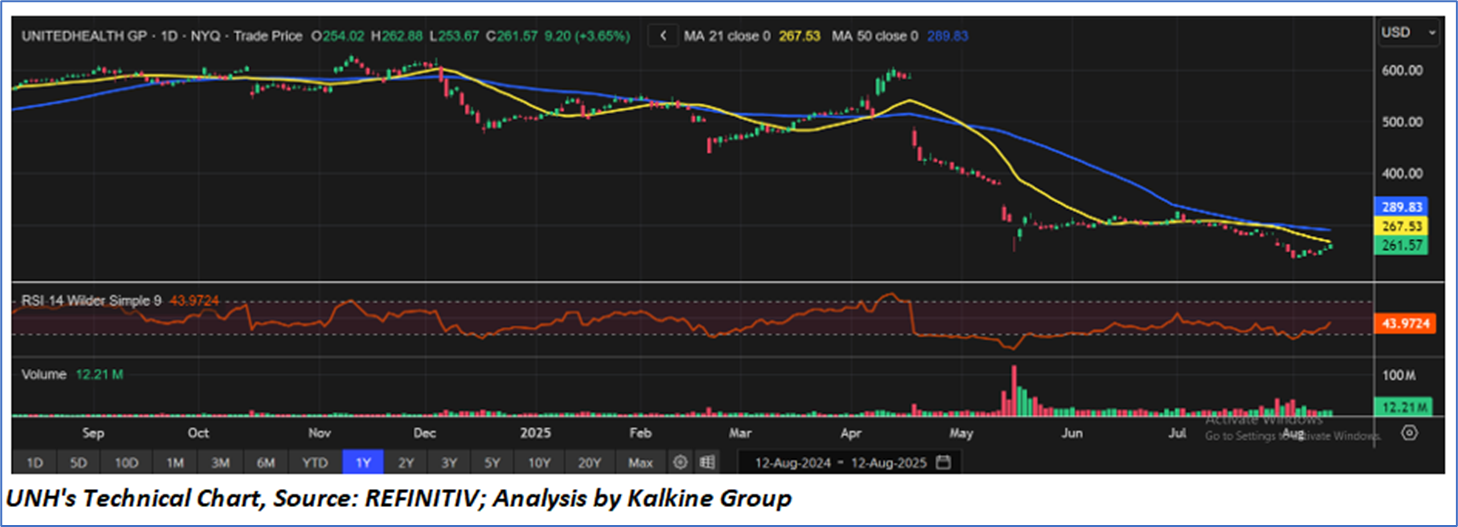
UnitedHealth Group’s stock has been in a clear downtrend since April 2025, falling from above USD 500 to around USD 261.57. While both the 21-day and 50-day moving averages still slope downward, the gap between them is narrowing, hinting at a potential slowdown in bearish momentum. The RSI at 43.97 signals mild bearishness without oversold conditions. A sustained recovery would require a strong break above both moving averages with higher trading volumes.
UnitedHealth Group delivered solid revenue growth in Q2 2025, with sales rising 13% year-over-year to USD 111.6 billion, supported by strong performance across UnitedHealthcare and Optum. The company reinstated and raised its full-year 2025 outlook, projecting revenues of up to USD 448 billion and adjusted EPS of at least USD 16.00, reflecting confidence in its operational execution and market positioning. Membership growth, particularly in Medicare Advantage and self-funded employer plans, along with continued expansion in Optum Rx and Optum Insight, highlights resilient demand for its diversified healthcare services. Management’s disciplined cost management, healthy cash flows, and shareholder returns further reinforce a constructive long-term growth trajectory.

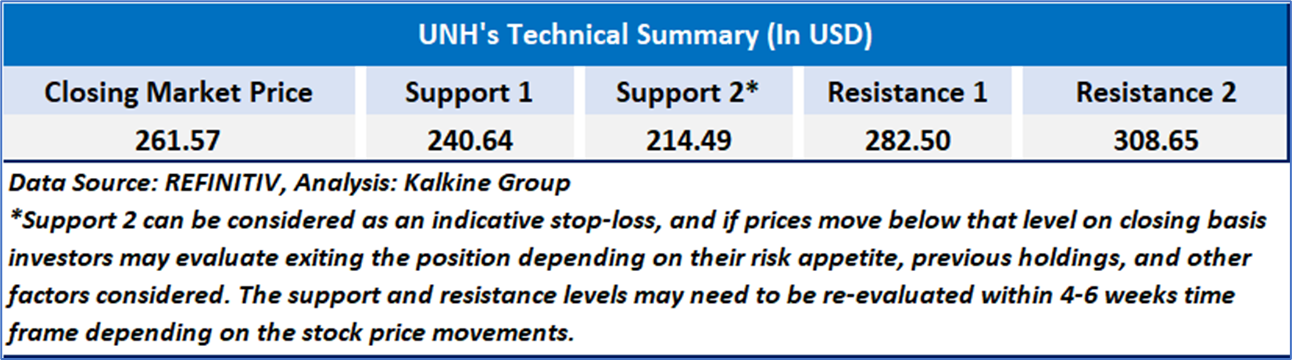
As per the above-mentioned price action, recent key business and financial updates, momentum in the stock over the last month, and technical indicators analysis, a ‘Buy’ rating has been given to UnitedHealth Group (NYSE: UNH) at the closing market price of USD 261.57 as of August 12,2025. 

Individuals can evaluate the stock based on the support and resistance levels provided in the report in case of keen interest taking into consideration the risk-reward scenario. 

Markets are trading in a highly volatile zone currently due to certain macro-economic issues and prevailing geopolitical tensions. Therefore, it is prudent to follow a cautious approach while investing.

Related Risk: This report may be looked at from a high-risk perspective and a recommendation is provided for a short duration. This report is solely based on technical parameters, and the fundamental performance of the stocks has not been considered in the decision-making process. Other factors which could impact the stock prices include market risks, regulatory risks, interest rates risks, currency risks, social and political instability risks etc. 

Note 1: Past performance is not a reliable indicator of future performance.

Note 2: The reference date for all price data, currency, technical indicators, support, and resistance level is August 12,2025. The reference data in this report has been partly sourced from REFINITIV.

Note 3: Investment decisions should be made depending on an individual's appetite for upside potential, risks, holding duration, and any previous holdings. An 'Exit' from the stock can be considered if the Target Price mentioned as per the Valuation and or the technical levels provided has been achieved and is subject to the factors discussed above.

Note 4: Target Price refers to a price level that the stock is expected to reach as per the relative valuation method and or technical analysis taking into consideration both short-term and long-term scenarios.

Note 5: ‘Kalkine reports are prepared based on the stock prices captured either from the New York Stock Exchange (NYSE), NASDAQ Capital Markets (NASDAQ), and or REFINITIV. Typically, all sources (NYSE, NASDAQ, or REFINITIV) may reflect stock prices with a delay which could be a lag of 15-20 minutes. There can be no assurance that future results or events will be consistent with the information provided in the report. The information is subject to change without any prior notice.


Disclaimer-

Kalkine Equities LLC, with Delaware File Number 4697384, Foreign Qualification Registration in California File Number 202109211078, and Texas File Number 805521396, is authorized to provide general advice only. The information on https://kalkine.com/ does not take into account any of your investment objectives, financial situation or needs. You should consider the appropriateness of advice taking into account your own objectives, financial situation and needs and seek independent financial advice before making any financial decisions. The link to our Terms and Conditions  and Privacy Policy has been provided for your reference. On the date of publishing the reports (mentioned on the website), employees and/or associates of Kalkine do not hold positions in any of the stocks covered on the website. These stocks can change any time and readers of the reports should not consider these stocks as advice or recommendations later.

Past performance is not a reliable indicator of future performance.